ARC 2701 High Renaissance into Mannerism
 Call Kai
 Learn
 Practice Test
 Spaced Repetition
 Match
 Flashcards
 Knowt Play
1/19

There's no tags or description
Looks like no tags are added yet.
20 Terms
The ___ is the European period between the early 15th and early 17th centuries in different regions, demonstrating a conscious revival and development of certain elements of ancient Greek and Roman thought and material culture.
Renaissance
the High Renaissance was a short period of the most exceptional artistic production in the Italian states, particularly ___ (capital of the Papal States) and in ___, during the Italian Renaissance.
Rome, Florence
The point is that the Renaissance in Italy was high intensity period of classical
rebirth, and as architects learned and used the pieces and parts, a gradual
transformation occurred from simple (___) to refined (___) to
intricate/complex (___)(Michelangelo). Eventually this evolves into the
Baroque
Alberti, Bramante, Mannerism
The leading architects of the High Renaissance were: ___, ___, ___
Bramante, Palladio, Michelangelo
The leading architects of Mannerism / Late Italian Renaissance: ___, ___
Michelangelo, Giacomo della Porta

___ as an ideal become popular during The Renaissance.
Central-plan churches

Bramante (Renaissance Architecture - High)(Rome)
The Tempietto

(Renaissance Architecture - High)(Rome)
St. Peter’s Basilica
Andrea ___’s palaces and villas were imitated for 400 years all over the Western
world; he was the first architect to systematize the plan of a house,
and consistently to use the ancient Greco-Roman temple front as a
portico, or roofed porch supported by columns.
Palladio
___ was the author of The Four Books of Architecture.
Palladio
___ was possibly the most influential architectural pattern book ever printed
The Four Books of Architecture
___'s own designs celebrating
the purity and simplicity of
classical architecture.
Palladio
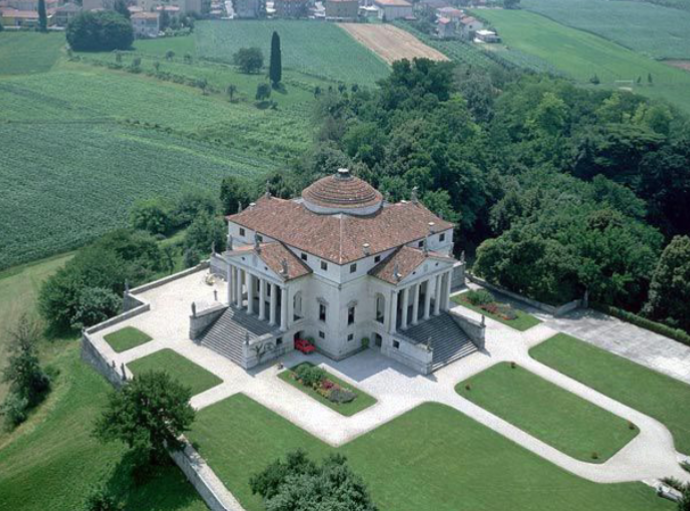
Palladio (Renaissance Architecture - High)(Vicenza, Italy)
Villa Rotonda

Floor plan of ___. Palladio (Renaissance Architecture - High)(Vicenza, Italy)
Villa Rotonda

Elevations of ___. Palladio (Renaissance Architecture - High)(Vicenza, Italy)
Villa Rotonda

Palladio (Renaissance Architecture - High)(Venice, Italy)
San Giorgio Maggiore
For the San Giorgio Maggiore, Palladio's solution superimposed two facades, one with a wide pediment and
architrave, extending over the nave and
both the aisles, apparently supported by
a single order of pilasters; and the other
with a narrower pediment (the width of
the nave) superimposed on top of it with
a giant order of ___ columns on
high ___.
engaged, pedestal
___ is the term applied to certain aspects of artistic style, mainly Italian, in the period between the
High Renaissance of the early 16th century and the beginnings of Baroque art in the early 17th.
Mannerism
___ was antithetical to many of the principles of the High Renaissance. Instead of harmony, clarity, and repose it was characterized by extreme sophistication, complexity, and novelty. Mannerist architects were no less interested in ancient Classical architecture than were their predecessors, but they found other qualities in ancient Roman architecture to exploit.
Mannerism

Michelangelo (