18: Introduction to Lipids
 Call Kai
 Learn
 Practice Test
 Spaced Repetition
 Match
 Flashcards
 Knowt Play
1/198

There's no tags or description
Looks like no tags are added yet.
199 Terms
What are the five major lipid categories?
1. Fatty Acids
2. Triacylglycerols
3. Glycerophospholipids
4. Sphingolipids
5. Steroids
What are the 3 biological functions of lipids?
1. Lipids in the form of a bilayer are essential components of biological membranes.
2. Lipids containing hydrocarbon side chains serve as energy stores.
3. Many intra- and intercellular signaling events involve lipid molecules
What characteristic distinguishes lipids from other biological molecule classes?
Lipids exhibit substantial structural diversity and are generally insoluble in water
Why do lipids generally have little to no water solubility?
Many lipids contain nonpolar hydrocarbon regions that do not interact favorably with polar water molecules
What are lipids?
Substances of biological origin that are soluble in organic solvents.
What is a fatty acid?
A carboxylic acid containing a long hydrocarbon chain.

What are the two major structural regions of a fatty acid?
Glycerol backbone
Fatty acid chain
What is the chemical structure of a glycerol backbone?
A chain primary made of carbon and hydrogens
Once the fatty acid breaks, each carbon is attached to one -OH group

What is the chemical structure of a fatty acid chain?
A fatty acid consists of a long hydrocarbon chain (carbon and hydrogen atoms) with a carboxyl group (–COOH) at one end.
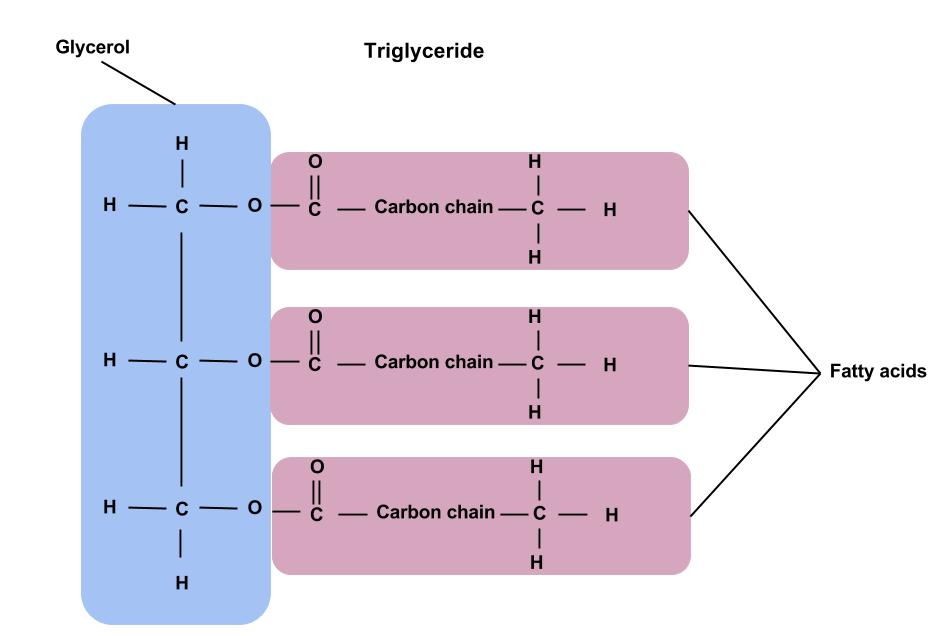
What form do fatty acids usually occur in?
Fatty acids usually occur in esterified forms with a backbone structure

What is the approximate carbon-chain length range of fatty acids?
C4 to C36.
C16 and C18 are the most common in plants and animals
Why are fatty acids important components of other lipids?
Their hydrocarbon chains contribute to the structure, hydrophobicity, and energy-storage properties of larger lipid molecules
Why is the carboxyl group of a fatty acid hydrophilic?
It contains polar oxygen atoms that allow favorable interactions with water.

Why is the hydrocarbon tail hydrophobic?
It consists primarily of nonpolar carbon-hydrogen bonds that do not interact favorably with water.

Why do amphipathic lipids form structurally ordered aggregates in water?
Their hydrophilic regions interact with water, while their hydrophobic regions associate away from water.
Most biological lipids are amphipathic and form structurally ordered aggregates
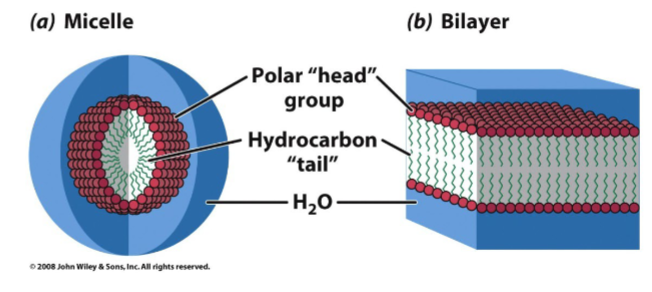
What is a micelle?
A roughly spherical arrangement of amphipathic molecules with hydrophilic heads facing outward and hydrophobic tails facing inward.

What is a lipid bilayer?
A structure consisting of two layers of amphipathic lipids with hydrophilic heads facing the aqueous environments and hydrophobic tails facing inward.

What are the two regions of a typical free fatty acid?
A hydrophilic carboxyl head group and a hydrophobic hydrocarbon tail

Why do saturated fatty acids form more rigid and organized aggregates?
Their straight chains allow close packing, increasing interactions between neighboring hydrocarbon chains.

How do unsaturated fatty acids affect lipid packing?
Their double-bond-induced bends prevent close packing, creating a less ordered arrangement.
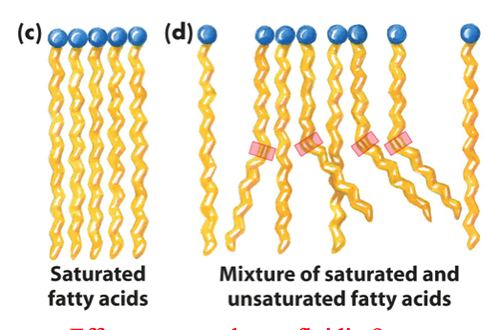
How do saturated vs. unsaturated fatty acids generally affect membrane fluidity?
Saturated: Decrease fluidity by promoting tighter packing
Unsaturated: Increases fluidity by preventing tight packing.
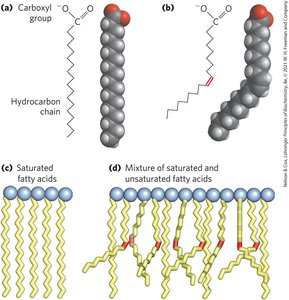
Why is membrane fluidity biologically important?
It influences membrane flexibility, protein movement, transport, signaling, and overall membrane function.
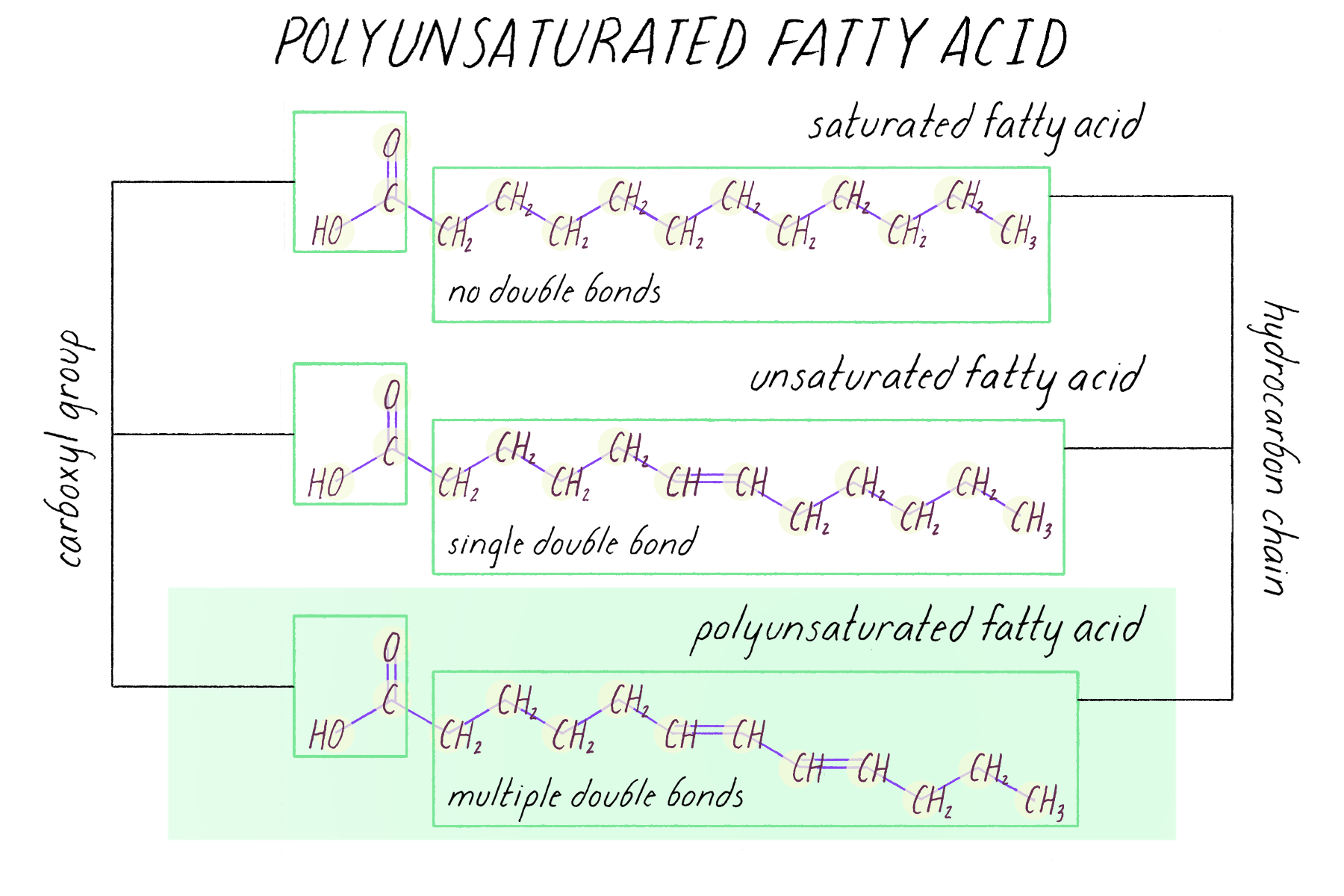
What is a saturated fatty acid?
A fatty acid containing no carbon-carbon double bonds and the maximum number of hydrogen atoms (fully reduced) possible for its carbon chain.

What is an unsaturated fatty acid?
A fatty acid containing one or more carbon-carbon double bonds.

What is a polyunsaturated fatty acid?
A fatty acid containing two or more carbon-carbon double bonds
What does the first number in fatty acid notation represent?
(1st: 2nd)
The total number of carbon atoms.
What does the second number in fatty acid notation represent? (1st:2nd)
The total number of carbon-carbon double bonds.
What does the Δ (delta) symbol represent in fatty acid nomenclature?
1st: 2nd (Δ x,…)
The positions of double bonds when counting from the carboxyl carbon.

What configuration to all double bonds in fatty acids have?
Cis configuration

Are double bonds in fatty acids conjugated?
No, double bonds in fatty acids are almost never conjugated (alternating single and double bonds), but rather possess a methylene group between the double bonds

What is the general first double-bond position in fatty acids?
Between C9 and C10
What is omega nomenclature used to describe?
The position of the first carbon-carbon double bond when counting from the methyl (-CH3) end of a fatty acid.
DOES NOT TELL YOU # OF DOUBLE BONDS

Palmitic Acid

Stearic Acid

Oleic Acid

Linoleic Acid

α-Linolenic acid

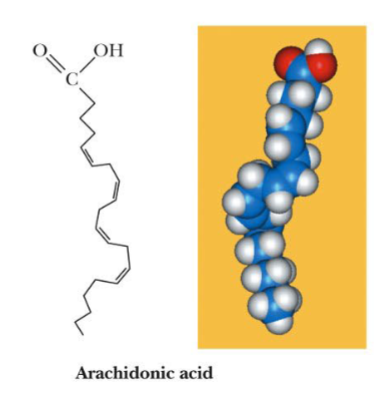
Arachidonic acid
Structural formula of Myristic acid
CH3(CH2)12COOH
Structural formula of Palmitic acid
CH3(CH2)14COOH
Structural formula of Stearic acid
CH3(CH2)16COOH
Structural formula of Palmitoleic acid
CH3(CH2)5CH=CH(CH2)7COOH
Structural formula of oleic acid
CH3−(CH2)7−CH=CH−(CH2)7−COOH
Structural formula of Linoleic acid
CH3(CH2)4(CH=CHCH2)2(CH2)6COOH
Structural formula of α-Linolenic acid
CH3CH2(CH=CHCH2)3(CH2)6COOH
What happens to melting temperature as fatty acid carbon-chain length increases?
Melting temperature generally increases because longer chains have greater intermolecular interactions.
What happens to melting temperature as the number of double bonds increases?
Melting temperature generally decreases because double bonds, particularly cis double bonds, introduce bends that prevent tight packing.
DOUBLE BONDS TAKE PRECEDENCE WHEN DETERMINING M.P.
Why do fatty acids generally have an even number of carbon atoms?
They are synthesized through the addition of two-carbon units derived from acetate
What is the main function of nonpolar lipids?
Energy storage
What is the main structural role of polar lipids?
They form the basis of biological membrane bilayers.
What is another name for triacylglycerols?
Triglycerides
What are the three major structural components of a triacylglycerol?
One glycerol molecule and three fatty acid molecules (R1, R2, R3)
Why are triacylglycerols nonpolar and water-insoluble?
Their three long hydrophobic fatty acid chains dominate the molecule, making it unable to interact favorably with water.
Do all three fatty acid chains in a triacylglycerol have to be identical?
No. Most triacylglycerols contain two or three different types of fatty acid residues.
What is the general fatty acid composition of animal fats?
Animal fats generally contain a high percentage of saturated fatty acid residues.
What determines the melting temperature of triacylglycerols?
The fatty acid composition, particularly the degree of saturation and the length of the fatty acid chains.
Structure of glycerol:
St

Structure of triacylglycerol
Fatty acid triesters of glycerol

Why is oil liquid at room temperature?
It has a long carbon chain with mostly unsaturated double bonds, whose double bonds prevent tight packing and lower the melting temperature.

Why is butter a soft solid at room temperature?
Its long carbon chain is a mixture of saturated and unsaturated fatty acids, giving it an intermediate melting temperature

Why is beef fat solid at room temperature?
Beef fat contains a long carbon chain of saturated fatty acids, allowing its chains to pack more closely and increasing the melting temperature

What is the primary biological role of triacylglycerols in animals?
They function as long-term energy reservoirs.
How are stored triacylglycerols used when the body needs energy?
They are broken down into glycerol and fatty acids. The fatty acids undergo oxidation to generate acetyl-CoA and ultimately support ATP production
Approximately how long can stored fat support survival during starvation?
Approximately 2–3 months
How long would the body's glycogen supply last?
Less than one day.
How much more metabolic energy does fat provide than an equal weight of glycogen?
Approximately six times more
What are adipocytes?
Specialized cells that store fat, primarily in the form of triacylglycerols
What is adipose tissue?
Tissue composed of adipocytes that serves as a major site of fat storage
Most abundant in the abdominal cavity
What approximate normal body fat percentages are listed for women and men?
26% for women and 21% for men
What type of molecule is glycogen?
A polysaccharide composed of many glucose molecules.
What is the primary role of glycogen in energy storage?
Short-term energy storage
What is the primary role of triacylglycerols in energy storage?
Long-term energy storage.
What are triacylglycerols commonly found in?
Fats and oils
TAG is the most abundant lipid!!
Why can triacylglycerols store more energy per unit of mass than glycogen?
Fatty acids are highly reduced and stored with little water, allowing triacylglycerols to provide substantially more energy per unit of mass.
What is the major lipid component of biological membranes?
Glycerophospholipids
What are the four major structural components of a glycerophospholipid?
A glycerol backbone, two fatty acid chains, a phosphate group, and a variable polar head group

Why are glycerophospholipids considered amphiphilic?
They contain both hydrophilic phosphate-containing heads and hydrophobic fatty acid tails.
How does the amphiphilic structure of glycerophospholipids allow them to form membranes?
Their hydrophilic heads interact with the watery environments, while their hydrophobic tails orient away from water and toward the interior of the bilayer.
Structure of glycerol-3-phosphate

Structure of glycerophospholipids

What are 5 examples of polar head groups?
Water
Ethanolamine
Choline
Serine
Glycerol
What is the head-group substituent shown for water?
Hydrogen (–H).
What is the head-group substituent for phosphatidic acid?
Water
-H
What head group is present in phosphatidylethanolamine?
Ethanolamine
Structure of Ethanolamine
-CH₂CH₂NH₃⁺
What head group is present in phosphatidylcholine (lecithin)?
Choline
Structure of Choline
–CH₂CH₂N(CH₃)₃⁺
What head group is present in phosphatidylserine?
Serine
Structure of serine
–CH₂CH(NH₃⁺)COO⁻
What head group is present in phosphatidylglycerol?
Glycerol
Structure of glycerol
-CH2CH(OH)CH2OH
Structure of Phosphatidylcholine

Structure of Phosphatidylethanolamine

Structure of Phosphatidylserine

Structure of Phosphatidylglycerol

What lipid is a neutral storage lipid?
Triacylglycerols
What lipids are phospholipids?
Glycerophospholipids
Sphingolipids
What lipids are glycolipids?
Sphingolipids
Galactolipids (sulfolipids)
What are sphingolipids?
A class of lipids that are major components of biological membranes and are derived from sphingosine
What molecule forms the backbone of sphingolipids?
Sphingosine
A C18 amino alcohol