Biomaterials for Periodontal & Soft Tissue Regeneration
 Call Kai
 Learn
 Practice Test
 Spaced Repetition
 Match
 Flashcards
 Knowt Play
1/59

There's no tags or description
Looks like no tags are added yet.
60 Terms
Goals of perio therapy (5)
Infection control - step 1 + 2 and elements in 3
Pocket reduction/Elimination - results in infection control
Regeneration - regeneration of all 4 types - cementum/pdl/bone formation
Long-term results
Improvement of aesthetics - regenerative procedures, or not make aesthetics worse

S3 guidlines
S1 - ID risk factors, OHI, behavioural change
S2 - PMPR ± adjunctive therapies
3 months later - re-evaluation
S 3 - Surgical procedures employed if residual defects
S 4 - No deep pockets more 6 mm, no pockets 4 or more that BOP - SPC - supportive periodontal care

BSP guidlines

Step 3: 2 main things that can be done here?
Access/treat non-responding sites to step 2
Regenerate or eliminate lesions that complexity to periodontitis management - intrabony and furcation defects
What are all the interventions that can be done in step 3? (4)
Repeated subgingival instrumentation ± adjunctive therapies
Access flap periodontal surgery
Resective periodontal surgery - e.g apically positioned flap
Regenerative periodontal surgery

Regenerative surgery can change what for the tooth?
infra-bony defect that has been filled with bone - strategic tooth that holds bridge in place - regenerative surgery can keep tooth in place
maintain tooth by treating infra-bony defects and furcation - changing prognosis of tooth due to periodontal regeneration

Planning a journey:
Evaluate wound healing and healing factors that we may affect healing
Periodontal regenerative principles
Ultimate end point is to maintain the tooth
In between different stops allows to make decision if you are able to control healing factors that

What type of flaps are created?
Conservative flaps to not create aesthetic problem, need as much tissue as possible for primary wound closure

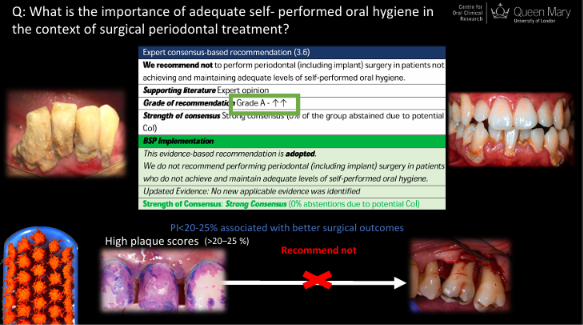
What is an important prerequisite for surgical periodontal treatment?
It is not recommended to perform periodontal surgery in patients who do not achieve and maintain adequate levels of self-performed oral hygiene
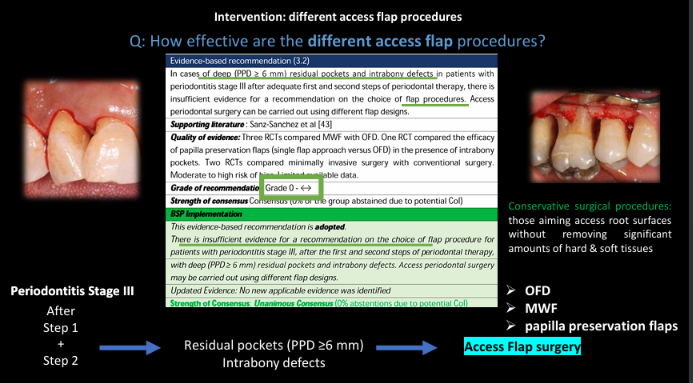
What does the evidence say about flaps, when might a flap be used?
Name 3 types of flaps, which is relating to conservative surgical procedures?
After S1 and S2 therapy
If deep pocket of 6 or more mm and intrabony defect
Access flap surgery can be employed
No evidence for particular flap
Conservative surgical procedures - aiming to access root surface to remove infection and maintain as much soft txs as possible
Papilla preservation flaps (conservative surgical procedure techniques, maintained and repositioned), modified widman flap, open flap debridement
What is the adequate choice of regenerative biomaterials for promoting healing of residual deep pockets associated with a deep intrabony defect?
How deep is the intrabony defect?
Use membrane with or without bone graft
placed above area in a way to allow space in the area- bone and periodontal tissue will grow under the membrane - guided tissue regeneration (GTR)
Deep pocket with intra-bony defect of more than 3 mm - not typical perio surgery - employ regenerative procedures - guided tissue regeneration with membrane (e.g collagen) ± bone graft or enamel matrix derivative - stimulate perio regeneration on root surface

What is adequate choice of surgical flap design for regenerative treatment of residual deep pockets associated with an intrabony defect?
Papilla preservation flap

What are 2 challenges to wound healing?
Open wound system - connection to oral cavity via sulcus - which may create infection
Healing on surface with poor blood supply - Large complex defect - intrabony and furcation defects- very open wound system and want to regenerate on root surface with poor blood supply

What cells can colonise the root surface and what are the problems
Achieve colonisation of root surface by 4 types of tissues
Defect and loss of attachment in the image
Want to stimulate pdl cells onto root surface, bone forming cells to reconstruct area
Pdl cells have competition - as epithelial cells which are fastest in healing will grow along root surface
if u have epithelium on surface you cannot regenerate the area as pdl cannot regenerate onto the root surface
GCT is the second fastest
we want pre pdl cells and then bone cells
epithelial cells and gingival connective tissue cells are also present in open wound healing system and are the fastest to colonise the root surface
pdl and bone cells which we want to colonise have competition

Histometric evaluation of periodontal surgery:
also seen in other periodontal surgery?
Long junctional epithelium in all treatments extending to or close to the attachment level prior therapy

New attachment we want?
Want to reconstruct what has been lost
cementum with inserting collagen fibres

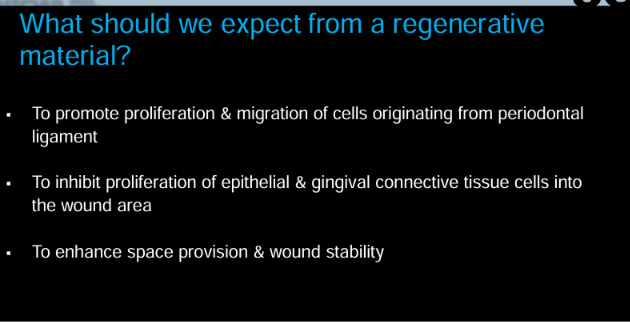
What should we expect from a regenerative material?
To promote proliferation and migration of cells originating from periodontal ligament
To inhibit proliferation of epithelial and gingival connect tissue cells into the wound area
To enhance space provision and wound stability
*Space to allow for the tissues to regenerate
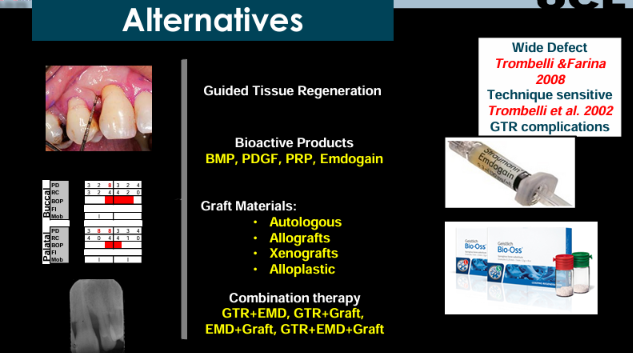
Alternative tx options?
GTR (mainly collagen matrix)
Bioactive products: BMP, PDGF, PRP, Emdogain (EMD)
These may be used alongside graft materials e.g Xenografts
Combination therapy also

collagen resorbable membrane
non resorbable Teflon membrane with titanium frame to maintain space
resorbable barrier with integrated suture
emd - mixture of different enamel matrix protein created during embryogenesis
GTR: brief explanation
deep PP, defect needs to be treated with regenrative perio surgery
need pdl and bone to fill in defect - collagen barrier - create spacec and time for pdl cells to grow along root surface and for bone forming cells to fill in defect
barrier - prevents fast cells epithelial and GCT cells from going into defect and repopulating faster than pdl

Adv of GTR?
good quality of tissues after tx
can be used for all types of defects
used for longer than 30 years so a lot studies - long term results
leads to tooth survival
technically difficult - exposers can lead to infection

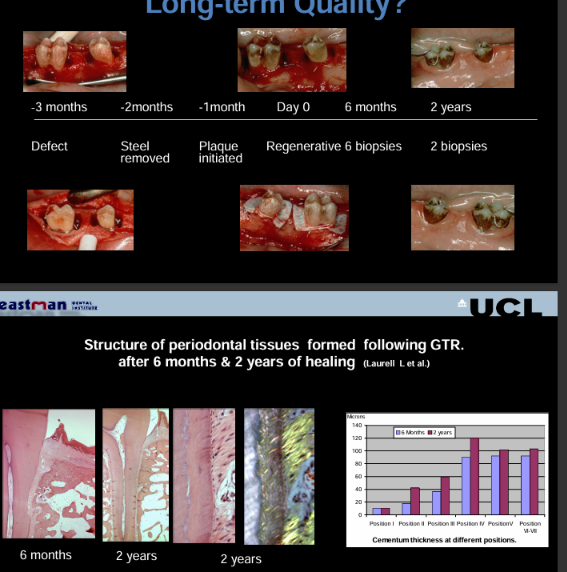
Explain the quality of tissue after tx based on evidence?
Evidence:
Resistance of new attachment to ligature induced periodontal breakdown
same as normal tooth

Overtime
even after 2 years - stay in the area
long term success of procedures
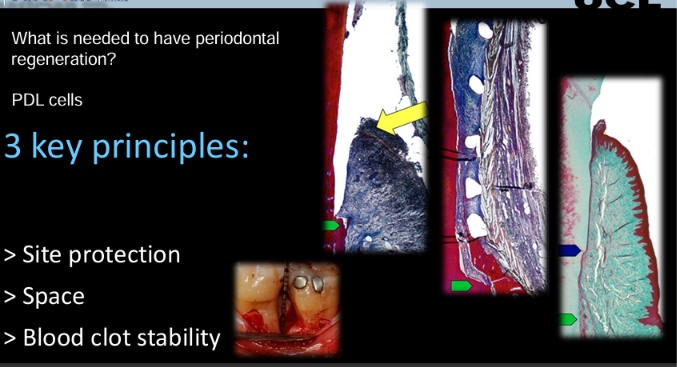
What is needed to have periodontal regeneration? 3 key principles general? - EMD and GTR (matrix)
PDL cells
site protection : no mechanical movement/injury/way you suture - you get primary wound closure
Space: under membrane or biological substances
Blood clot stability - anything related to healing - suturing
Site protection:
You need complete closure of area with suture to protect membrane and site
complete coverage with gingival tissues

Space:
for pdl and bone growth you need space, if barrier or flap collapses on the root there is no space for bone or pdl to grow onto root surface
between root and flap/membrane

Blood clot stability:
blood clot stabilises with time

Membrane properties (4)
Biocompatible - resorbable (6-12 weeks) and non resorbable (removed after 6 weeks) membranes
Not elicit inflammatory reaction
maintain barrier function
non-collapsible - not used with any bone grafting - non resorbable material should be non-collapsible and should create space for pdl to grow

Membrane timeline:
4 types of membranes
non-res synthetic or teflon membranes - first gen
resorbable synthetic
resorbable collagen
human cell/tissue-based - not used that much - other humans or animals

Non-resorbable:
Required what and what is a problem?
second surgery for removal 4-6weeks
trauma of newly formed tissues

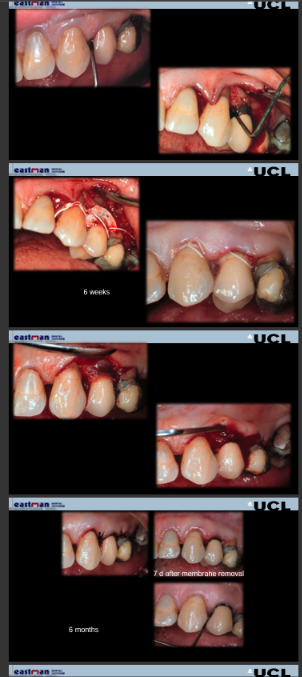
non-resorbable
membrane stretched and held with sutures
second surgery to remove - create minor trauma in tissues
Absorbable collagen membranes
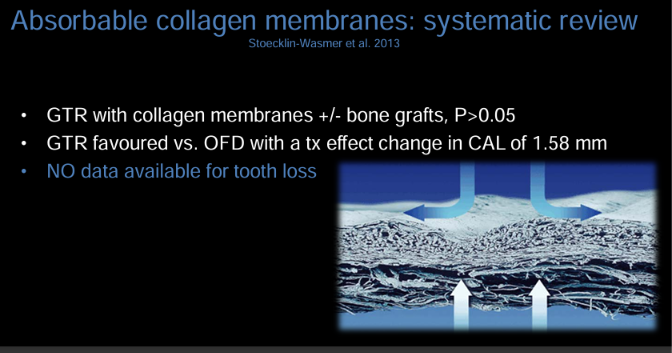

Placement of bone graft then place the barrier, then suture - site protection


fill until the intrabony defect is no longer visible
GTR associated problems, what must you be clear about with patients?
what you see as clinical evidence you will also see histological evidence
risk of infection
costs
poor acceptance due to religion
use of animal-derived products - vegans/vegetarians

Technically difficult - membrane exposure - need experience

GTR is becoming less common in practice - EMD
what happens?
Deposition of enamel matrix protein onto developing root surface represents crucial step for cementum formation
The formation of PDL and alveolar bone are dependent upon cementum formation

How is EMD derived?
Pure amelogenin (main protein during formation) is hydrophobic and is isolated
adding carrier, has low pH value while human tissues are pH neutral - this difference leads to adhesion of active substances to tooth surface
applied onto root surface
by applying to root surface, you start attracting mesenchymal cells into the lesion towards the root surface covered with EMD

What happens next?
The cells attach and populate the surface and begin proliferating
Increased intracellular signalling are activated and start creating pdl regeneration pathway
6-12 weeks - differentiation - gf affect area and cells to organise and produce cementum and collagen
After 6 months - some alveolar bone formation as well

Timeline:
Take up to a year

What are the biological effects of EMD/P (proteins)?

stimulate own tissues to grow by the presence of amelogenin proteins
brown = the emd

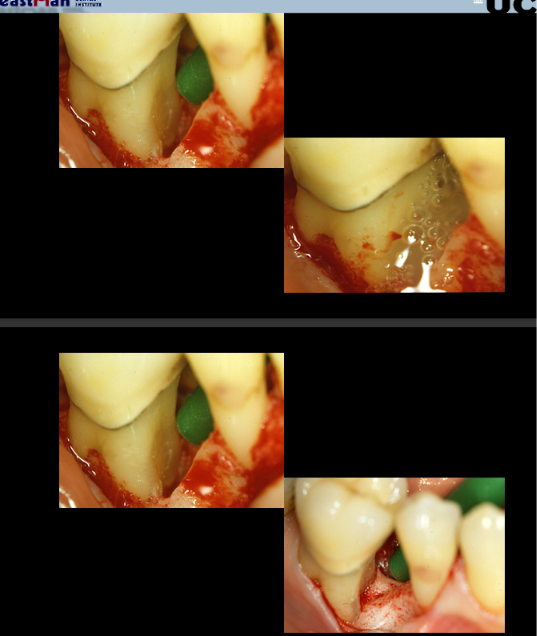
Clean the surface
apply material onto root surface
modify surface using EDTA to remove any debris,
After opening up - defect is completely healed with newly formed attachment
Histological evidence

Clinical evidence: emp/d vs GTR
similar changes

Again what are 2 variationsof flap designs following conservative appraoch?
Simplified and modified papillae preservation flap
preseve papilla nad dont extend that mutch - might need to extend with GTR
simplified - used when space between 2 teeth is narrow
modified - when space between 2 teeth is wide

more recent flap design
moving towards minimally invasive surgically technique
buccal and lingual flaps limited around tooth
modified mist - buccal no palatal flap
not able - them do minimally invasive - buccal and lingual - only limited to area around tooth
if very wide then you extend flap

Other techniques
Overall - these flaps are papilla preservative flaps

other

Rationale for a combination stratergy?
very large defect
to enhance periodontal regeneration by EMD, GF or GTR
different graftings
Again, same surgical techniques employed
might need to use slightly more extensive flaps for combination

Approaches:


2 mm - so used simplified
EMD and bone graft
EDTA gel first, apply EMD on root surface, them combination of bonegraft and EMD in a way to fill defect, suture to protect area- fine suturing material 6.0 or 5.0 very least
create space with the flap


Autologous platelet concentrates
clot - bioactive factors
membrane
blood from pt - autocentrifuged
f2 - clot - highly concentrated bioactive factors
f1 - membrane


How is this used in regenerative surgery?
fill in defect with clot then put f1 membrane on top (utilised as a gtr on top of the clot)
then primary closure

realistic
Whatever you choose - all still successful
instead of placing implants, before thinking about removing teeth
