Art Module 3 (Classical Rome)
 Call Kai
 Learn
Learn Practice Test
 Spaced Repetition
 Match
Match Flashcards
 Knowt Play
1/33

There's no tags or description
Looks like no tags are added yet.
Name | Mastery | Learn | Test | Matching | Spaced | Call with Kai | Chat |
|---|
No analytics yet
Send a link to your students to track their progress
34 Terms

Name: Necorpolis at Caere
Place: Cerveteri (Italy)
Year: 5th to 4th century BCE
Extra: Interior excavated from tufa rock, a soft stone originally formed in through volcanic eruptions.

Name: Tomb of the Reliefs
Place: Cerveteri (Italy)
Year: 5th-4th century BCE
Material: Interior of Etruscan tomb: rock-cut tomb with brightly painted plaster reliefs representing weapons, tools, kitchen utensils, a range of objects used on a daily basis.
Extra: Notice the niches which would hold the sarcophagi of the deceased.

What is it: Sarcophagus, or coffin
Place: Cerveteri Italy
Year: 520 BCE
Material: Terracottaa (baked clay)
Extra: Depicting a reclining couple (those buried here). Life-like appearance; gestures allude to a banquet scene. Modeled rather than carved.

Name: She-Wolf of the Capitol
Year: 500 BCE
Material: Bronze (this and terracotta were the materials of choice of Etruscan artists)
Extra: Founding myth of Rome: Romulus & Remus twin brothers were kids of Vestal Virgin & Mars (the god of war); abandoned & suckled by a she-wolf in the wild. Both found Rome but conflict led to Romulus killing Remus. She-wolf known as Etruscan, suckling infants date from the Renaissance.

Name: Chimera
Place: Arezzo, Italy
Year: 5th-4th century BCE
Material: Bronze
Extra: Monster with lions head, serpents tail, and second head of a goat whose right horn is seized by the serpent. Hybrid of demonic types that plague the dead in the underworld, could be Egyptian or Mesopotamia influences.

Name: Head of a Roman
Year: 80 BCE
Material: Marble
Extra: Not idealized in Greek tradition but one that expresses the Roman values of peritas (literalness, verism - notice the wrinkles in this naturalistic portrait) and severitas (severity). The sitter of this portrait bust was almost certainly a patrician.

Name: Roman Patrician with Busts of his Ancestors (The Barberini Statue)
Year: 30 BCE
Material: Marble
Extra: Life size marble statue from the end of the Republican period.

Name: Temple of “Fortune Virilis”
Place: Rome
Year: Late 2nd century BCE
Extra: Synthesis of Greek (Ionic columns) and Etruscan architectural elements. This one is different bc: high podium, large cellae (=Gr. Naos, or enclosed chamber inside a temple)w/ a deep porch, engaged columns (inserted into the wall proper, not freestanding) > Etruscan heritage?
Temple now believed to be dedicated to Portunus, god of the harbor

Name: Temple of Vesta
Place: Tivoli, Italy
Year: early 1st century BCE
Extra: Semicircular tholos temple w/ an axial alignment. Outer appearance remains Greek: Corinthian order (defining feature: acanthus leaves - the third Greek order not discussed so far. Etruscan-type podium, monolithic columns (all in 1 piece, not assembled from drum segments as in Greece), walls made out of concrete (a Roman invention), frieze w/ decoration of garlands held up by heads of oxen (typically Roman).

Name: Sanctuary of Fortuna Primigenia
Place: Palestrina, Italy
Year: 120-80 BCE (late Republican period, dictator Sulla)
Extra: Expansive temple structure on site where oracular lots had been cast. Sanctuary on top terrace, in center of a colonnaded semicircle, axial symmetry; structure re-emerged after bomb raid in WWII. One of the very earliest examples of Roman innovations in building techniques that define architecture to the present day: use of concrete (opus caementicium = lime mortar, water, volcanic dust), combined w/ use of arches & vaults.

Extra: Notice rubble fill mixed w/ concrete inside. Decorative sheathing made of marble slabs, plaster, or ornamental brick -or stonework outside (opus incertum, opus reticulatum, etc)

Name: House of the Vetii
Place: Pompeii
Year: 62-79 CE (frescoes completed during this time)
Extra: Volcanic eruption preserved both commercial & residential sections of Pompeii, including a number of upscale private villas like those one, richly decorated with frescoes. Typical Pompeian town house w/ atrium, opening in the roof (compluvium).


Name: The Villa of the Mysteries
Place: Near Pompeii
Year: 50 BCE
Material: Frescoes
Extra: Very good example of frescoes. Illusionistic ledge with a succession of naturalistically rendered figure groups; “Pompeian Second Style”. Subject: initiation ceremonies into a Roman mystery cult, believed to be that of Dionysus (in Rome before Christianity). Frescoes follow a young female novice through the various trials of initiation (whipped by winged genius?).


Name: Augustus of Primaporta
Year: 20 BCE
Material: Marble
Extra: Sedate, idealized manner (“August”) fit Roman taste: Emperor proclaiming a diplomatic victory. Breastplate decoration with mythological and allegorical figures: sky god, earth goddess, personifications of the pacified provinces of Spain and Gaul (France). official religion of Imperial Rome was the Cult of the Emperor, Emperors were seen as god-like.

Name: Ara (altar) Pacis (pacis augustae = Augustan peace)
Place: Rome
Year: 13-9 BCE
Material: Marble
Extra: Another monument to celebrate Augustan peace, aka the pacification of Spain & Gaul (the empire as a whole). Exterior & interior decoration of relief panels. Garlands, bucrania (oxen heads), acanthus leaves decorations.

Name: Tellus Relief panel (left) & Procession panel (right)
Extra: Left- Ancient Roman earth mother; drapery, pose betray Greek influence. Right- Led by Augustus himself, commemorates dedication ceremonies.

Name: Colosseum
Year: 70-82
Place: Rome
Extra: Amphitheater (Roman invention), consisting of 2 semi-circular theaters enclosing an oval arena; moveable sun cover. Begun by Emperor Vespasian (69-79) & finished in 80 by his successor Titus; name derives from a giant (“colossal”) statue of Nero in front, which has since vanished. Ex of Roman public works. Performances: gladiator fights, man-beast struggles, inaugurations: staged naval battle w/ 3000 participants, arena flooded on purpose.

Name: Thumbs Down (Pollice Verso)
Artist: Jean-Léon Gérôme
Year: 1859
Material: Oil
Extra: Stereotypes about the Colosseum

Name: Plan of the Forum Romanum
Extra: These forums from the Forum Romanum were the center of Roman political , business, & social life. Most forums consisted of colonnaded courts, often with a temple dedicated to the protective deity of the titular emperor attached to it. Today, only fragments and ruins remain.

Name: Arch of Titus
Place: Rome
Year: 81
Extra: Ornamental version of city gate, used by emperor to triumphantly enter Rome after battle; in this case, Emperor Titus returning from conquest of Jerusalem at the end of the Jewish Wars (66-70). Reliefs: Spoils (menorah, trumpets) of the Temple of Jerusalem brought to Rome (bottom left) Titus triumphant on his chariot (bottom right).

Name: Portrait of a Flavian Lady
Year: 90 BCE
Material: Marble

Name: Portrait of Emperor Hadrian
Year: 120 BCE
Material: Marble
Name: Equestrian Statue of Marcus Aurelius
Place: Capitoline Hill, Rome
Year: 165 BCE
Material: Bronze


Name: Portrait of Emperor Caracalla
Year: 215 BCE
Material: Marble
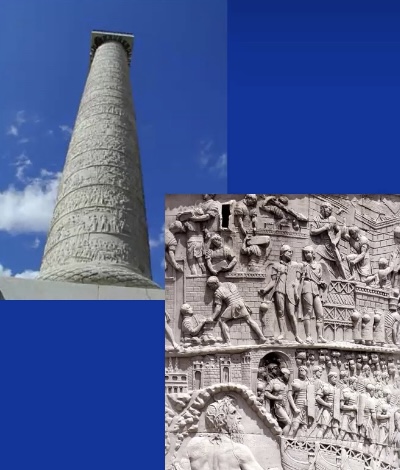
Name: Column of Trajan (Attributed to Apollodorus)
Place: Rome
Year: 113
Extra: Another commemorative monument, sponsored by Emperor Trajan to celebrate his two successful campaigns against the Dacians, annexing today’s Hungary and Rumania to the Roman Empire; under Trajan Empire was at its largest expanse. Low relief (marble) forms a continuous spiral band telling in 150 episodes the Dacian Wars. Detail: Roman troops building a pontoon bridge across Danube; Trajan speaking to his troops.

Name: The Pantheon
Place: Rome
Year: 118-125 BCE
Extra: Only building that’s been in use since classical antiquity to now; built during rule of Emperor Hadrian 117-138. Temple dedicated to all gods, later converted into a church. facade set in front a domed rotunda; dome consists of a shell of concrete that gradually thickens towards the base.
Interior: coffered ceiling (decorative, sunken panels), oculus (round opening in the ceiling); floor slightly convex (drainage).

Name: Baths of Caracalla (giant)
Place: Rome
Year: 215 BCE
Extra: Another ex. of Roman public works; giant complex of public baths, named after Emperor Caracalla. Monumentality of later Roman art & architecture. Extensive use of vaults, originally mosaic decoration; heights up to 140ft; recreation for thousands of Romans at a time. Succession of cold water pool (frigidarium), central room w/ smaller warm-water pool (tepidarium), circular hot-water pool in domed rotunda (caldarium); steam baths, dressing rooms, lounges, exercise rooms (palestrae), public library.


Name: Pont du Garden
Place: Near Nimes (France)
Year: 1st century BCE
Extra: Water supply depended on aqueducts, carried over 50 miles or more. This example dates from Republican period; note extensive use of arches; engineering feat.


Name: The Four Tetrarchs
Place: Porphyry (Piazza San Marco, Venice)
Year: 305 BCE
Extra: Porphyry is an extremely har stone; rendering, frontal pose are almost regressions to archaic simplicity; work originally located in the
Philadelphion of Constantinople; “acquired” during 4th Crusade 1204 by the Venetians.

Name: Palace of Diocletian
Place: Split (Croatia)
Year: 300-305 CE
Extra: As part of these administrative changes, Diocletian built, for his retirement, a large fortified palace in Split. Plan is laid out like that for a Roman colonial city; axial arrangement; detail: one of the colonnaded courtyards. Military aspect runs strong: fortification walls, tower-flanked gates. Fusion of military fortress & imperial palace.

Name: Al-Khazneh (the “Treasury”)
Place: Petra (Jordan)
Year: 2nd century CE
Material: Rock-cut mausoleum
Extra: In Petra an entire temple facade was excavated from rock. Notice dramatic recesses, broken pediment of upper pediment. Theatrical effects, possibly influenced by stages of Greek and Roman theaters.

Name: Constantine the Great
Year: 300 CE
Material: Marble (brick core, wooden torso, sheathed with bronze; marble hands, feet, and head)
Extra: Classical sense of measure & proportions disappear; monumentality; transition from late antiquity to early Medieval Period. This huge marble head was part of a colossal statue of Constantine (30ft high) placed the western apse of the Basilica (Forum) of Constantine.

Name: Arch of Constantine
Place: Rome
Year: 312-315 CE
Extra: Medallions date from Hadrians time, but relief band below is genuine 4th century: Constantine, surrounded by his entourage, stands on a rostrum (a platform), addressing the people. Rigid formality, repetition, flatness, static composition, lack of proportionality mark the shift. Remnants of the classical ideal will continue to live on in Byzantine Art.


Name: The Porta Nigra (“Black Gate”)
Place: Trier (Germany)
Year: 280-310 CE
Material: Use of rusticated (roughly hewn) masonry, structure left unfinished.
Extra: Constantius Chlorus, “Caesar” of the Wetsern hemisphere and father of Constantine the Great, established a new residence in the German city of Trier (Augusta Trevirorum). Sacked by the Franks & Alemanni (German tribe), the city was rebuilt w/ a large defensive wall, pierced by the “Black Gate” (Porta Nigra). Ex. of a Roman city gate, built not only for defensive purposes but also to impress visitors w/ a display of power.
