ATMS Chemistry
 Call Kai
 Learn
 Practice Test
 Spaced Repetition
 Match
 Flashcards
 Knowt Play
1/46

Earn XP
47 Terms
Annual Share of Global CO2 Emissions
Colonization in 1776
Industrial Revolution emission spike
Clean Air Act (1950s)
Is there an issue with CO2 and climate?
Yes, CO2 ½ life is 50-200 years
Great Oxidation Event
2.4-2.1 Gya
O2 started escaping into atmosphere and reacted with methane
Methane was displaced by O2
Aeronomy vs Meteorology
Meteorology is troposphere and stratosphere
Aeronomy is anything above
Jean’s Escape
where individual molecules evaporate into a collisionless exosphere
Troposphere
0 to 10 km in height
15 to -56°C in temp
80-90% of mass of atmosphere
Highest at equator
Greenhouse Gases
Ozone, Methane, Water Vapor, NOx
Extinction
The measure of how much radiation is being stored
What makes a strong greenhouse gas?
Absorption peaks and high extinction coefficient
Mesosphere
50 to 90 km in height
-2.5 to -86.5°C in temp
coldest layer in atmosphere
Rapid vertical mixing
Thermosphere
90 to 800 km in height
-86.5 - 1200°C in temp
Contains the ionosphere (ions produced by photoionization)
Exosphere
800 to 3000 km in height
1200°C in temp
Hot because direct radiation from Sun
Stratosphere
10 to 50 km in height
-56.5 to -2.5°C in temp
Highest concentration of ozone (~90%)
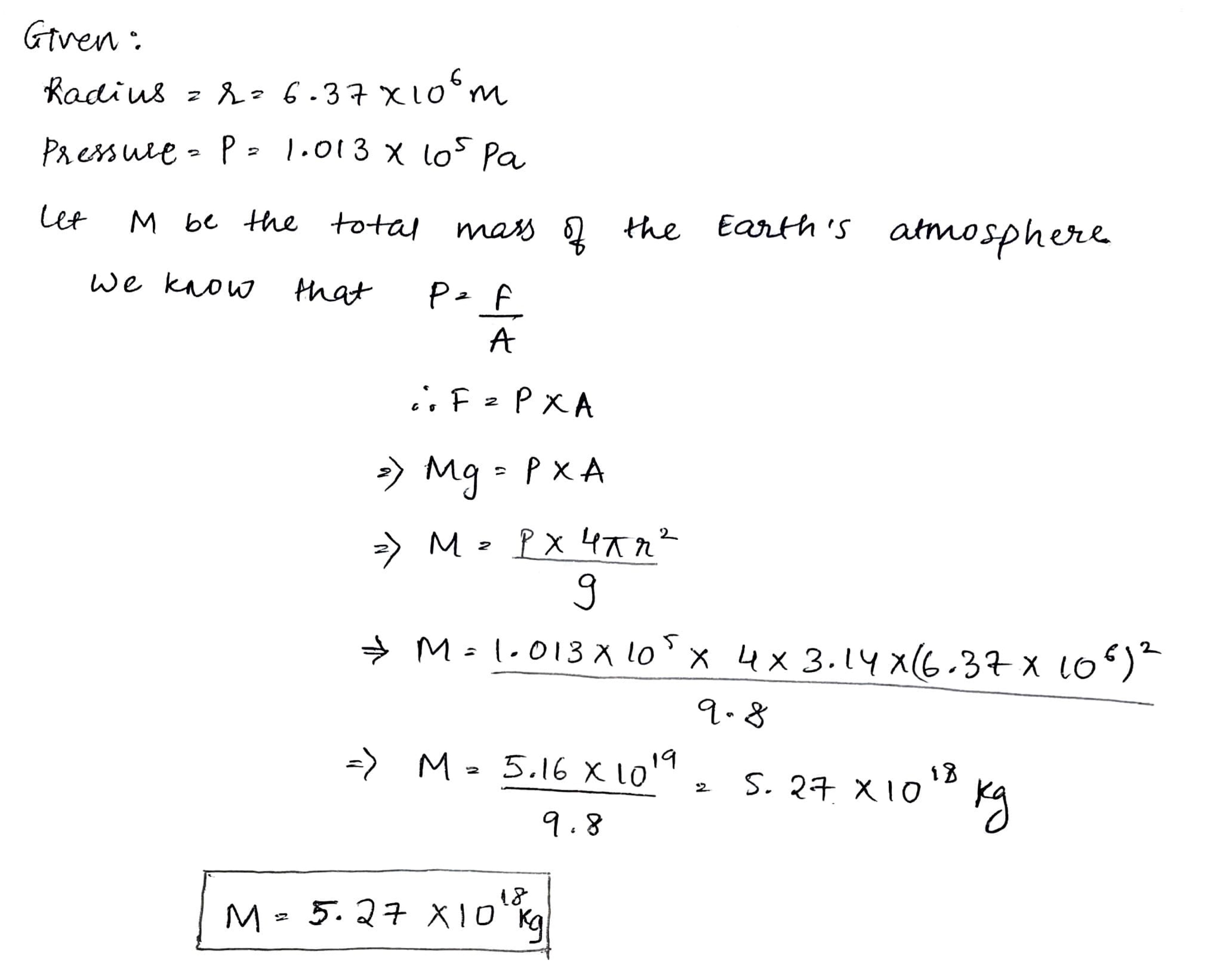
Derive mass of Earth’s atmosphere
Conduction
Transfers thermal energy through direct contact. If two objects are placed in contact with each other, thermal energy flows from the warmer object to the cooler object
Convection
The movement of thermal energy within fluids and occurs due to bulk movement of molecules in a liquid, gas, or liquid-gas mixture
Advection
When heat is carried along with the flowing fluid
Sun’s energy distribution
50% visible, 40% NIR, 10% UV
Positive feedback loop
increases the effect of the change and produces instability
Negative feedback loop
reduces the effect of change and helps maintain balance
Inter-Tropical Convergence Zone
A belt of low pressure which circles the Earth generally near the equator where the trade winds of the Northern and Southern Hemispheres come together
Milankovitch Cycle
Describe how relatively slight changes in Earth's movement affect the planet's climate
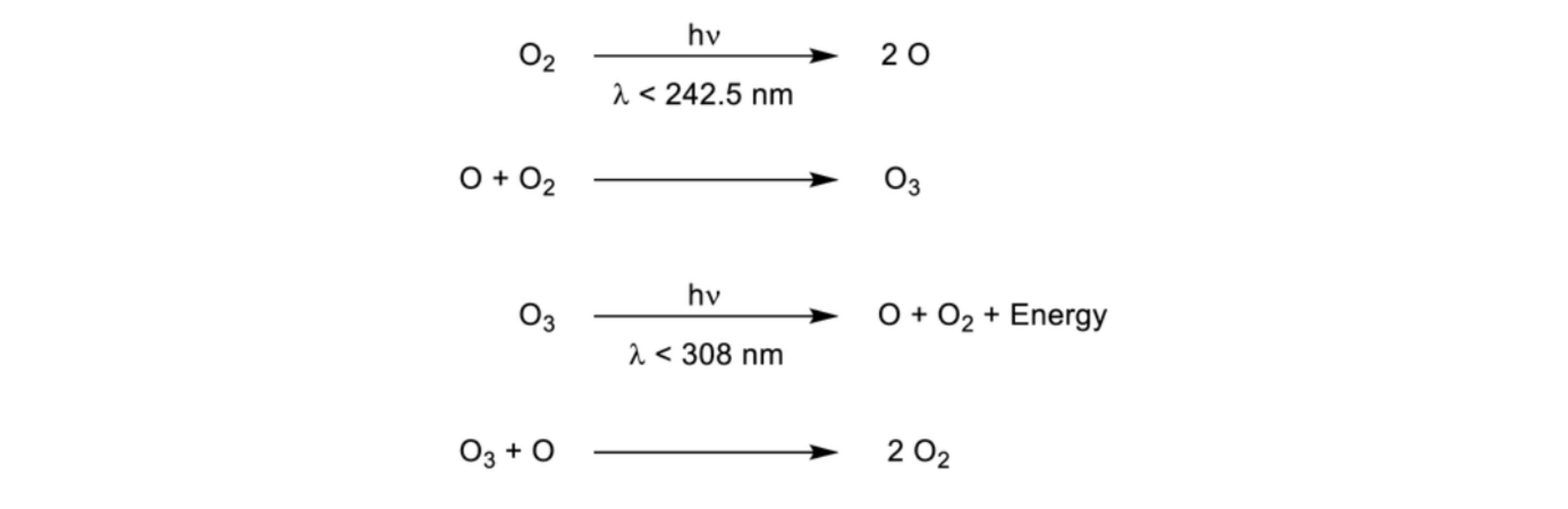
How is Ozone formed in the atmosphere
Aerosols
Liquid, solid, or mixed particle suspended in the atmosphere with highly variable chemical composition and size distribution
How do aerosols directly impact the planetary energy balance?
Absorption and scattering of incoming radiation
How do aerosols indirectly impact the planetary energy balance?
By acting like cloud condensation nuclei (CCN) thus influencing cloud droplet size and precipitation rates
Oxidation
gain oxygen, lose electrons
Reduction
lose oxygen, gain electrons
Clausius-Claperyon Equation
P(water,sat)= Aexp[B(1/T) -(1/T₀)]
Hadley Circulation
Assumed Earth is comprised of one large sea-breeze circulation but was wrong because it neglected Coriolis Force which led to the concept of multi-cell circulations
Lifetime equation
τ = (m/L) = (1/Kc)
Photochemistry
The study of interaction with matter resulting in a physical change or chemical reaction
Stephan-Boltzman Law
F = σT⁴
Arrhenius equation definition
Reaction rates obey an equation based on 3 factors: # of collisions per unit time, fraction of collisions that occur with correct orientation, and fraction of colliding molecules
Reaction half-life
t1/2 = ln(2)/0.693 or t1/2 = 1/k[A0]
Zero order rxn equations
Rate = k
First order rxn equations
Rate = d[A]/dt = -k[A]
ln[A] - ln[Ao] = -kt or ln[A]/ln[A0] = -kt
[A] = A0e-kt
Second order rxn equations
Rate = d[A]/dt = -k[A]²
Rate = d[A]/dt = -k[A][B]
Arrhenius Equation
k = Ae^(Ea/RT)
Chapman Mechanism
theorizes the creation of ozone production and destruction
Modes of Accumulation
Nucleation (D < 0.01 um)
Ultrafine (D < 0.1 um)
Accumulation (0.1 um < D < 1 um)
Coarse (D > 1 um)
Brewer-Dobson Circulation
determines the mean age and residence time of stratospheric gases, as well as tropical tropopause temperatures and stratospheric water vapor
Kelvin Effect
Equilibrium vapor pressure is higher over a curved surface than a flat one
Smaller a particle, more curvature, less surface tension
Larger particle activate at lower supersaturations
Raoult’s Law
Equilibrium vapor pressure is proportional to concentration of water molecules on surface of the droplet
Water equilibrium vapor pressure is lower over salt solutions than pure water
Blackbody
An object that absorbs all of the radiation that it receives
Wien’s Law
Objects of different temperatures emit spectra that peak at different wavelengths (higher temp, “lower” wavelength peak)