UCLA Cluster 80a Frontiers of Aging Midterm 1
 Call Kai
 Learn
 Practice Test
 Spaced Repetition
 Match
 Flashcards
 Knowt Play
1/111

There's no tags or description
Looks like no tags are added yet.
112 Terms
longevity revolution
Human lifespans grew by 30 years since 1900. It would've taken the previous 5,000 years of human history to achieve that same amount of growth.
Measures of aging
Life span and life expectancy
life span
max number of years a species has been known to survive.
life expectancy
Average number of years a person in a population is expected to live.
Biophyschosiocal Perspective Factors (BPS)
Biological: Physical illness, disability, medication effects
Psychological: Personality, behaviors, memory, coping skills
Sociology: social support, family background, education, social & econ status
Gerontology
The study of how biological, psychological, social, and political factors shapes people's lives.
Geriatrics
clinical study and treatment of older people and the diseases that affect them
Prevent/manage diseases as people age
medical study of aging
Chronological age
age measured in years since birth
Psychological age
based on: cognitive abilities, memory, intelligence, maturity
Biological age
based on physical function (ability/disability, organ system)
Social age
based on social roles and relationships (student, parents)
Subjective age
'“you're as young as you feel”
Active aging
The optimization of aging experience and viewing it as a positive continuous growth with family, community, and society, regardless of physical and cognitive decline.
Optimizing the process of aging; embracing the positive side.
Determinants of active aging
1) Economic Determinants
2) Health & Social Services
3) Behavioral Determinants
4) Personal Determinants
5) Physical Environment
6) Social Determinants
Person-Environment Perspective
Continually changing environment as the older person modifies it and adapts to it
Environment press
load of physical and social environment on the person
Ageism
Systematic stereotyping and/or discrimination because of age
Similar experience to racism, sexism, etc
Can be verbal; name-calling
Stereotyping
Positive or negative beliefs that every person in a group looks, acts, or thinks the exact same way.
Discrimination
Action or behavior based on stereotypes that limits a person's opportunities.
Often in the workplace
Effect of Ageist Attitudes (Internalize Age Stereotypes)
Older:
Greater cardiovascular response to stress
Worse health behavior (higher tobacco use)
Lower likelihood of recovery from severe disability
Younger:
Greater likelihood of cardiovascular events compared to those who are exposed to positive stereotypes.
Biology
The study of an organism's origin, growth, reproduction, and behavior.
Psychology
The study of the mind or of mental states and processes
Sociology
The study of human society, social issues, and the consequences of human behavior.
Heterogeneity
Variation in quality
Everyone ages differently
Diminished Reserve
Increased frailty
Harder to recover physically
3 different frameworks
1) Biopsychosocial perspective
Biological, psychological, sociological
2) Life course perspective
Individual, Social System, Historical Period
3) Systems perspective
Hierarchical factors from cell to global
How to study aging
1) Cross-sectional
2) Longitudinal Studies
3) Individual Cells
4) Accidents of Nature
Genetic diseases that affect aging
Cross sectional
Collection of data on people of different ages all at once.
Pros: cheaper, no attrition (losing people & disappearing)
Cons: Showcase immediate and temporary results.
Longitudinal
Study of same person over period of months and years
Pros: More accurate analysis
Cons: High cost, selective survival, higher attribution
Individual Cells
Study aging using cells in laboratory
Accident of Nature
Genetic diseases that affect aging
Progeriod Syndromes: diseases that mimic physiological aging. (make someone looks older than their age) & caused by genetic mutation:
1) werner's syndrome
2) hutchinson-gilford
3) down syndrome
System Approach
System levels are hierarchal, interactive, and interdependent.
From cells - gobal world health organization
Process in Living Systems
Boundaries: Divide the larger system into smaller individual components (subsystems)
Feedback: Information that allows the system to self-regulate
Equilibrium: A state of balance between oposite force.
Lifecourse framework
Aging is the intersection of individuals' experiences (biographical), social system (socio - cultural), time period (historical context).
Life Course Perspective Factors
Sociocultural: sex, race/ethnicity, SES
Historical: WW1, great depression, Cold War era
Individual factors: personal characteristics (Life events, opportunities, roles, decisions)
Cohort & Age Cohort
Cohort: Individuals who experience similar event within the same historical time
Age Cohort: People who are born around the same time period
AKA “generation”
Cohort’s View Shaped By
1) Historical Period:
Opportunity, event
2) Compositional Characteristics:
Gender, ethnicity
3) Structural Characteristics
Education, family
What Make Each Cohort Different?
Age Effect: Change/event that occurs as a result of aging
Period Effect: Impact of an event on the entire society
(ex: COVID, Economic Recession)
Cohort Effect: Impact on a group in a specific time by a shared life experience.
(ex: Everyone experiences COVID differently)
Public Health
The art & science of protecting and improving the health of the entire community.
In the Socioecological Model, which level is described as the home of interventions to improve public health?
Community
interventions to improve the public’s health
organized effort of community
Public health interventions
Activities to promote public's health and organized efforts of society
3 levels of prevention
Primary: Aims to reduce the risk of diseases before they begin
Secondary: Reducing the risk of current diseases in patients who are already diagnosed
If illnesses are genetic (cancers, type 1 diabetes), then most people start at secondary prevention.
Tertiary: Focuses on reducing the long-term impact of chronic diseases.
Surgical intervention
According to the natural history of diseases, when does each level of prevention occur?
Primary: Before onset
Secondary: Early detection
Tertiary: Rehab
Modifiable risk factors
Healthy habits that helps lower the risk of getting a disease.
Non-modifiable risk factors
Health traits that can not be change:
genetics, age, gender, race, family history
Natural Process of Aging
Down:
muscle
bone mineral density
water content
wound healing abilities (wrinkle: lack of elasticity/collagen)
hair loses its pigment (grey hair)
Up:
body weight
fat tissues
obesity
Define by body mass index (BMI)
Height & Weight
Inaccurate b/c fat & muscles mass can be different even with same height and weight
Waist circumference and bmi over 30
Diabetes
Impaired ability to produce and respond to insulin
Diagnosis based on glucose level: >100 -125 mg/dL
Type 1: Body doesn’t produce enough insulin. common in younger people
Type 2: Body can’t break down glucose properly. Body doesn’t response to insulin. Common in middle age.
Insulin
Help maintain blood glucose → take up excess glucose + stored for later use.
A hormone that helps move sugar from blood to body cells
Repeated glucose spikes
Leads to:
heart disease, nerve damage, kidney failure, vision problems, poor circulation, hypertension.
Endocrine system
Produced by cells in the pancreas and secreted into the bloodstream.
Signals cells to metabolize glucose/carbs
Releases hormones into the bloodstream to regulate bodily functions.
Level decline with age
Hormone replacement therapy
Hyperglycemia
Excess levels of glucose from insufficient insulin levels
Anabolic
Processes promote tissue growth
(ex: lean mass, bone)
Catabolic
Processes break down bone/ lean tissues
Hormonal Shifts with Age - A/C Imbalance
A < C
Promote greater visceral adiposity (cardiovascular disease)
Decrease in Anabolic Hormones (growth + sex hormones, etc)
Poor muscle quality
Loss of skeletal mass and integrity
Hypertrophy and adipose tissue
impaired neurotransmission and neurotropism
Increase in catabolic hormones (cortisol, etc)
Promotion of visceral adiposity
Ecologic model
Four layers:
Individual
Relationship
Community
Societal

Successful prevention of disease
Leads to compression of morbidity
Compression Morbidity
Def: living a healthy long life and squeezing all sickness into a short period before dying.
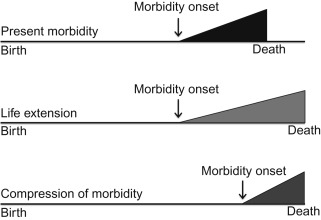
3 factors of disability
lack of exerise, smoking, obesity
Reversal of compression may be caused by
Increase rate of obesity
Chronic diseases (e.g. diabetes)
Increases function impairment
Low exercise among cohort
3 Issues in life course research
age/period/cohort problem
Life-course fallacy
Comparing younger people to older people, and assume the younger people will eventually become exactly like the older people.
Social determinants of health
Definition: Non-medical factors that influence health outcomes. A system that shapes the conditions of one’s daily life.
5 social determinants of health (SDoH)
-Neighborhood and built environment
-Health and health care
-Social and community context
-Education
-Economic stability

Neighborhood and built environment
Access to healthy foods
Crime/violence (more stressors = negative health outcomes)
Environment (growing up near the freeway can make you shorter)
Housing (lead paint, mold, bugs)
Health and Health Care
Access to health care
Health literacy/management
Communication with doctors (conversing with doctors in the same lanaguage)
Social and Community context
Social support
Discrimination
Social cohesion
A lack of social support & high discrimination can negatively impact health.
Besides family, most older adults do not have a social circle. Harder to make friends.
Education
Acess/ Quality: Depends on where you live and how accessible it is to certain people
Ex: California has a more accessible system for higher education
Barriers to Learning: Ability to get to school/ school breakfast program
Economic Stability
Poverty: hard to get out of, high stress
Steady Employment: low cortisol level
Barriers to work: lack of accomodation for disability, transportation, childcare.
How can education affect health?
Edu → health knowledge → income → status
-> smoking, diet, exercise, housing, coping, behavior, resources
Upstream vs Downstream
Upstream: the most impacted intervene
Downstream: last-minute resolution. Not as impactful
Socioeconomic Gradient
Social Economic Status (SES)
Higher SES = Better Health
Persisting Disparities
Health differences between groups of people based on: race wealth gap, discrimination housing
Most effective interventions for supporting older adults
Educational
Employment/volunteer opportunities
Benefits/retirement policies
Neighborhood conditions
Swarbrick’s 8 Dimensions of Wellness
1) Physical
exercise, nutrition, sleep, organ health
2) Emotional
negative emotions (fear, anger, worry, etc)
changes in appetite, trouble making decision, worsen chronic diseases
3) Environmental
Community that promote health, transportation, walkable
Access to fresh food
Volunteer opportunity
4) Financial
Awareness of personal financial situation
Minimize financial challenges
Comfortable with sources of money
5) Intellectual
Open mind to new ideas/ experiences
Accumulated skills/ knowledge
Improving cognition: multi tasking can improve cognitive abilities to be 30 years younger
6) Occupational
Fulfillment from job, schools, volunteering
Belief of they’re making a positive impact to the world
7) Social
Connect with others
Make + maintain positive relationships
Combats: impaired mental performance & lower risk of illnesses and depression
8) Spiritual
Living with purpose
Lived by personal values
Connected to the world
Awareness if self + community + environment
5 theories of aging
1) Wear and Tear
2) Antagonistic Pleiotropy
3) Immunological Theory
4) Free Radical/ Oxidative
5) Cellular Senescence Theory
Antagonistic pleiotropy
A single gene/ process can have several different effect with an organism
Positive effect during youth
Negative effect during old age
Replicative senescence
Growth arrest of cells
Stop dividing, don’t die, causing all sorts of malfunction issues
Leads to characteristic changes:
Resistance to apoptosis, altered gene expression, increased secretions, dysfunction
Hayflick limit
The maximum number of times a cell can divide before dying. 40-60 replications.
Lung cells could only divide 50
Cells that reach their growth limit undergo Replicative Senescene
Telomerase
Definition: repetitive DNA sequences (TTAGGG) that exist at the end of chromosomes
Telomere Shortening causes Replicative Senescence
Telomeres are important for DNA Replication
Free
Cells in connective tissue that produces collagen and other fibers. Cells w senescent markers increase in frequency in samples from elderly donors. Rate of wound healing decreases with age.
Public health and policy
The art and science of protecting and improving the health of the entire community, rather than one-on-one.
Interventions to improve the public’s health
Organized effort of community
Cellular aging can interfere w proper organ function
vasculature- atherosclerosis
lymphocytes- immuno deficiency
Cancer's greatest risk factor
age
Why cancer is related to aging
-6-7 mutations have to accumulate before becoming a tumor
-accumulation of senescent fibroblasts make a favorable environment
-decline in immuno surveilance
Four major cancers in older people
Lung, prostate, breast, colorectal
Non-modifiable risk factors of breast cancer
age, race, sex, family history & genetics, early menarche and late menopause
Modifiable risk factors of breast cancer
older at first pregnancy, nulliparity (never had a baby)
Demographic transition
changes in a population's age structure from "young" to "middle age" to "old"
Demography
study of the characteristics of human populations such as size, growth , density, distribution adn vital statistics
Demographic transitions based on 3 shifts in population
-fertility
-mortality
-migration
Replacement rate
2.1
fertility
average number of children born to a woman over her lifetime
fertility rate
# live births in a year/ # of (15-44 yo) women in the year
Mortality rate
deaths in a population. # deaths in a year/ # ppl in same year
Leading causes of death
overall: heart disease
Depends per group
Migration
establish criteria/boundaries of region. Higher immigration of certain groups add to the changing age structure/pyramid of the US
Stages of demographic transition
1.High fertility rates/ high death rates
2.High fertility rates/ declining death
3. low fertility/low death
Changes that create an aging society
- societal level: better food supply, clean water, sanitation
- public health interventions
Epidemiological transition
changes in a population's age structure due to disease patterns. mortalities, and other factors.
from infectious disease to chronic illnesses