physics reflection, refraction and diffraction
 Call Kai
 Learn
Learn Practice Test
 Spaced Repetition
 Match
Match Flashcards
 Knowt Play
1/29

There's no tags or description
Looks like no tags are added yet.
Name | Mastery | Learn | Test | Matching | Spaced | Call with Kai | Chat |
|---|
No analytics yet
Send a link to your students to track their progress
30 Terms
Reflection
Reflection is the bouncing of a wave off a surface. The wave changes direction but remains in the same medium. Reflection occurs with all types of waves, including light, sound, and water waves.
What is the Law of Reflection?
The angle of incidence equals the angle of reflection.
θi=θr
Both angles are measured from the normal (an imaginary line at 90° to the surface), not from the surface itself
What happens to wavelength and frequency during reflection?
Neither changes. The wave simply changes direction. Since the wave remains in the same medium, its speed, wavelength, and frequency stay the same.
What is an echo?
An echo is a reflected sound wave that returns to the listener after the original sound. The delay occurs because the sound must travel to an object and then back again.
Why do bats use reflection?
Bats use echolocation. They send out high-frequency sound waves and listen for the reflected waves (echoes). This allows them to determine the location, size, and distance of objects.
What is refraction?
Refraction is the bending of a wave when it enters a new medium where its speed is different. The change in speed causes the wave to change direction.
Why does refraction occur?
Refraction occurs because waves travel at different speeds in different media. When part of a wave changes speed before the rest of the wave, the wave bends.
What happens when a wave moves from a fast medium to a slow medium?
The wave:
Slows down
Decreases in wavelength
Keeps the same frequency
Bends towards the normal
Memory trick:
"Fast to slow, to the normal we go."
What happens when a wave moves from a slow medium to a fast medium?
The wave:
Speeds up
Increases in wavelength
Keeps the same frequency
Bends away from the normal
Why does the frequency stay constant during refraction?
The frequency is determined by the source producing the wave. Entering a new medium changes the speed and wavelength, but it does not change how frequently the source generates waves.
Which wave properties change during refraction?
Changes:
Speed ✅
Wavelength ✅
Does not change:
Frequency ❌
What happens to wavelength when a wave slows down?
The wavelength decreases.
Since:
v=fλ
and frequency remains constant, a decrease in speed must cause a decrease in wavelength.
What is Total Internal Reflection?
Total Internal Reflection (TIR) occurs when all of a wave is reflected back into a medium and none of it is refracted out of the medium.
What two conditions are required for Total Internal Reflection?
The wave must travel from a slow medium to a fast medium.
The angle of incidence must be greater than the critical angle.
If either condition is missing, TIR cannot occur.
What is the critical angle?
The critical angle is the angle of incidence that produces a refracted angle of exactly 90°.
At this point the refracted ray travels along the boundary between the two media.
What happens when the incident angle is smaller than the critical angle?
Part of the wave is reflected and part is refracted.
Both reflection and refraction occur.
What happens when the incident angle is larger than the critical angle?
No refraction occurs.
All of the wave is reflected back into the original medium.
This is Total Internal Reflection.
Why are optical fibres able to transmit light over long distances?
The light repeatedly undergoes Total Internal Reflection inside the fibre, preventing it from escaping and allowing information to travel long distances.
What is diffraction?
Diffraction is the bending of waves around obstacles and the spreading out of waves after passing through a gap or opening.
When is diffraction most significant?
Diffraction is greatest when the wavelength is similar in size to the gap or obstacle.
Gap size≈Wavelength
How does wavelength affect diffraction?
Longer wavelengths diffract more easily than shorter wavelengths.
This is why sound waves diffract much more than light waves.
How does gap size affect diffraction?
The smaller the gap, the greater the diffraction.
A narrow opening causes the waves to spread out more after passing through it.
Why can you hear someone through a doorway but not see them?
Sound waves have long wavelengths and therefore diffract significantly around the doorway.
Light has extremely short wavelengths and undergoes very little diffraction, so it travels mostly in straight lines.
Why can distant thunder sound like a low rumble?
Low-frequency sound has a longer wavelength.
Long wavelengths diffract around buildings, trees, and other obstacles more effectively, allowing them to travel greater distances.
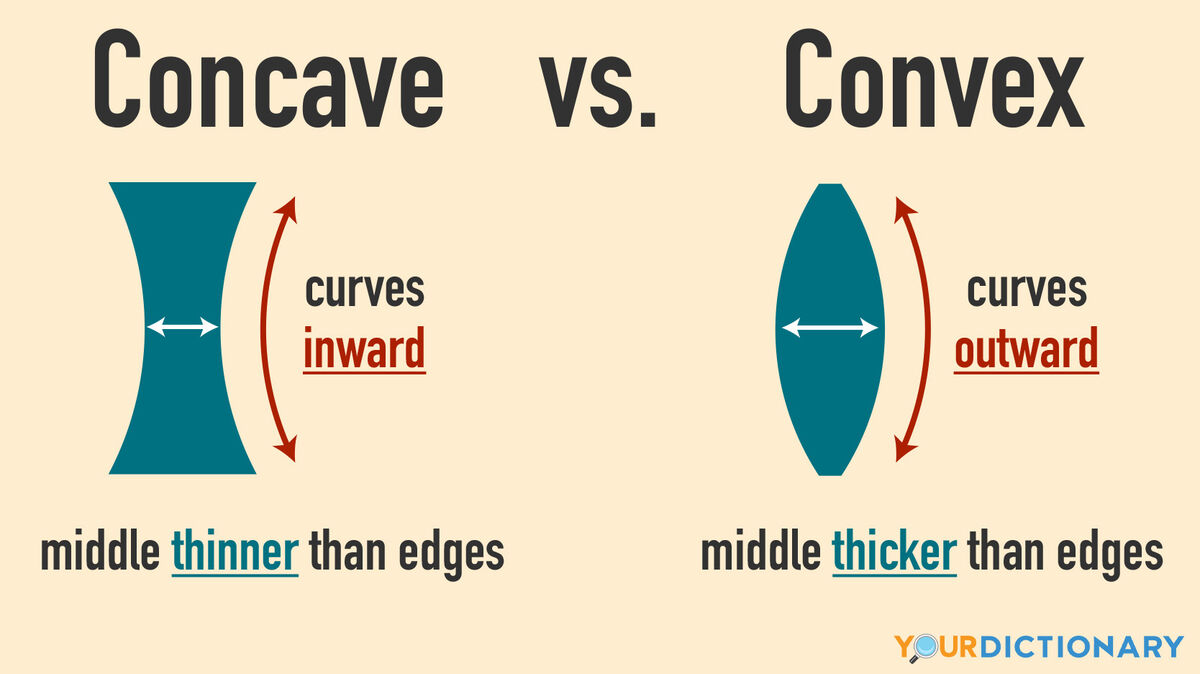
Concave vs Convex
Reflection from Flat Barrier Mirror
Incident wave reflects off the surface.
Angle of incidence = angle of reflection.
Reflected wavefronts remain parallel.
Rays stay parallel after reflection.
No focusing or spreading of waves occurs.
Remember:
Flat barrier → straight waves stay straight
Concave Mirror Reflection
Curves inward like the inside of a bowl.
Parallel incident waves reflect towards a focal point.
Reflected rays move closer together.
Waves become converging waves.
Produces a concentrated beam at the focus.
Used when focusing light or sound is required. [2 - reflec...fract 2025 | PowerPoint]
Key Word:
✅ Converging
Remember:
Concave = Converge
Convex Mirror Reflection
Curves outward like the outside of a bowl.
Parallel incident waves reflect and spread apart.
Reflected rays move further apart.
Waves become diverging waves.
Produces a wider field of view. [2 - reflec...fract 2025 | PowerPoint]
Key Word:
✅ Diverging
Remember:
Convex = Diverge
Convex Lens Refraction
Thicker in the middle.
Bends light towards a focal point.
Converges light rays.
Also called a converging lens.
Memory:
Convex Lens = Converging Lens
Concave Lens Refraction
Uses refraction, not reflection.
Thinner in the middle.
Spreads light rays apart.
Diverges light rays.
Also called a diverging lens.
Memory:
Concave Lens = Diverging Lens