Bacteria, Viruses, Prions
 Call Kai
 Learn
 Practice Test
 Spaced Repetition
 Match
 Flashcards
 Knowt Play
1/152

There's no tags or description
Looks like no tags are added yet.
153 Terms
Are bacteria cellular or noncellular organisms?
Cellular; each bacterium is a prokaryotic cell.
List the five major characteristics of bacteria.
Prokaryotic
reproduce with binary fission
peptidoglycan walls
circular DNA
highly diverse metabolism.
What distinguishes a prokaryotic bacterium from a eukaryotic cell?
It lacks a nucleus.

What is binary fission?
A bacterial cell divides to produce two identical daughter cells.

How is the main bacterial chromosome usually organized?
As one circular DNA molecule.

What is a plasmid?
A small, circular DNA molecule

How can bacteria acquire genetic variation despite binary fission?
Exchange plasmids, acquire new DNA, or mutations
What can extra DNA in plasmids give bacteria?
Additional traits
Why are plasmids useful in genetic engineering?
They can carry and transfer selected genes.
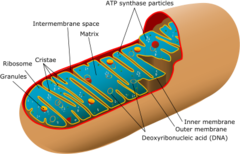
Which human organelle has its own circular DNA?
Mitochondria
Where do bacteria occur?
Everywhere
What does high metabolic diversity mean for bacteria?
They can obtain energy and nutrients in various ways
What two major groups are distinguished by Gram staining?
Gram-positive and Gram-negative bacteria.
Gram (p)ositive = (p)urple
Gram-positive = thick peptidoglycan

Which color indicates Gram-positive cells after Gram staining?
Purple or violet.

Which color indicates Gram-negative cells after Gram staining?
Pink or red.

What features can be used to classify bacteria besides Gram staining?
Habitat and cell shape.
A sample has purple cocci and pink rods. Which are Gram-positive?
The purple cocci.
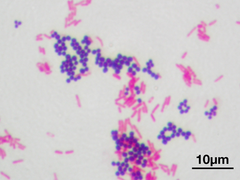
What are the three common bacterial cell shapes?
Coccus (round), bacillus (rod), and spiral.

What is a coccus?
A round or spherical bacterium.
c(o)ccus - o looks like a ball

What is a bacillus?
A rod-shaped bacterium.
The two l's in the name look like rods

What shape is a spiral bacterium?
Curved or corkscrew-like.

What does the prefix strepto- describe?
Cells arranged in chains.

What does the prefix staphylo- describe?
Cells arranged in clusters.

Approximately what fraction of human illness is attributed to bacteria?
About 50%!
How do many pathogenic bacteria cause illness?
By producing toxins
What is an endotoxin?
A toxin in bacterial cells outer structures.
What is an exotoxin?
A toxin secreted by bacterial cells.
Botulinum or Tetanus
What is the key difference between exotoxins and endotoxins?
Exotoxins are secreted; endotoxins are cell-associated components.
Which bacterium produces botulinum toxin?
Clostridium botulinum.
What illness is associated with Clostridium botulinum toxin?
Botulism, or food poisoning.
How many people could 1 gram of botulinum exotoxin potentially kill?
1 million.
Under ideal conditions, how often can a bacterium divide?
About every 20 minutes.
How many doublings occur in 10 hours at one doubling per 20 minutes?
30 doublings.
Starting with one bacterium, how many cells result after 30 doublings?
2^30 = 1,073,741,824 (over 1 billion).
What kind of toxin is Botox?
A neurotoxin derived from botulinum toxin.
What does botulinum toxin act on: muscle fibers or nerve signaling?
Nerve signaling, particularly at neuromuscular junctions.

How does Botox reduce muscle contraction?
It blocks release of acetylcholine from nerve endings

Why can Botox temporarily reduce wrinkles?
It inactivates the chain of neurons that allow the muscles (which induce wrinkling) to fire
Which part of a neuron releases neurotransmitters into the synaptic cleft?
The axon terminal via synaptic vesicles.

What is a bacterial endospore?
A dormant and resistant structure in some bacteria containing a DNA copy and organelles surrounded by protective layers.

Why do bacteria form endospores?
To survive harsh environmental conditions.
How long can some bacterial endospores persist?
For centuries.
What is peptidoglycan?
A bacterial cell-wall material made of sugar chains and short peptides.

Which cellular structure contains peptidoglycan?
The bacterial cell wall.

Do plant or animal cells have peptidoglycan walls?
No.
How does penicillin affect bacteria?
It stop peptidoglycan cell-wall synthesis.
What is the major wall difference between Gram-positive and Gram-negative bacteria?
Gram-positive: thick peptidoglycan; Gram-negative: thinner peptidoglycan plus an outer membrane.

Why can antibiotics target peptidoglycan without targeting animal cell walls?
Animal cells lack peptidoglycan.
What does MRSA resist?
Methicillin
What type of pathogen causes Lyme disease?
A spirochete bacterium.
What is the primary bacterial species responsible for Lyme disease?
Borrelia burgdorferi.
Who is associated with identifying the Lyme disease bacterium?
Willy Burgdorfer - OSU!
What class of medicines treats Lyme disease?
Antibiotics
Where are Lyme disease cases especially concentrated in the United States?
The Northeast and Upper Midwest.
Which tick species commonly transmits Lyme disease?
The black-legged tick

What is a characteristic early skin sign of Lyme disease?
An expanding bull's-eye rash (erythema migrans).

In Lyme disease transmission, what is the vector?
An infected black-legged tick.

Are viruses made of cells?
No; they are noncellular infectious agents.
Do viruses belong to any biological domain or kingdom?
No.
Why is the question of whether viruses are alive debated?
They are infectious and contain genetic material but cannot reproduce independently.
Can viruses infect bacteria?
Yes; bacteriophages infect bacteria.
What are the two essential components of a virus?
A DNA/RNA genome and a protein coat (capsid)

Can a virus contain either DNA or RNA as its genetic core?
Yes; viral genomes may be DNA or RNA.
What is a viral capsid?
The protective protein coat around the viral genetic material.

Are smallpox and cowpox DNA or RNA viruses?
DNA viruses (poxviruses).
Are herpes and chickenpox DNA or RNA virus diseases?
DNA viruses (herpesviruses).
What organ is affected by hepatitis B?
The liver.
Which RNA virus group includes rubella and chikungunya?
Togaviruses.
What is another name for rubella?
German measles.
Which RNA virus family includes Ebola and Marburg?
Filoviruses.
What serious syndrome is associated with Ebola and Marburg?
Hemorrhagic fever.
Bleed from mucous membranes - eyes, mouth etc
Is HIV a DNA virus or an RNA virus?
An RNA retrovirus.
Why must viruses infect living cells to reproduce?
They lack the machinery needed to make new viruses on their own.
Who makes the components of new viruses?
The infected host cell.
What happens during viral attachment (step 1)?
The virus binds to a receptor on a host cell.
What must happen before a virus can infect a particular host cell?
Its attachment structures must recognize and bind that cell.

If a virus cannot attach to a host cell, will infection proceed?
No.
Which HIV surface protein attaches to host receptors?
gp120

What host-cell receptor does HIV gp120 recognize?
CD4.
White blood cells only!

Which immune cells are major HIV targets?
White blood cells containing CD4!
What is reverse transcriptase packaged within HIV used for?
Converting viral RNA into DNA.
What is a bacteriophage?
A virus that infects bacteria.
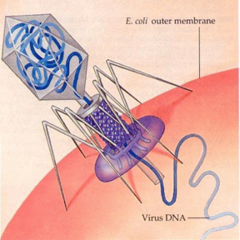
Which bacteriophage structure helps it attach to a bacterial surface?
Tail fibers.

Where is a bacteriophage's DNA housed?
In its head/capsid.

Which body tissue is commonly infected by wart-causing viruses?
Skin.
Which body cells can harbor latent herpes infection?
Nerve cells.
Which tissue is primarily infected by influenza virus?
Respiratory tissue, especially in the lungs.
Why can herpes infection remain in the body permanently?
The virus can establish latency in nerve cells.
Does every viral infection necessarily persist for life?
No; some are cleared, while others become latent or persistent.
What makes hidden herpes virus difficult for immune defenses to eliminate?
It persists in nerve cells in a latent state.
What happens during viral penetration (step 2)?
The viral genetic material enters the host cell.
What genetic material enters the host cell during HIV infection?
Viral RNA.
What happens during DNA formation (step 3) in the HIV cycle?
HIV RNA is copied into DNA using reverse transcriptase!!!
What enzyme converts HIV RNA to DNA?
Reverse transcriptase.
Why do DNA viruses not need RNA-to-DNA reverse transcription at step 3?
Their genome is already DNA.
What happens during viral DNA incorporation (step 4)?
Viral DNA becomes integrated into host-cell DNA.
What happens during component construction (step 5)?
The host cell makes the parts needed to form new viruses.
Does a host cell necessarily die immediately when viral DNA integrates?
No; an infected cell may remain alive.
What occurs during assembly and release (step 6)?
Viral parts assemble and new viruses leave the host cell.
What is viral budding?
Release of viruses through the host cell membrane.
