periotic Table

0.0(0)
Studied by 1 person
call kaiCall Kai
learnLearn
examPractice Test
spaced repetitionSpaced Repetition
heart puzzleMatch
flashcardsFlashcards
GameKnowt Play
Card Sorting

1/29

encourage image

There's no tags or description

Looks like no tags are added yet.

Last updated 11:55 AM on 10/19/26
Name
Mastery
Learn
Test
Matching
Spaced
Call with Kai
Chat

No analytics yet

Send a link to your students to track their progress

30 Terms

1
New cards

Periods

7 Horizontal rows across the periodic table


<p>7 Horizontal rows across the periodic table</p><p></p><p></p>
2
New cards

Family/Group

18 vertical columns on the periodic table

<p>18 vertical columns on the periodic table </p>
3
New cards

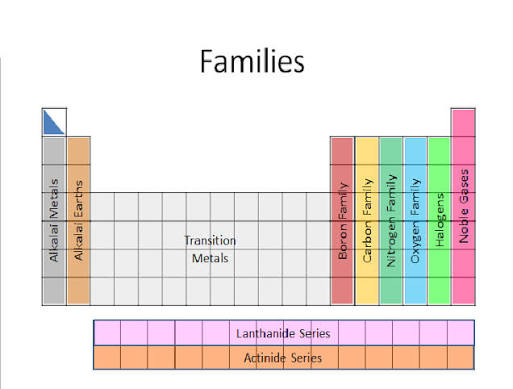
Family 1

Alkali Metals

  • 6 metal elements

  • 1 valence electron

  • Soft, Luster, Low melting point


<p>Alkali Metals</p><ul><li><p>6 metal elements</p></li><li><p>1 valence electron</p></li><li><p>Soft, Luster, Low melting point</p></li></ul><p></p>
4
New cards

Family 2

Alkaline Earth Metals

  • 6 metal elements

  • 2 valance electrons

  • Tarnish quickly, harder, high melting point

<p>Alkaline Earth Metals</p><ul><li><p>6 metal elements</p></li><li><p>2 valance electrons</p></li><li><p>Tarnish quickly, harder, high melting point</p></li></ul><p></p>
5
New cards

Family 17

Halogens

  • 6 nonmetal elements

  • Seven valance electrons

  • High reactivity


<p>Halogens</p><ul><li><p>6 nonmetal elements</p></li><li><p>Seven valance electrons</p></li><li><p>High reactivity</p></li></ul><p></p>
6
New cards

Family 18

Noble Gases

  • 7 non metal elements

  • Helium has 2 valance electrons but the rest are stable

  • Low reactivity


<p>Noble Gases</p><ul><li><p>7 non metal elements</p></li><li><p>Helium has 2 valance electrons but the rest are stable</p></li><li><p>Low reactivity</p></li></ul><p></p>
7
New cards

What charge is a proton

Positive ➕

8
New cards

What charge is a netron

No charge 0

Atomic number - protons= nutrons

9
New cards

What charge is an electron

Negative charge ➖

Protons = Electrons

10
New cards

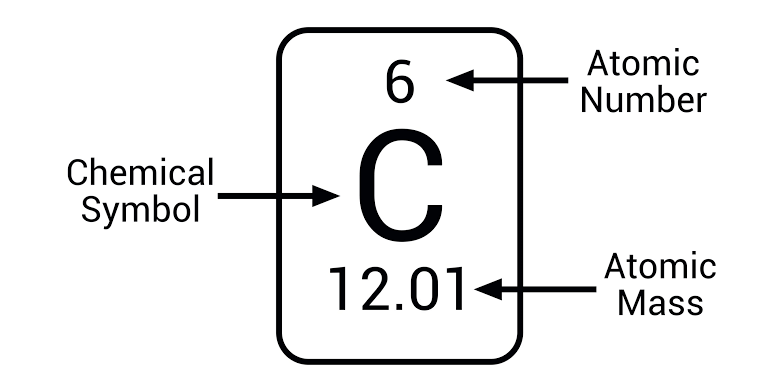
Whats Atomic Number

Is the total number of protons in the nucleus

Atomic Number= Protons = Electrons
<p>Is the total number of protons in the nucleus</p><p>Atomic Number= Protons = Electrons </p>
11
New cards

What is Atomic Mass

Total mass of an atom adveradge of protons and neutrons

Atomic Mass = Protons + Nutrons

<p>Total mass of an atom adveradge of protons and neutrons</p><p>Atomic Mass = Protons + Nutrons</p>
12
New cards

Metal

left side and centre of table

  • shiny

  • Solid at room temperature

  • Malluable & ductile ( hammer or drawn to wires)


<p>left side and centre of table</p><ul><li><p>shiny</p></li><li><p>Solid at room temperature</p></li><li><p>Malluable &amp; ductile ( hammer or drawn to wires)</p></li></ul><p></p>
13
New cards

Metalics or Metolloids

Make the staircase

  • Dull

  • Solid at room temperature

  • Brittle


<p>Make the staircase</p><ul><li><p>Dull</p></li><li><p>Solid at room temperature</p></li><li><p>Brittle</p></li></ul><p></p>
14
New cards

Non - metals

Make the far right of the table

  • Dull

  • Solid Gass or Liquid

  • Brittle


<p>Make the far right of the table</p><ul><li><p>Dull</p></li><li><p>Solid Gass or Liquid</p></li><li><p>Brittle</p></li></ul><p></p>
15
New cards

What is a Bohr Rutherford Diagram

Show number and location of protons nutrons and electrons in an atom ( Photosphorus)

<p>Show number and location of protons nutrons and electrons in an atom ( Photosphorus)</p>
16
New cards

Orbits

Each orbit represents energy levels and whatever period it is in is the amount if orbits

<p>Each orbit represents energy levels and whatever period it is in is the amount if orbits </p>
17
New cards
<p>What is Stability? How to make this stable </p>

What is Stability? How to make this stable

When the outer shell is full (remove one from the photo)

<p>When the outer shell is full (remove one from the photo) </p>
18
New cards

What are 2 types of Ions

Cation and Anion

<p>Cation and Anion</p>
19
New cards

Cation

If an atom LOSES an electron or becomes POSITIVE

<p>If an atom LOSES an electron or becomes POSITIVE </p>
20
New cards

Anion

An atom GAINS an electron and becomes NEGATIVE

<p>An atom GAINS an electron and becomes NEGATIVE</p>
21
New cards
<p>Valance Electrons ( how many valence electrons) </p>

Valance Electrons ( how many valence electrons)

The amount of electrons in the outer shell and determines the family or group( 1 valance electron )

<p>The amount of electrons in the outer shell and determines the family or group( 1 valance electron ) </p>
22
New cards

Isotope

An atom with a same number as protons but different netrons

<p>An atom with a same number as protons but different netrons </p>
23
New cards

Ion

Different number of protons and electrons

<p>Different number of protons and electrons</p>
24
New cards

Who created the first periodic table?

Dmitri Mendeleev created the first periodic table The elements shared a natural orderly relationship based on weights and properties

<p>Dmitri Mendeleev created the first periodic table The elements shared a natural orderly relationship based on weights and properties</p>
25
New cards

Aristle

Earth Water Fire Air

<p>Earth Water Fire Air</p>
26
New cards

John Dalton

Billiard Ball

<p>Billiard Ball</p>
27
New cards

JJ thomas

Negotive and positive charges puding model

<p>Negotive and positive charges puding model</p>
28
New cards

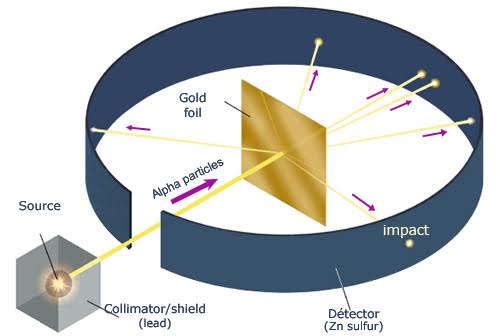
Ernest

Gold foil Experiment

<p>Gold foil Experiment</p>
29
New cards

James

Planetray model

<p>Planetray model</p>
30
New cards

Neils Bhor

Bhor Rutherford Diagram

<p>Bhor Rutherford Diagram</p>