55020 Meters
 Call Kai
 Learn
 Practice Test
 Spaced Repetition
 Match
 Flashcards
 Knowt Play
1/18

There's no tags or description
Looks like no tags are added yet.
19 Terms
What are the 3 important meter specifications?
Accuracy, sensitivity, and input resistance.
What is input resistance?
The resistance inside the meter between its two probes. It determines how much the meter affects the circuit being measured.
Measurement error formula
Measured voltage × accuracy percentage (as a decimal).
If a meter has 1% accuracy and measures 600V, what is the possible error?
±6V
As voltage increases, possible measurement error _________.
Increases
How is voltmeter sensitivity expressed?
Ohms per volt (Ω/V).
1 ÷ full-scale current.
Ideal input resistance of a Voltmeter:
Very HIGH resistance, to draw very little current and avoid disturbing the circuit.
Ideal input resistance of an Ammeter
Very LOW resistance, so it doesn't add significant resistance and reduce circuit current.
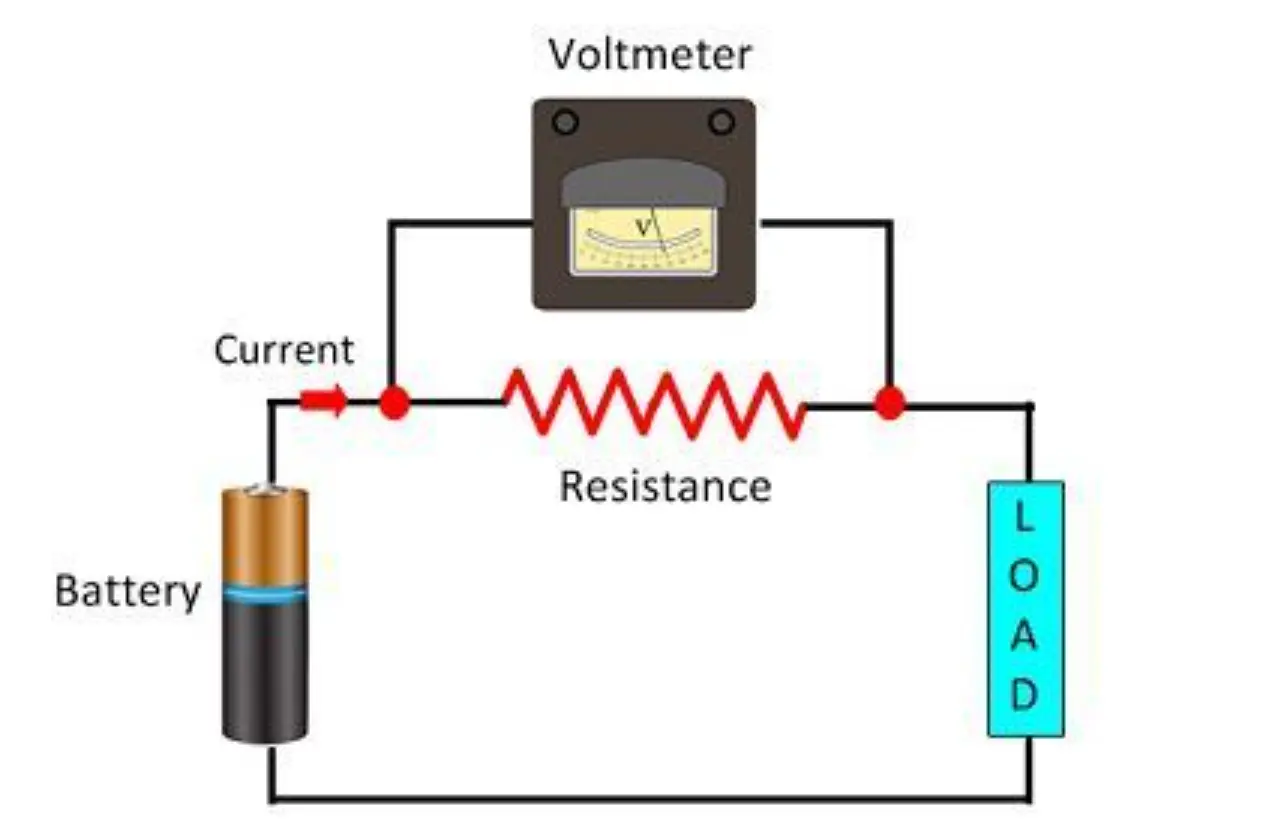
Voltmeter
Connected in PARALLEL.
Red probe toward positive.
Black probe toward negative.
Needs HIGH internal resistance.

Ammeter (Current)
Connected in SERIES.
Red probe toward positive.
Black probe toward negative.
Needs LOW internal resistance.

Ohmmeter (resistance)
Measures resistance using current supplied by the meter.
Circuit power must be OFF.
Avoid touching both probes while measuring.
What is the biggest cause of error when measuring resistance?
An unwanted parallel path for current.
What is a Wheatstone bridge used for?
Measuring unknown resistance with high accuracy.
Continuity
A continuous electrical connection from one point to another. Continuity tester beeps when detected
Circuit loading
When connecting a meter changes the original circuit's behavior. The meter adds resistance and draws or restricts current.
Vvoltmeter loading
The voltmeter's resistance is not high enough compared with the circuit resistance. Use a meter with much higher internal resistance than the circuit to prevent this.
How much higher should voltmeter resistance ideally be according to the packet?
About 20 times the circuit resistance.
What are the four main switches/adjustments of a typical meter?
Function, range, ohms adjust, and zero adjust.
Formulas
1. Ohm's Law
I=VRI=RV
Current = Voltage ÷ Resistance
2. Voltage
V=I×RV=I×R
3. Resistance
R=VIR=IV
4. Parallel Resistance (two resistors)
RT=R1R2R1+R2RT=R1+R2R1R2
5. Measurement Error
Error=V×AccuracyError=V×Accuracy
6. Meter Sensitivity
Sensitivity=1Full Scale CurrentSensitivity=Full Scale Current1
Prefix | Meaning |
|---|---|
m (milli) | 0.001 |
µ (micro) | 0.000001 |
k (kilo) | 1,000 |
M (mega) | 1,000,000 |