UNIT 19. PARTIALLY ACID FAST & NON-ACID FAST, GRAM (+) BACILLI
 Call Kai
 Learn
 Practice Test
 Spaced Repetition
 Match
 Flashcards
 Knowt Play
1/34

There's no tags or description
Looks like no tags are added yet.
35 Terms
Nocardia
partial acid fastness
Gram (+) bacilli
long, thin, beaded, branching rods
Occasionally fragments into rod-shaped and short coccoid forms during aging
Nocardia
Catalase (+)
Strictly aerobic
Main habitat: soil and water
Grows on selective media but may take a week or more
Also grow on media used to recover fungi
peptidoglycan
mesodiaminopimelic acid (DAP)
sugars: arabinose & galactose
ENUMERATE
Cell wall components of Nocardia
Actinomyces
Nocardia stains positively with a modified acid-fast (Ziehl-Neelsen or Kinyoun) stain, differentiating them from ____, which may have a similar Gram-stain appearance
growing the organism for about 4 days on Middlebrook 7H10 agar, or in litmus milk broth
Partial acid fastness of Nocardia can be enhanced by ?
Nocardia
dry, chalky-white to orange-tan pigment colonies ("breadcrumbs-looking”)
can be waxy, bumpy or velvety rugose forms with yellow orange pigments in 5-20 days

paraffin
Nocardia Utilize __ as a source of carbon and energy
Nocardia asteroides complex
Nocardia cyriageorgica
Nocardia farcinica
Nocardia nova
Nocardia brasiliensis
Nocardia otitidiscaviarum
NOCARDIOSIS: Most clinical infections have been caused by members of ?
Resistant to lysozyme (-)
Urease (+)
Differential tests of Nocardia
cell wall analysis
Gas-liquid chromatography is used for __ of Nocardia
Nocardia
Gram-positive aerobic, catalase (+), branching, filamentous bacteria that can fragment into rods and coccі
Can be isolated from soil, fresh and marine water, and organic matter
Primarily acquired by inhalation
Can grow on most nonselective media for bacterial mycobacterial and fungi isolation
Infections: skin infections, pneumonia, catheter-associated sepsis
Gordonia spp.
Gram (+) to gram (V)
partially acid fast
nonmotile
catalase (+)
Considered "nocardioforms"
Gordonia spp.
smooth, slimy colonies. and glossy to irregular edges
Mucoid colonies that are adherent to the media to dry, raised colonies; absence of mycelia

Susceptible to lysozyme (+)
Differential test of Gordonia
Tsukamurella spp.
Gram (+)
long rods; fragments to 3 parts
no aerial hyphae
catalase (+)
Kinyoun staining
Tsukamurella is Slightly acid fast as by __ method
Tsukamurella spp.
circular colonics with rhizoid edges and white or orange pigment
Kuthria
Gram (+) rods
Non AFB
obligate aerobe
motile
(+) catalase
(-) gelatinase and oxidase
Kuthria
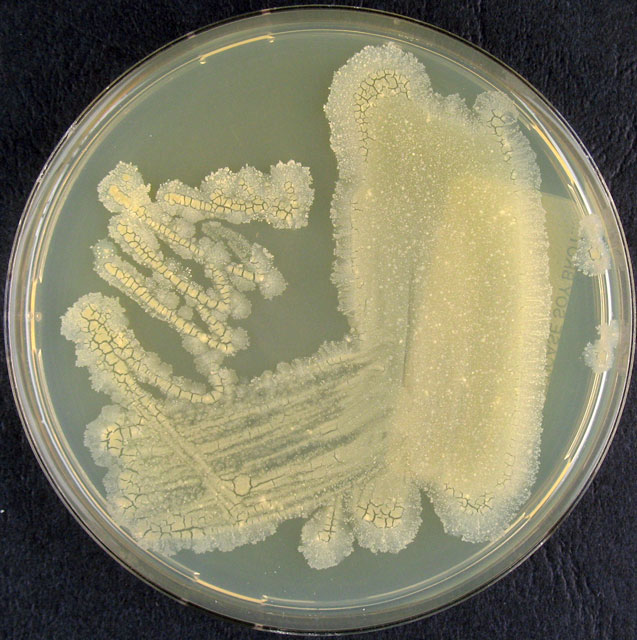
large "medusa head" colonies
Rhodococcus equi
Partially acid fast
has mycolic acid with longer carbon chains
Found in soil and causes respiratory tract infections in animals
Can be acquired via respiratory route; exposure to infected animals
Rhodococcus equi
Can infect HIV patients → causing slowly progressive granulomatous pneumonia
Can persist and replicate within macrophages-facultative intracellular organism
Can be isolated from the blood of infected individuals
Rhodococcus equi
Microscopy: cocobacilli in "zigzag" pattern; appear as diphtheroids Gřam-positive rods
Culture: BAP → pale pink or yellow, "coral-like and slimy” colonies
Resembles Klebsiella with salmon-pink colonies at RT
susceptible to lysozyme (+)
Rhodococcus equi differential test
Streptomyces
Actinomadura
Dermatophilus
Nocardiopsis
Thermophilic Actinomycetes
[SAD NaTo :((]
ENUMERATE
NON-ACID-FAST AEROВIC ACTINOMYCETES
Gram (+)
DO NOT contain mycolic acids
NON-ACID-FAST AEROВIC ACTINOMYCETES are Gram ___ branching filaments; ___ mycolic acids
actinomycetoma
hypersensitivity pneumonitis
NON-ACID-FAST AEROВIC ACTINOMYCETES caused
Thermoactinomycetes
Saccharomonospora
Saccharopolyspora
ENUMERATE
Thermophilic actinomycetes:
Actinomadura spp.
Causes wound infection for persons walking barefooted especially in tropical countries
Microscopic and colony morphology are very similar to Nocardia spp.
mycetomas
Actinomadura causes wound infection for persons walking barefooted especially in tropical countries called ___
Actinomadura spp.
waxy, cerebriform colored colonies
Routine agar → "molar tooth" appearance
A. madurae
A. pelletieri
ENUMERATE
Actinomadura species
Tropheryma whippelii
Gram (+) actinomycete
facultative intracellular pathogen
Has been isolated from feces, saliva, and secretions
Has been cultivated in stable cell lines and has been adapted to an axenic culture media supplemented with essential amino acids
Tropheryma whippelii
The etiologic agent of Whipple's disease
Streptomyces
Found in soil, primarily saprophytes
dry to chalky heaped colonies, gray-white colonies and have "must basement" odor;
hyphae are characterized by variable pigmentation
Some species do not produce aerial hyphae
S. somaliensis - human pathogen
ENUMERATE
Streptomyces species