BCH 100 MIDTERM 2
 Call Kai
 Learn
 Practice Test
 Spaced Repetition
 Match
 Flashcards
 Knowt Play
1/186

There's no tags or description
Looks like no tags are added yet.
187 Terms
What enzymes are responsible for digesting proteins?
Proteases (peptidases), such as pepsin, trypsin, and chymotrypsin, hydrolyze peptide bonds to break proteins into smaller peptides and amino acids.
What enzyme is responsible for digesting polysaccharides?
Amylase hydrolyzes α-1,4 glycosidic bonds in starch and glycogen, producing smaller carbohydrates.
What enzymes are responsible for digesting lipids?
Lipases hydrolyze ester bonds in triglycerides, producing free fatty acids and monoacylglycerols.
What happens during ATP hydrolysis?
Water breaks ATP's terminal phosphoanhydride bond, producing ADP + Pi and releasing free energy: ATP + H₂O → ADP + Pi.
What four factors contribute to ATP's high phosphoryl-transfer potential?
1. Relief of electrostatic repulsion between negatively charged phosphates.
2. Resonance stabilization of products.
3. Greater hydration (solvation) of products.
4. Increased entropy from forming more particles.
Why are digestive enzymes synthesized as inactive zymogens?
To prevent enzymes from digesting the cells and tissues that produce them. Zymogens are activated only when they reach the appropriate location.
What are the three fates of pyruvate?
1. Converted to acetyl-CoA for the citric acid cycle (aerobic conditions).
2. Converted to lactate through lactic acid fermentation.
3. Converted to ethanol and CO₂ through alcoholic fermentation (yeast).
What is the structural difference between alanine and pyruvate?
Alanine contains an amino group (–NH₃⁺), while pyruvate contains a keto group (C=O). They can be interconverted through transamination.

What step of glycolysis is this?
Step 1
What happens in step 1 of glycolysis?
What enzyme catalyzes step 1 of glycolysis?
How much ATP is used in step 1 of glycolysis?
Glucose is phosphorylated to form glucose-6-phosphate (G6P).
Hexokinase.
1 ATP is consumed and converted to ADP.
Is step 1 of glycolysis reversible or irreversible?
Irreversible under cellular conditions.
What is step 2 of Glycolysis?
What is its enzyme?
Isomerization of glucose-6-P to fructose-6-P
phosphoglucose isomerase.
What happens in step 3 of glycolysis?
What enzyme catalyzes step 3, and how much ATP is used?
Fructose-6-phosphate (F6P) is phosphorylated to form fructose-1,6-bisphosphate (F1,6BP).
Phosphofructokinase-1 (PFK-1) catalyzes the reaction, consuming 1 ATP and producing ADP.
Is step 3 reversible or irreversible, and why is it important?
Irreversible. It is the first committed step of glycolysis, meaning the molecule is committed to proceeding through glycolysis.
How does ATP regulate PFK-1 and glycolysis?
Low ATP: PFK-1 activity increases, stimulating glycolysis to produce more ATP.
High ATP: PFK-1 is inhibited, slowing glycolysis because the cell has sufficient energy.

What step of glycolysis is this?
Step 4
What happens in step 4 of glycolysis?
Cleavage of F-1,6-BP by aldolase to generate two triose phosphates, DHAP and GAP, plus aldolase.

What step of glycolysis is this?
Step 5
What happens in Step 5 of Glycolysis?
Convert DHAP into GAP by triose phosphate isomerase
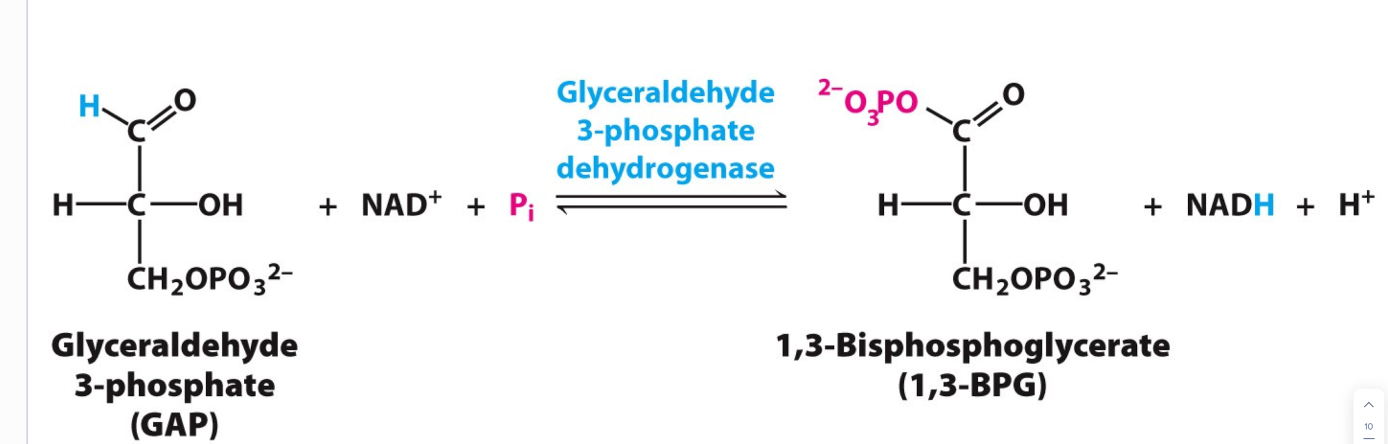
What step of Glycolysis is this?
Step 6 (x2)
Why does step 6 occur twice per glucose molecule, and how much NADH is produced?
Each glucose produces 2 GAP molecules, so step 6 occurs twice, producing a total of 2 NADH per glucose.

What step of Glycolysis is this?
Step 7 (x2)
What happens in step 7 of glycolysis?
What enzyme catalyzes step 7 of glycolysis?
How much ATP is produced in step 7 of glycolysis, and why?
A phosphate group is transferred from 1,3-bisphosphoglycerate (1,3-BPG) to ADP, producing 3-phosphoglycerate (3-PG) and ATP.
Phosphoglycerate kinase.
2 ATP per glucose because each glucose produces 2 molecules of 1,3-BPG, and each produces 1 ATP.
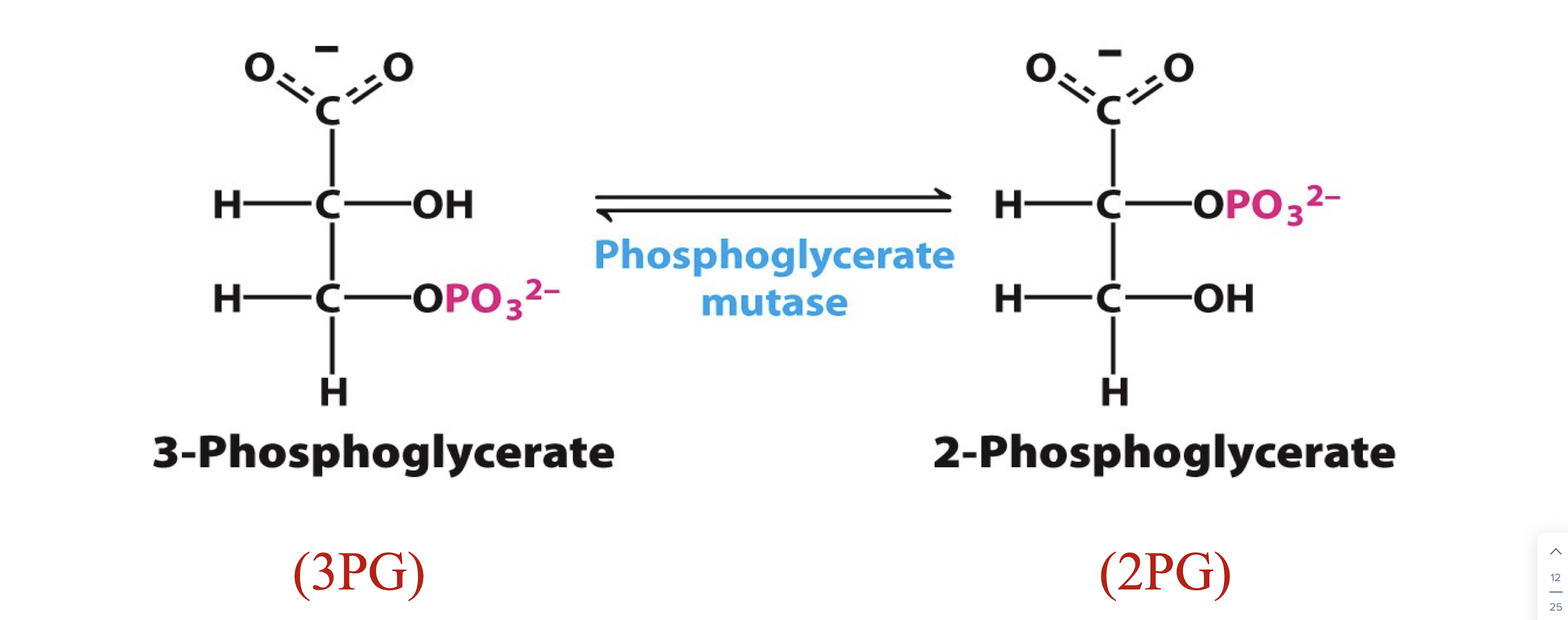
What step of Glycolysis is this?
Step 8 (2x)
What happens in step 8 of glycolysis?
What enzyme catalyzes step 8 of glycolysis?
Is step 8 of glycolysis reversible or irreversible?
3-phosphoglycerate (3PG) is converted to 2-phosphoglycerate (2PG) by moving a phosphate group from carbon 3 to carbon 2.
Phosphoglycerate mutase.
Reversible

What step of Glycolysis is this?
Step 9 (2x)
What happens in step 9 of glycolysis?
What enzyme catalyzes step 9 of glycolysis?
Is step 9 of glycolysis reversible, and is ATP used or produced?
2-phosphoglycerate (2PG) undergoes dehydration to form phosphoenolpyruvate (PEP) and water (H₂O).
Enolase.
Step 9 is reversible. No ATP is consumed or produced.

What step of Glycolysis is this?
Step 10
What happens in step 10 of glycolysis?
What enzyme catalyzes step 10 of glycolysis?
How much ATP is produced in step 10 of glycolysis, and why?
Phosphoenolpyruvate (PEP) transfers a phosphate group to ADP, producing pyruvate and ATP.
Pyruvate kinase.
2 ATP per glucose because each glucose produces 2 PEP molecules, and each PEP produces 1 ATP.
What type of phosphorylation occurs in step 10?
Substrate-level phosphorylation. A phosphate group is transferred directly from PEP to ADP to form ATP. This is the second substrate-level phosphorylation in glycolysis.
Is step 10 reversible or irreversible, and why is ATP produced?
Irreversible under cellular conditions. PEP has high phosphoryl-transfer potential, allowing phosphate transfer to ADP to form ATP.
Glucose + ? NAD+ + ? ADP + ? Pi —> ? Pyruvate + ? NADH + ? H+ + ? ATP
Glucose + 2 NAD+ + 2 ADP + 2 Pi —> 2 Pyruvate + 2 NADH + 2 H+ + 2 ATP (4 total but 2 net)
Which 3 steps of glycolysis are irreversible and tightly regulated?
Step 1: Hexokinase/glucokinase. Step 3: PFK-1. Step 10: Pyruvate kinase. All have large negative ΔG values.
How is PFK-1 regulated in muscle versus liver?
Muscle: inhibited by ATP and H⁺; activated by AMP.
Liver: inhibited by ATP and citrate; activated by AMP and fructose-2,6-bisphosphate.
How are hexokinase and pyruvate kinase regulated in muscle versus liver?
Muscle: hexokinase inhibited by G6P; pyruvate kinase inhibited by ATP.
Liver: glucokinase not inhibited by G6P; pyruvate kinase inhibited by ATP and alanine.
What activates and inhibits PFK-1, and how does ATP regulate it?
Activators: AMP and fructose-2,6-bisphosphate.
Inhibitors: ATP and citrate.
ATP is also a substrate, but high ATP allosterically inhibits PFK-1 to slow glycolysis. (negative allosteric regulator)
What is the overall reaction of lactate fermentation, and how much ATP is produced?
Glucose + 2 ADP + 2 Pi → 2 lactate + 2 ATP + 2 H₂O. Net yield: 2 ATP per glucose.
What happens to pyruvate during lactate fermentation?
Under anaerobic conditions, pyruvate is reduced to lactate by lactate dehydrogenase.
What happens to pyruvate during ethanol fermentation?
Under anaerobic conditions in yeast, pyruvate is decarboxylated to acetaldehyde, releasing CO₂. Acetaldehyde is then reduced to ethanol.
What enzymes and cofactor are involved in the two steps of ethanol fermentation?
Step 1: Pyruvate decarboxylase uses TPP (vitamin B1 derivative). Step 2: Alcohol dehydrogenase uses NADH.
What happens to NADH during ethanol fermentation, and why is it important?
NADH is oxidized to NAD⁺ as acetaldehyde is reduced to ethanol. This regenerates NAD⁺ so glycolysis can continue.
What happens in the muscle during the Cori cycle?
What happens in the liver during the Cori cycle?
During anaerobic exercise, glycolysis converts glucose to pyruvate, producing ATP. Pyruvate is reduced to lactate to regenerate NAD⁺. Lactate travels to the liver through blood.
Lactate is converted to pyruvate, then to glucose through gluconeogenesis using ATP. Glucose returns to the muscle for glycolysis and ATP production.
Glycolysis
Glucose + ___ NAD⁺ + ___ ADP + ___ Pi → ___ pyruvate + ___ NADH + ___ ATP
Glucose + 2 NAD⁺ + 2 ADP + 2 Pi → 2 pyruvate + 2 NADH + 2 ATP
Gluconeogenesis:
Complete the overall stoichiometry. ___ pyruvate + ___ ATP + ___ GTP + ___ NADH → ___ glucose + ___ ADP + ___ GDP + ___ Pi + ___ NAD⁺
2 pyruvate + 4 ATP + 2 GTP + 2 NADH → 1 glucose + 4 ADP + 2 GDP + 6 Pi + 2 NAD⁺
Pyruvate dehydrogenase complex (PDC):
Complete the overall stoichiometry. ___ pyruvate + ___ CoA + ___ NAD⁺ → ___ acetyl-CoA + ___ CO₂ + ___ NADH
1 pyruvate + 1 CoA + 1 NAD⁺ → 1 acetyl-CoA + 1 CO₂ + 1 NADH
Citric acid cycle (per acetyl-CoA):
Complete the overall stoichiometry. ___ acetyl-CoA + ___ NAD⁺ + ___ FAD + ___ GDP + ___ Pi → ___ CO₂ + ___ NADH + ___ FADH₂ + ___ GTP + ___ CoA
1 acetyl-CoA + 3 NAD⁺ + 1 FAD + 1 GDP + 1 Pi → 2 CO₂ + 3 NADH + 1 FADH₂ + 1 GTP + 1 CoA
Citric acid cycle (per glucose):
Complete the overall stoichiometry. ___ acetyl-CoA + ___ NAD⁺ + ___ FAD + ___ GDP + ___ Pi → ___ CO₂ + ___ NADH + ___ FADH₂ + ___ GTP + ___ CoA
2 acetyl-CoA + 6 NAD⁺ + 2 FAD + 2 GDP + 2 Pi → 4 CO₂ + 6 NADH + 2 FADH₂ + 2 GTP + 2 CoA
UDP-glucose synthesis:
Complete the overall stoichiometry. ___ glucose-1-phosphate + ___ UTP → ___ UDP-glucose + ___ PPi
1 glucose-1-phosphate + 1 UTP → 1 UDP-glucose + 1 PPi
Glycogen synthesis from free glucose:
Complete the overall stoichiometry. ___ glucose + ___ ATP + ___ UTP + glycogen(n) → glycogen(n+1) + ___ ADP + ___ UDP + ___ PPi
Glycogen(n) + 1 Pi → glycogen(n−1) + 1 glucose-1-phosphate
Pentose phosphate pathway (PPP), oxidative phase:
Complete the overall stoichiometry. ___ G6P + ___ NADP⁺ → ___ Ru5P + ___ NADPH + ___ CO₂
1 G6P + 2 NADP⁺ → 1 Ru5P + 2 NADPH + 1 CO₂
Pentose phosphate pathway (PPP), nonoxidative phase:
Complete the overall stoichiometry. ___ pentose-5-phosphate → ___ fructose-6-phosphate + ___ glyceraldehyde-3-phosphate
3 pentose-5-phosphate → 2 fructose-6-phosphate + 1 glyceraldehyde-3-phosphate
Electron transport chain (ETC), NADH oxidation:
Complete the reaction and proton pumping. ___ NADH + ___ H⁺ + ___ O₂ → ___ NAD⁺ + ___ H₂O; ___ H⁺ pumped
1 NADH + 1 H⁺ + ½ O₂ → 1 NAD⁺ + 1 H₂O; 10 H⁺ pumped
Electron transport chain (ETC), FADH₂ oxidation:
Complete the reaction and proton pumping. ___ FADH₂ + ___ O₂ → ___ FAD + ___ H₂O; ___ H⁺ pumped
1 FADH₂ + ½ O₂ → 1 FAD + 1 H₂O; 6 H⁺ pumped
Photosynthesis, linear light reactions: Complete the stoichiometry.
___ H₂O + ___ NADP⁺ + light → ___ O₂ + ___ NADPH; minimum ___ photons absorbed
2 H₂O + 2 NADP⁺ + light → 1 O₂ + 2 NADPH; minimum 8 photons absorbed. ATP is also produced.
What are the three irreversible glycolysis reactions that gluconeogenesis must bypass?
Hexokinase: glucose → G6P; PFK-1: F6P → F-1,6-BP; pyruvate kinase: PEP → pyruvate.
What are the four enzymes used to bypass the three irreversible glycolysis steps?
Pyruvate carboxylase, PEP carboxykinase (PEPCK), fructose 1,6-bisphosphatase (FBPase-1), glucose 6-phosphatase (G6Pase).
In gluconeogenesis, how is pyruvate converted to PEP?
Pyruvate → oxaloacetate by pyruvate carboxylase (ATP, biotin); oxaloacetate → PEP by PEPCK (GTP).
What cofactor and vitamin are required by pyruvate carboxylase?
Biotin (vitamin B7); ATP is consumed.
How is oxaloacetate transported from mitochondria to cytoplasm?
Converted to malate, transported to cytoplasm, then converted back to oxaloacetate.
Which enzyme converts F-1,6-BP to F6P, and how is it regulated?
FBPase-1; inhibited by AMP and F-2,6-BP; activated by citrate (and ATP, per slide 5).
Which enzyme converts G6P to glucose, and where is it located?
Glucose 6-phosphatase (G6Pase), in the endoplasmic reticulum of liver cells.
How many ATP-equivalent energy units convert 2 pyruvates to 1 glucose?
6 total: 4 ATP + 2 GTP. Also consumes 2 NADH.
Complete glycogen breakdown stoichiometry: Glycogenₙ + ___ → glycogenₙ₋₁ + ___
Glycogenₙ + Pi → glycogenₙ₋₁ + G1P.
What is the activated glucose donor used directly in glycogen synthesis?
UDP-glucose (not free glucose, G1P, or G6P).
What does glycogen synthase do?
Adds glucose from UDP-glucose to nonreducing ends, forming α-1,4 bonds and releasing UDP.
What does the glycogen branching enzyme do?
Transfers approximately 7 glucose residues to an internal position, creating an α-1,6 branch.
How many ATP-equivalent units are consumed when glucose is stored as glycogen and released as G1P?
2 ATP equivalents per glucose residue, including UTP regeneration.
How does phosphorylation affect glycogen phosphorylase versus glycogen synthase?
Phosphorylation activates glycogen phosphorylase but inactivates glycogen synthase.
What is the effect of protein phosphatase 1 (PP1) on glycogen metabolism?
PP1 dephosphorylates both: inactivates glycogen phosphorylase and activates glycogen synthase.
Which hormones favor glycogen synthesis versus breakdown?
Insulin promotes synthesis; glucagon promotes liver breakdown; epinephrine promotes muscle breakdown.
What are the two main functions of the pentose phosphate pathway (PPP)?
Produce NADPH for biosynthesis and oxidative stress protection; produce R5P for DNA/RNA and coenzyme synthesis.
What are the two phases of PPP, and where do they occur?
Oxidative phase: irreversible, generates NADPH.
Nonoxidative phase: reversible, rearranges sugars. Both occur in cytoplasm.
Which enzyme is responsible for the first oxidative reaction of PPP?
Glucose 6-phosphate dehydrogenase (G6PD).
How many NADPH molecules are generated per G6P → Ru5P?
2 NADPH and 1 CO₂ per G6P.
PPP phase I stoichiometry: ___ G6P + ___ NADP⁺ → ___ Ru5P + ___ CO₂ + ___ NADPH
1 G6P + 2 NADP⁺ → 1 Ru5P + 1 CO₂ + 2 NADPH.
Which enzymes convert Ru5P to R5P and Xu5P?
Ru5P → R5P: phosphopentose isomerase.
Ru5P → Xu5P: phosphopentose epimerase.
Which enzymes transfer 2-carbon and 3-carbon units in PPP?
Transketolase transfers 2-carbon units; transaldolase transfers 3-carbon units.
What are the three carbon-rearrangement reactions of PPP phase II?
C5 + C5 → C7 + C3 (transketolase);
C7 + C3 → C6 + C4 (transaldolase);
C4 + C5 → C6 + C3 (transketolase).
PPP phase II stoichiometry: ___ Ru5P → ___ F6P + ___ GAP
3 Ru5P → 2 F6P + 1 GAP.
Which two glycolytic intermediates are produced by the nonoxidative phase of PPP?
Fructose 6-phosphate (F6P) and glyceraldehyde 3-phosphate (GAP).
When cells need only NADPH, what are the products of 3 Ru5P in PPP phase II?
2 F6P + 1 GAP; these can be recycled toward G6P by gluconeogenesis.
Which PPP pathway is favored when cells need only R5P?
Reverse nonoxidative PPP using glycolytic intermediates F6P and GAP to generate R5P.
Which PPP phases are used when cells need both NADPH and R5P?
Oxidative phase generates NADPH and Ru5P; Ru5P is converted to R5P.
What happens to PPP intermediates when cells need NADPH and ATP?
PPP phase I produces NADPH; phase II produces F6P and GAP, which enter glycolysis, followed by PDC and CAC.
What is NADPH primarily used for, and how does it protect against oxidative stress?
Reductive biosynthesis and regeneration of reduced glutathione (GSH) from GSSG to help detoxify reactive oxygen species (ROS).
by transketolase

by transaldolase

by transketolase

What is the overall PDC reaction?
Pyruvate + CoA + NAD⁺ → acetyl-CoA + CO₂ + NADH.
What are the two stoichiometric cofactors and three catalytic cofactors of PDC?
Stoichiometric: CoA, NAD⁺. Catalytic: TPP, lipoate, FAD.
What are the three enzymes of PDC?
E1: pyruvate dehydrogenase;
E2: dihydrolipoyl transacetylase;
E3: dihydrolipoyl dehydrogenase.
What reaction does PDC catalyze, and where does it occur?
Irreversible oxidative decarboxylation of pyruvate to acetyl-CoA in mitochondria.
Which vitamins are associated with TPP, FAD, NAD⁺, and CoA?
TPP: B1 (thiamine);
FAD: B2 (riboflavin);
NAD⁺: B3 (niacin);
CoA: B5 (pantothenate).
Which PDC cofactor is associated with beriberi disease?
TPP (thiamine pyrophosphate), derived from vitamin B1. Thiamine deficiency causes beriberi.
What inhibits PDC, and what activates it?
Inhibited by ATP, NADH, acetyl-CoA. Activated by ADP and pyruvate.
What type of high-energy bond is found in acetyl-CoA?
Thioester bond, linking the acetyl group to coenzyme A.
Where does the CAC occur, and which enzyme is the exception?
Primarily mitochondrial matrix; succinate dehydrogenase is in the inner mitochondrial membrane.
What are the eight CAC intermediates in order, starting with citrate?
Citrate → isocitrate → α-ketoglutarate → succinyl-CoA → succinate → fumarate → malate → oxaloacetate.
Which enzyme converts oxaloacetate + acetyl-CoA to citrate? Is it reversible?
Citrate synthase; irreversible, committed CAC step.
Which enzyme converts citrate to isocitrate?
Aconitase; isomerization by dehydration and rehydration.