Overview of Diagnosis, Classification, and Treatment Planning
 Call Kai
 Learn
Learn Practice Test
 Spaced Repetition
 Match
Match Flashcards
 Knowt Play
1/74

There's no tags or description
Looks like no tags are added yet.
Name | Mastery | Learn | Test | Matching | Spaced | Call with Kai | Chat |
|---|
No analytics yet
Send a link to your students to track their progress
75 Terms
What is the code for a Comprehensive Oral Evaluation?
D0150
T/F: Periodontal screening and/or charting is not included in a Comprehensive Oral Evaluation.
False
T/F: Oral cancer screenings are included in a Comprehensive Oral Evaluation.
True
What are 3 key measurements that can be used to evaluate for periodontal diagnosis?
1. Probing depth
2. Gingival Recession
3. Clinical Attachment level (CAL)
How do you measure probing depth?
from gingival margin to base of pocket
How do you measure gingival recession?
CEJ to gingival margin
How do you measure CAL?
from CEJ to base of pocket
How do you calculate CAL?
CAL= PD+GR
There are ___ types of gingival recession patterns.
3
What is gingival recession type 1 (RT1)?
Gingival recession with no loss of interproximal attachment. Interproximal CEJ is clinically not detectable at both mesial and distal aspects of the tooth.

What is gingival recession type 2 (RT2)?
Interproximal attachment loss less than or equal to the buccal site

What is gingival recession type 3 (RT3)?
Interproximal attachment loss more than the buccal site.

Which type of gingival recession results in there not being enough interproximal support for a tooth to allow for a gingival graft?
RT3
What constitutes periodontal health?
the absence of clinically detectable inflammation. There is a biological level of immune surveillance that is consistent with clinical gingival health and homeostasis.

What is gingivitis?
a non-specific inflammatory lesion resulting from interactions between dental plaque and the host's immune-inflammatory response. Reversible, contained within the gingiva.
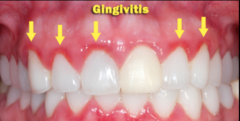
What % BOP constitutes gingivitis?
> or equal to 10%
What are 4 signs of gingival inflammation?
1. Swelling (loss of knife-edged margin, blunted papillae)
2. Bleeding on gentle probing
3. Redness
4. Discomfort on gentle probing
What are 6 symptoms patients may report that indicate gingivitis?
1. Bleeding gums (metallic/altered taste)
2. Pain (soreness)
3. Halitosis
4. Difficulty eating
5. Appearance (swollen red gums)
6. Reduced oral health-related quality of life.
T/F: Radiographs alone can be used to diagnose gingivitis.
False
What is the difference between local risk factors and systemic risk factors?
Local: Predisposing factors
Systemic: Modifying factors
What are 2 local risk factors for gingivitis?
1. Dental plaque biofilm retention factors (tooth and restoration factors)
2. Oral dryness (reduced cleansing of tooth surfaces)
What are 6 systemic risk factors for gingivitis?
1. Smoking
2. Metabolic factors
3. Nutritional Factors
4. Pharmacological agents
5. Elevation in sex steroid hormones
6. Hematological conditions
What does it mean when a non-periodontitis patient has a health on a reduced periodontium?
they have a healthy state with no active inflammation, but their gums and bone have been permanently lowered due to factors other than active periodontal disease, such as gingival recession, gum surgery, or trauma
What does it mean when a patient has healthy, stable periodontitis with a reduced periodontium?
they have experienced previous periodontal disease, but their condition is now stable and free of active inflammation.
What is the correct diagnosis for a stable periodontitis patient that has gingivitis signs/symptoms?
Gingival inflammation on a Reduced Periodontium
T/F: Periodontitis cannot be reversed to gingivitis.
True
What are necrotizing periodontal diseases?
Inflammatory destructive infections of periodontal tissues characterized by tissue necrosis.
What is necrotizing gingivitis?
ulcers within the stratified squamous epithelium and the superficial layer of the gingival connective tissue, surrounded by a non-specific acute inflammatory infiltrate

What are some signs/symptoms of necrotizing periodontal diseases? (4)
1. Halitosis
2. Pain
3. Fever (may need antibiotics)
4. A grey pseudomembrane covering ulcers
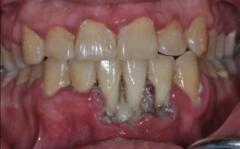
What are some predisposing factors for necrotizing periodontal disease? (2)
1. Temporarily/moderately compromised patients (smoking, stress, habits, nutrition)
2. Severely compromised patients (HIV+/AIDS with CD4 count
What is periodontitis?
Periodontitis is a chronic multifactorial inflammatory disease associated with dysbiotic plaque biofilms and characterized by progressive destruction of the tooth-supporting apparatus
What are the 3 primary features of periodontitis?
1. Loss of periodontal tissue support, manifested through CAL and radiographically assessed alveolar bone loss
2. Presence of periodontal pocketing
3. Presence gingival bleeding
_____% of American adults aged >30 years have some form of periodontitis.
42
How do you diagnose periodontitis?
a multidimensional approach that results in staging and grading
The staging of periodontitis is largely dependent on what?
the severity of disease at presentation (including tooth loss due to periodontitis), though complexity and distribution is also involved.
T/F: The process of staging periodontitis does not take into account the complexity of disease management.
False
What are the 3 factors that determine the severity of the periodontitis presentation, which will affect staging?
1. Interdental CAL (at site of greatest loss)
2. Radiographic bone loss
3. Tooth loss due to periodontitis
Which severity factor is the most ideal factor for diagnosing the stage of periodontitis?
Interdental CAL
What are the interdental CAL measurements for periodontitis, stages I-IV (in mm)?
I= 1-2mm
II= 3-4mm
III= > or equal to 5mm
IV= > or equal to 5mm
What are the radiographic bone loss %s for periodontitis, stages I-IV?
I= LESS THAN 15% (in coronal 1/3)
II= 15-33% (in coronal 1/3)
III= Extending to middle 1/3 of root and beyond
IV= Extending to middle 1/3 of root and beyond
What are the # of teeth lost due to periodontitis for stages I-IV?
I= no tooth loss
II= no tooth loss
III= < or equal to 4 teeth
IV= > or equal to 5 teeth
T/F: When diagnosing periodontitis, tooth loss due to periodontitis only includes past loss, not future loss.
False
T/F: When diagnosing periodontitis, tooth loss due to periodontitis includes both past and future loss.
True
What are 2 complexity factors for patients with stage I periodontitis?
1. Maximum PD is < or equal to 4mm
2. Mostly horizontal bone loss
What are 2 complexity factors for patients with stage II periodontitis?
1. Maximum PD is < or equal to 5mm
2. Mostly horizontal bone loss
What are 4 complexity factors for patients with stage III periodontitis (in addition to the stage II complexity)?
1. PDs > or equal to 6mm
2. Vertical bone loss > or equal to 3mm
3. Class II or III furcation involvement
4. Moderate ridge defects
In addition to the stage III complexity factors, patients with stage IV periodontitis need very complex rehabilitation due to what 5 possible factors?
1. Masticatory dysfunction
2. Secondary occlusal trauma (tooth mobility degree > or equal to 2)
3. Severe ridge defects
4. Bite collapse, drifting, flaring
5. < or equal to 20 remaining teeth (10 opposing pairs)
What are 3 ways to describe the extent of periodontitis during staging?
1. Localized (LESS THAN 30% of teeth involved)
2. Generalized
3. Molar/Incisor pattern
What 3 factors/measurements result in an automatic stage III or IV diagnosis?
1. Vertical bone loss > or equal to 3mm
2. Furcation involvement Class II or III
3. Loss of teeth due to periodontitis.
What are the 3 classifications of intrabony defects?
1. 1 wall defect
2. 2 wall defect
3. 3 wall defect

What are the 3 aspects of periodontitis described by grading?
1. Rate of progression
2. Responsiveness to standard therapy
3. Potential impact on systemic health
What are the primary criteria for grading periodontitis?
direct and indirect evidence of progression
What is direct evidence of periodontitis progression (used for grading)?
Radiographic bone loss or CAL over 5 years
What are the Radiographic bone loss measurements over 5 years for periodontitis, grades A-C?
A= No loss
B= LESS THAN 2mm
C= GREATER OR EQUAL 2mm
What are 2 types of indirect evidence for periodontitis progression (used for grading)?
1. % bone loss/ age
2. Case Phenotype
What are the % bone loss/age calculations for periodontitis grades A-C?
A= LESS THAN 0.25
B= 0.25-1.0
C= GREATER THAN 1.0
Periodontitis Grade ____ has a case phenotype consisting of destruction commensurate with the biofilm deposits.
B
Periodontitis Grade ____ has a case phenotype consisting of heavy biofilm deposits with low levels of destruction.
A
Periodontitis Grade ____ has a case phenotype consisting of destruction that exceeds expectations given the biofilm deposits.
C
T/F: Grade modifiers can only make the grade worse, not better.
True
What are the 2 main grade modifiers for periodontitis?
1. Smoking
2. Diabetes
How many cigarettes/day would a patient with grade A-C periodontitis smoke?
A= None
B= LESS THAN 10
C= EQUAL OR GREATR THAN 10
What HbA1c would a patient with grade A-C periodontitis have?
A= normoglycemic/no diabetes diagnosis
B= LESS THAN 7.0%
C= EQUAL OR GREATER THAN 7.0%
T/F: Patients can have multiple stages and grades of periodontitis.
False
What is the 4 step practical approach to diagnosing periodontitis?
1. Initial overview of case (screening), determine if the disease is Mild-Moderate vs Severe-Very Severe.
2. Fine-tune stage to stage I-IV
3. Determine grade, using grade B as a default
4. Make a treatment plan
Patients with stage 1 or 2 periodontitis (regardless of stage) will need what type of treatment?
Standard (non-surgical) periodontal treatment
Patients with stage 3 or 4 periodontitis (regardless of stage) will need what type of treatment?
Complex and/or multidisciplinary (surgical and nonsurgical)
What is phase I periodontal therapy?
non-surgical phase
What is the progression of phase I therapy? (7 steps)
1. Control of etiological factors
2. Behavioral modification
3. Correction of plaque retentive factors
4. Caries control
5. Extraction of hopeless teeth
6. Treatment of occlusal trauma
7. Phase I evaluation
When considering the control of etiological factors during phase I therapy, (plaque/calculus) is controlled via SRP and (plaque/calculus) is controlled via oral hygiene instructions.
calculus, plaque
When is phase I therapy evaluated?
4-6 weeks post-treatment
What are the 3 therapeutic goals of periodontal maintenance?
1. Prevent and minimize disease recurrence
2. Prevent or reduce the incidence of tooth or implant loss by monitoring the dentition and prosthetics
3. Increase the probability of locating and treating other conditions/diseases found within the oral cavity.
What is the main advantage of following a schedules periodontal maintenance care program?
Treatment of periodontal disease coupled with a proper maintenance schedule leads to less tooth loss
What are some factors that influence the time required for periodontal maintenance appointments? (7)
1. Number of teeth or implants
2. Patient cooperation
3. Oral hygiene efficacy and compliance
4. Systemic health
5. Previous frequency of PM
6. Instrumentation access
7. History of disease or complications
T/F: Every dental patient requires a comprehensive periodontal evaluation as an integral step in the treatment planning phase.
True