Final practical review
 Call Kai
 Learn
 Practice Test
 Spaced Repetition
 Match
 Flashcards
 Knowt Play
1/119

There's no tags or description
Looks like no tags are added yet.
120 Terms
What wavelengths (colors) are present in visible light?
-Red
-Orange
-Yellow
-Green
-Blue
-Indigo
-Violet
Which color has the shortest wavelength? Which has thee longest?
Violet, Red
Longer wavelengths carry more or less energy?
Less
If an object is green, what happens to each wavelength of visible light that hits the object?
Green is reflected off of the object, and all of the other colors are absorbed
Chlorophyll
Most abundant pigment in plants
What colors does Chlorophyll absorb the best?
Blue and red
What wavelength(s) is the highest absorbance peak for Chlorophyll?
Typically those in the blue region
What are the two major steps of photosynthesis?
-Light dependent reactions (photo)
-Calvin Cycle (synthesis)
Where do light reactions occur?
Thylakoid membranes

What are the products of light reactions?
-ATP
-NADPH
-O2
Where does the Calvin Cycle occur?
Stroma

What is used in the Calvin Cycle?
-ATP
-NADPH
What are the products/end results of the Calvin Cycle?
-G3P, glucose
-Regenerates NADP+, ADP, and Pi (inorganic phosphate)
What would you expect to happen with leaf discs submerged in water that are left under light?
The discs left under light will float due to O2 production and accumulation in the leaf tissue via photosynthesis
What is another observed effect of the leaf discs that are exposed to the light?
They tend to float faster than those kept in the dark
Four common pigments found in nature
-Chlorophyll a (darker green)
-Chlorophyll b (lighter green)
-Xanthophyll (yellow)
-Beta-Carotene (orange)
In chromatography, what would be the order in which the four pigments appear?
Beta-Carotene → top
Xanthophyll
Chlorophyll a
Chlorophyll b (bottom)
Why does each pigment separate into bands?
The order of the pigments depends on polarity and the overall travel distance of the pigment as a result
What does this tell you about beta-carotene?
It is the least polar of the four pigments and travels the fastest and furthest on the strip, meaning is has the highest Rf value
What does this tell you about Chlorophyll B?
It is the most polar and travels slower and not that far from the origin, meaning it has the lowest Rf value
What is an Rf factor?
The ratio of the distance travelled by a compound vs the distance traveled by the solvent front
Range of Rf factors
0-1
Formula for Rf factor
(Distance traveled by compound) / (Distance traveled by solvent front)
Stages of mitosis
Prophase
Prometaphase
Metaphase
Anaphase
Telophase
Cytokinesis

What phase of mitosis is shown in this image?
Prophase

What phase of mitosis is shown in this image?
Metaphase

What phase of mitosis is shown in this image?
Anaphase
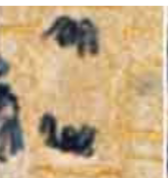
What phase of mitosis is shown in this image?
Telophase

What phase of mitosis is shown in this image?
Telophase/Cytokinesis
What happens during prophase of mitosis?
-Spindle fibers begin to form
-Chromosomes condense
What happens during pro-metaphase of mitosis?
-Nuclear envelope breaks down
-Microtubules attach to kinetochore
What happens during metaphase of mitosis?
-Chromosomes line up at metaphase plate
What happens during anaphase of mitosis?
-Sister CHROMATIDS separate
-Chromosomes move towards opposite poles
What happens during telophase of mitosis?
-Nuclear envelope reforms
-Chromosomes decondense
-Mitotic spindle dissolves
-MITOSIS completes
What happens during cytokinesis of mitosis
-Cytoplasm divides
-Two daughter cells form
-In animal cells, cleavage furrow forms
How is mitosis different from meiosis?
-Asexual reproduction
-End result is two genetically unique diploid daughter cells (clones)
-Occurs in somatic cells to contribute to cell growth and repair
-Only has one division
-In humans, the # of chromosomes would remain 46 in these cells, as they remain diploid
Cytokinesis in animal cells form…
Cleavage furrows
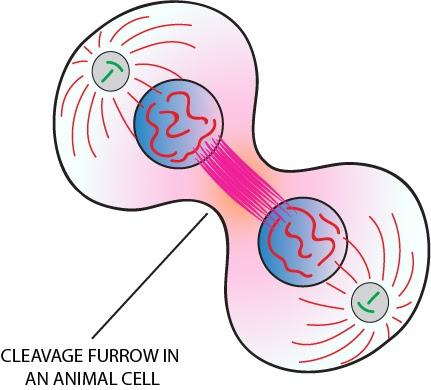
Cytokinesis in plant cells form…
Cell plates

What material do cleavage furrows consist of?
Actin
What material do cell plates consist of?
Polysaccharide material similar to cellulose
What are the cytoskeletal components that aid in cell division?
Microtubules and microfilaments
On fluorescent cell images, what are the green structures?
Spindle fibers (microtubules)
On fluorescent cell images, what are the blue structures?
Chromosomes/DNA
Which phase of interphase lasts the longest? Why is this?
G1 phase, as most cell growth occurs here
Which phase of mitosis lasts the longest?
Prophase
What are the four major phases of development (mitosis)
-Prophase
-Metaphase
-Anaphase
-Telophase
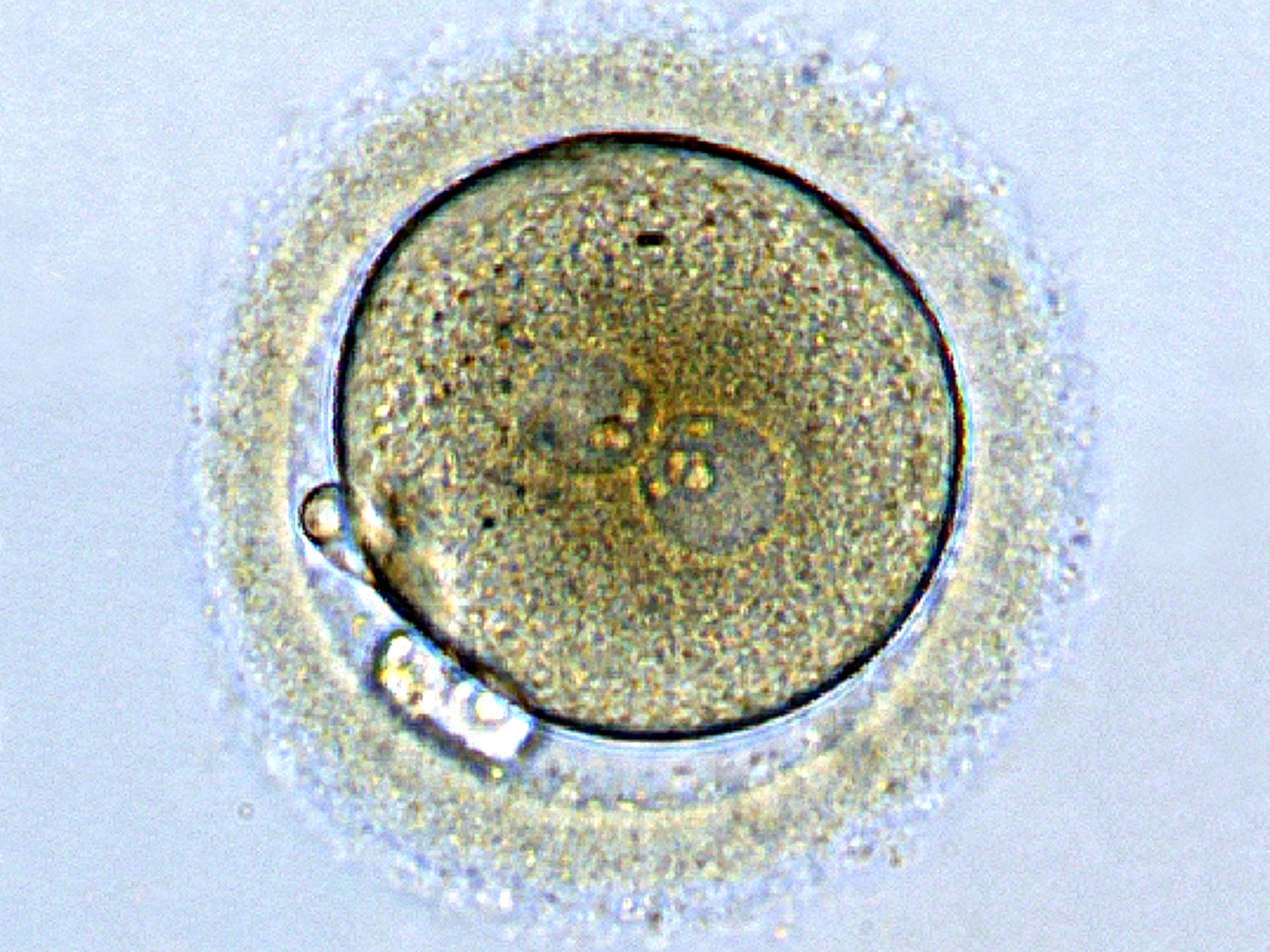
What is shown in the image?
Zygote

What is shown in the image?
Morula

What is shown in the image?
Blastula
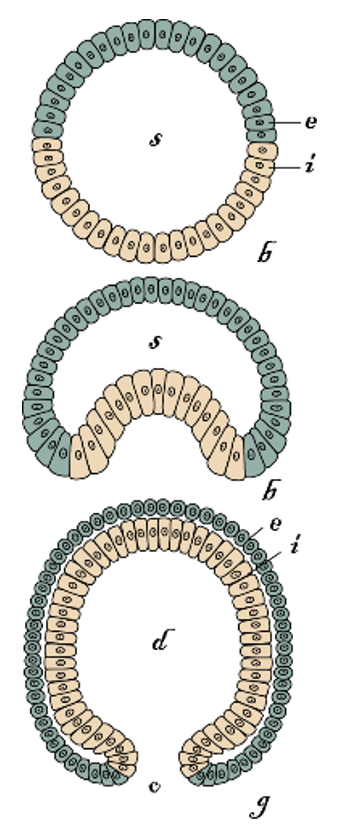
What is shown in the image?
Gastrula
Blastocoel
Fluid filled cavity
What is the blastopore?
Opening into the primitive gut
*Forms when cells fold inward during gastrulation
The archenteron develops into what?
Primitive digestive cavity
Notochord
Supportive rod in developing embryo
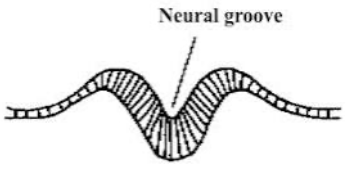
Neural groove
Develops into nervous system
What are the three germ layers?
-Ectoderm
-Mesoderm
-Endoderm
What does the ectoderm form?
Nervous system and epidermis
What does the mesoderm form?
Muscles, skeleton, circulatory system
What does the endoderm form?
Digestive and respiratory linings

In the image of a whitefish blastula, what mitotic phase is the cell in that is labeled A?
Anaphase

In the image of a whitefish blastula, what mitotic phase is the cell in that is labeled B?
Prophase

In the image of a whitefish blastula, what mitotic phase is the cell in that is labeled C?
Metaphase

In the image of the blastula, what is the region labeled as A?
Blastocoel
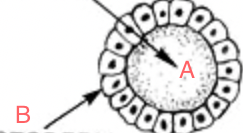
In the image of the blastula, what is the region labeled as B?
Blastoderm

In the image of the gastrula, what is the region labeled as A?
Ectoderm
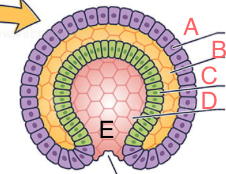
In the image of the gastrula, what is the region labeled as B?
Blastocoel
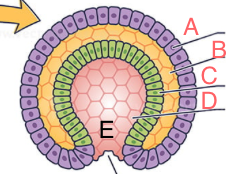
In the image of the gastrula, what is the region labeled as C?
Endoderm

In the image of the gastrula, what is the region labeled as D?
Archenteron

In the image of the gastrula, what is the region labeled as E?
Blastopore
True or false: The ectoderm produces muscles and internal skeleton
False, this would be the mesoderm
Homologous chromosomes
Pairs of chromosomes that carry the same genes in the same order, but may have different alleles of said genes
-Orient randomly at metaphase 1
Tetrad
A structure of four chromatids formed during prophase I of meiosis when two replicated homologous chromosomes pair up
Crossing over
Nonsister chromatids exchange DNA segments
-Occurs during prophase 1
Synapsis
Replicated chromosomes align with corresponding homologous chromosomes to form tetrads, and chromosomes can then intertwine
Independent assortment
Alleles of different genes sort into gametes independently of one another during reproductive cell formation
-Occurs in metaphase 1
Sister chromatids
Two identical copies of a chromosome
How is meiosis different from mitosis?
-Sexual reproduction
-End result is four genetically unique haploid daughter cells
-Has two divisions
-Genetic variation is shuffled
-Occurs in germ cells to create gametes
-In humans, the number of chromosomes is 23 and is haploid due to cell division
Meiosis 1 phases
-Prophase 1
-Metaphase 1
-Anaphase 1
-Telophase 1
NO PRO-METAPHASE!
Meiosis 2 phases
-Prophase 2
-Metaphase 2
-Anaphase 2
-Telophase 2
-Cytokinesis
Prophase 1
-90% of the time required for meiosis
-Crossing over occurs
-Tetrad (4 chromatids)
-Homologous chromosomes pair
Metaphase 1
-Tetrads line up at metaphase plate (23 tetrads in humans)
-Independent assortment occurs
Anaphase 1
-Pairs of HOMOLOGOUS CHROMOSOMES separate
Telophase 1
–Two haploid cells form
Cytokineses (meiosis)
-Simultaneous with telophase I. Forms two haploid daughter cells
Interkinesis
NO CHROMOSOMES REPLICATED. Stage in between meiosis I and II
Prophase 2
-Spindle apparatus forms
-Chromosomes move towards the metaphase plate
Metaphase 2
-Microtubules attach to kinetochores
-Sister chromatids are arranged at the metaphase plate
-Not genetically identical because of crossing over
Anaphase 2
-Sister CHROMATIDS separate
Telophase 2
-Chromosomes arrive at opposite poles
-Nuclear envelops reform
-Chromosomes begin decondensing
End result of meiosis 1
-Two haploid daughter cells (2n)
End result of meiosis 2
-Four genetically unique haploid daughter cells
Diploid (2n)
Total chromosome number
Haploid (n)
Half of total chromosome number
Human diploid #
46 chromosomes
Human haploid #
23 chromosomes

What phase is this cell in? (Hint: Stage of meiosis 1)
Prophase 1

What phase is this cell in? (Hint: Stage of meiosis 1)
Metaphase 1

What phase is this cell in? (Hint: Stage of meiosis 1)
Anaphase 1

What phase is this cell in? (Hint: Stage of meiosis 1)
Telophase 1 and cytokinesis 1

What phase is this cell in? (Hint: Stage of meiosis 2)
Prophase 2