Lecture 12: Growth and Body Size
 Call Kai
 Learn
Learn Practice Test
 Spaced Repetition
 Match
Match Flashcards
 Knowt Play
1/58

There's no tags or description
Looks like no tags are added yet.
Name | Mastery | Learn | Test | Matching | Spaced | Call with Kai | Chat |
|---|
No analytics yet
Send a link to your students to track their progress
59 Terms
List the growth hormones.
growth hormone releasing hormone (GHRH)
growth hormone (GH)
insulin-like growth factor 1(IGF-1)
Review the hypothalamic-pituitary axis:
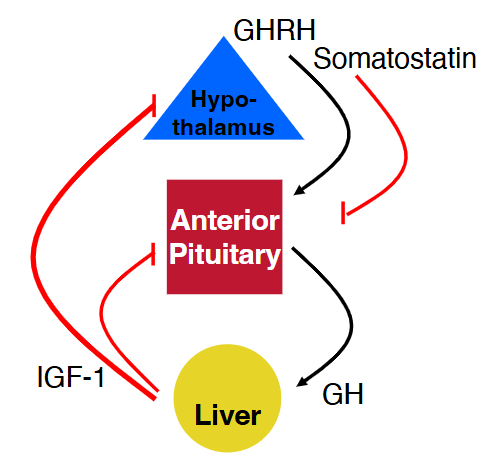
What negatively regulates GH secretion?
somatostatin
Where is somatostatin made?
small-bodied neurons in the PVN
What type of peptide is somatostatin (more specifically than a peptide hormone)?
tetradecapeptide
Where is GHRH produced?
small-bodied neurons in the arcuate nucleus
How many amino acids does GHRH have?
44 amino acids
Which receptor does somatostatin act on?
SSTR
Briefly describe SSTR.
a GPCR, specifially through G-inhibitory to reduce cAMP
What is the receptor for GHRH?
GHRHR
Briefly describe GHRHR.
a GPCR that acts through G-stimulatory to increase cAMP and PKA
What stimulates GH release?
GHRH
List the process of GHRH and somatostatin.
neurosecretory cells in the arcuate nucleus secrete GHRH, a 43 amino acid peptide that reaches the somatotrophs via the hypophyseal portal blood supply
cells in the periventricular region release somatostatin, a hormone that is a potent inhibitor of GH secretion, into the portal blood supply
GHRH causes somatotrophs to synthesize and release GH
somatostatin inhibits the release of GH by somatotrophs
How does GHRH stimulate transcription of GH?
acts on PROP1, CREB, and PIT1
How many amino acids does GH have?
191 amino acids
True or False: GH is part of a hormone family with prolactin and human placental lactogen.
true
What is 50% of GH bound to?
GH-binding protein (GHBP)
What is the half-life of unbound GH?
20 minutes
Briefly describe GH release.
pulsatile release with a peak right before waking
What type of receptor is GHR? Which pathway does GHR act through?
a tyrosine kinase receptor; acts through the JAK-STAT pathway
Where is GHR found in (which organs/tissues)?
liver
adipocytes
muscle
True or False: There is type I and type I insulin-like growth factors.
true
What regulates IGF1 transcription? Where does this occur?
GH regulates IGF1 transcription in the liver
True or False: Of 29 amino acids in IGF-1, 13 are homologous with the insulin B domain.
true
True or False: Insulin receptors and IGF-1 receptors are tyrosine kinase receptors.
true
Where is circulating IGF-1 produced
primarily in the liver (endocrine effects)
What is the function of IGF-1?
main mediator of the growth promoting effects of GH
Where else can IGF-1 be produced to have paracrine/autocrine effects?
the bone and muscle
What percentage of IGF1 is bound to binding proteins?
90%
True or False: There are 6 IGFBPs which regulate the biological actions of IGF-1 and IGF-2.
true
What does IGFBPs increase IGFs half-life to?
12 hours
What are IGFBPs degraded by?
IPGFBP proteases
What type of complex are IGFBPs? What are the different subunits?
ternary complex with IGFBP-3, IGF1, and acid labile subunit
What are the 3 actions of GH and IGFs? Which hormone does what?
increase linear growth by IGF action
increase protein synthesis and organ growth mainly through IGF action
diabetogenic (raises blood glucose) by GH action
When does GH-IGF1 increase linear growth?
affects height starting after birth and continuing until the end of puberty
When do GH-IGF1 levels decline?
during aging
True or False: The pubertal peak rate of growth corresponds to the peak serum concentrations of IGF-1.
true
What are the specific functions of how GH-IGF1 increases linear growth?
stimulate growth of bones, cartilage, and soft tissue
regulate metabolism of chondrocytes (cartilage making cells)
stimulate osteoblast replication (mitogenic) and collagen and bone matrix synthesis
acts to increase length of bones until epiphyseal plate closes
stimulate appositional growth after epiphyseal plate closes
How does GH action increase organ growth?
in almost all organs, GH increases amino acid uptake and ultimately protein synthesis
How does GH cause short-term increase in blood glucose?
antagonizes insulin action in adipose and muscle (causes insulin resistance)
What does GH decrease phosphorylation of? What does this upregulate?
decrease IRS and PI3K phosphorylation—upregulating inhibitors
What does GH induce to inhibit PI3K?
p85-alpha
What are the diabetogenic actions of GH in fat?
increases lipolysis and serum levels of free fatty acids (HSL)
decreases glucose uptake
What is the diabetogenic action of GH in the liver?
gluconeogenesis
What are the diabetegenic action of GH in the muscle?
increases amino acid uptake and protein synthesis (anabolic)
decrease glucose uptake
True or False: GH shifts metabolism to lipid use to spare the muscle.
true
Which factors play into increased longevity with decreased GH/IGF-1 levels?
less proliferation
better insulin sensitivity
better immune system
What are the other growth promoting hormones?
thyroid hormones
sex steroids
What does a thyroid hormone deficiency before closure of epiphyseal plate cause?
dwarfism
True or False: Thyroid hormone is needed for optimal GH levels.
true
True or False: Estrogen and androgen stimulate growth but promote closure of epiphyseal plate.
true
What does a mutation in PROP1 cause in both mice and humans?
dwarfism
What does GH insensitivity block?
cancer and diabetes
What is gigantism due to?
excess GH before closure of epiphyseal plates
What is gigantism most often due to?
GH-secreting pituitary tumor
What is acromegaly due to?
excess GH after closure of epiphyseal plates due to GH secreting tumor
What are the treatments for GH secreting tumors?
octreotide: somatostatin analog
pegvisomant: GHR blockade
True or False: ALP1 mutations have also been detected in about 15% of patients with FIPA (familial isolated pituitary adenoma).
true
What does AIP stand for?
aryl hydrocarbon interacting protein