quant ii mid 1
 Call Kai
 Learn
 Practice Test
 Spaced Repetition
 Match
 Flashcards
 Knowt Play
1/30

There's no tags or description
Looks like no tags are added yet.
31 Terms
∫f(x)δ(x)=
f(0)
*when integrating over all space
in perturbation theory, H =
H0+λH′
1st order energy correction?
En1=<n0∣H′∣n0>
how to find H’ of an electric field?
find the potential of the electric field
L /cdot S in the coupled basis?
L /cdot S = ½ (J² - L² - S²)
L /cdot S in the uncoupled basis?
LxSx+LySy+LzSz
spin of a hydrogen atom?
s=1/2
because its only particle is an electron, which is a fermion (s-1/2)
action of p² on an unperturbed state nlm(0)> ?
p2nlm(0)>=2m(En0−V)nlm(0)>
1st order state correction?
well-defined components of uncoupled states
uncoupled states have “good” (well-known) uncoupled components:
l,s,ml,ms
well-defined components of coupled states
coupled states have “good” (well-known) coupled components:
j,mj
does coupled basis representation have more or less states than uncoupled basis representation for the same system?
Both will have the same number of states for the same system.
dimensions of a matrix built from states?
(# of states) x (# of states)
when can an operator act backwards? (on a bra instead of a ket)?
when the operator is Hermitian (so conjugate = normal)
examples:
Hamiltonian H=2mp2+V(x)
position operator x = x
momentum operator p=−iℏ∂x∂
what is fine structure?
the phenomenon where the states of an atom split into multiple closely spaced energy levels
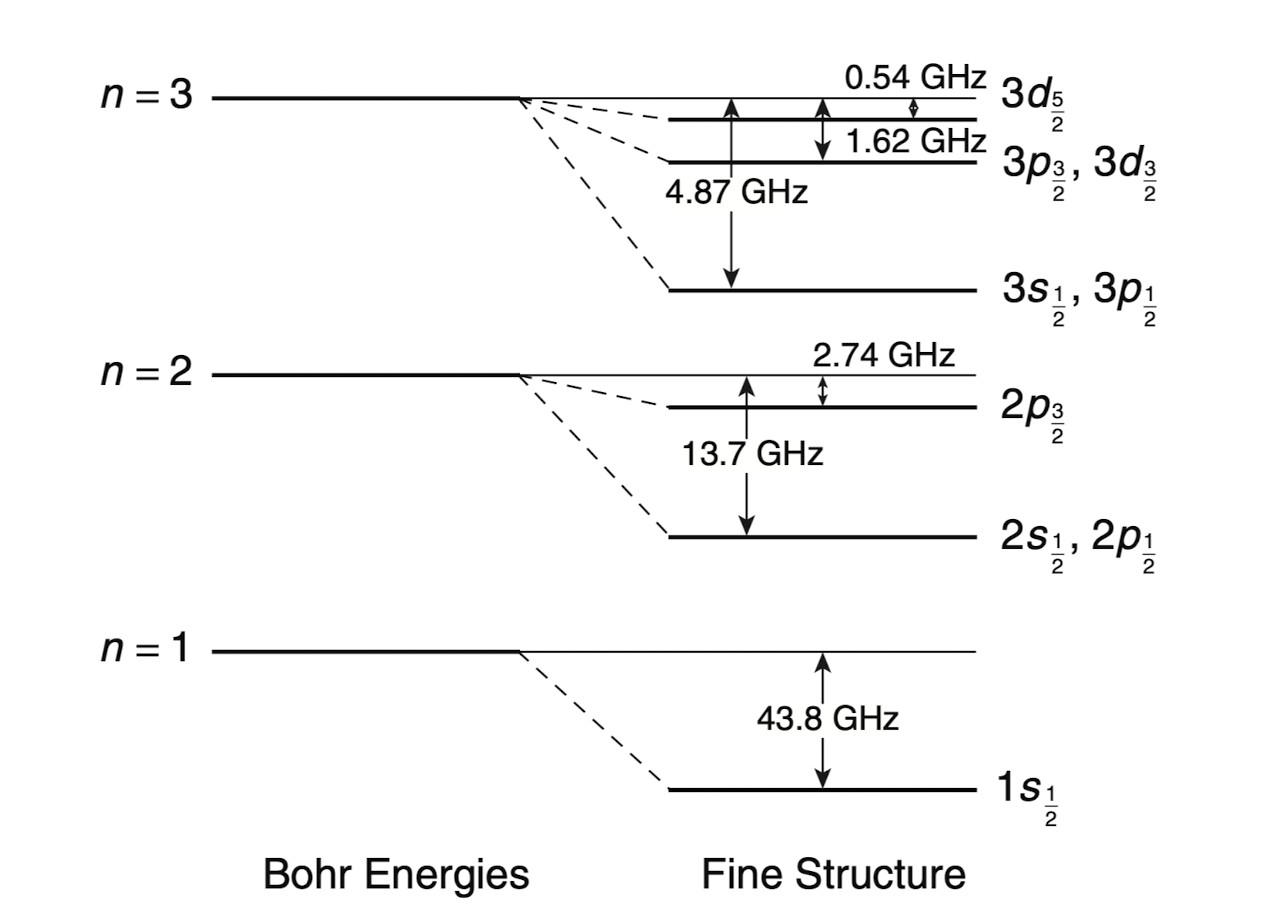
what causes fine structure?
the electron is relativistic (has a kinetic energy that is decently-sized compared to the speed of light)
the interaction between the electron’s intrinsic magnetic moment (caused by its spin) with the magnetic field created by its orbit around the nucleus
to what types of atoms does fine structure apply?
all atoms
F =
J + I
= L + S + I
J =
L + S
for strong field perturbations?
uncoupled basis
energy corrections proportional to m_s
for weak field perturbations?
coupled basis
energy corrections proportional to M_F
the zeeman hamiltonian is diagonal in what basis?
the uncoupled
Sz is diagonal in what basis?
uncoupled
how to determine the magnetic field that separates a strong and weak field correction?
A=μBB
spin-orbit energy correction = 0 unless?
unless it’s a state with a non-zero l (angular momentum number)
how do total spin raising and lowering operators affect the symmetry of a state?
they don’t. A state will maintain its original symmetry after being acted upon by a ladder operator
the average distance between identical particles in a symmetric state
is smaller than if they were distinguishable (symmetric → snuggle)
spin triplet state
total spin S=1, so ms= -1, 0, 1 (hence triplet)
spin singlet state
total spin S=0, so ms = 0 (hence singlet)
the average distance between identical particles in an anti-symmetric state
is larger than if they were distinguishable (anti → away)
what is the symmetry of harm osc, inf well, and hydrogen ground states?
symmetric