PHAR 182: Professional Responsibilities, Practice Standards, and Reflection in Pharmacy
 Call Kai
 Learn
 Practice Test
 Spaced Repetition
 Match
 Flashcards
 Knowt Play
1/99

Earn XP
Description and Tags
Comprehensive practice flashcards covering PHAR 182 professional responsibilities, NAPRA standards of practice, communication methods, scope of practice limits, referrals, and reflective practice.
100 Terms
How is professionalism broadly defined across a practitioner's career continuum?
It is described as a continuum extending from an individual's attributes to interpersonal interactions to societal responsibility.
What is meant by stating that pharmacy is a "self-regulated profession"?
It means that the profession of pharmacy is trusted to govern itself.
Which organization sets training and educational learning outcomes and steps for Canadian pharmacy technicians?
CPTEA (Canadian Pharmacy Technician Educators Association).
Which national regulatory body sets the Principles of Professionalism and entry-to-practice competencies for pharmacy technicians?
NAPRA (National Association of Pharmacy Regulatory Authorities).
Where are provincial codes of professional ethics established for pharmacy professionals in Canada?
By each Provincial College of Pharmacy professionals, as each province maintains its own code of ethics.
What is Principle 1 of NAPRA's Principles of Professionalism?
The profession of pharmacy cares for patients and their support networks as its primary motivation.
What is Principle 2 of NAPRA's Principles of Professionalism?
The profession of pharmacy cares about the community and the health system within which it practices.
What is Principle 3 of NAPRA's Principles of Professionalism?
The profession of pharmacy collaborates with other health professions in a patient-focused manner.
What is Principle 4 of NAPRA's Principles of Professionalism?
The profession of pharmacy cares about the quality and integrity of the profession.
How does NAPRA Principle 5 describe the pharmacy profession's role regarding healthcare resources?
The profession acts as a steward of resources to support a sustainable healthcare system.
What does NAPRA Principle 6 establish regarding accountability?
The profession is accountable to patients, communities, and society for decisions made and actions taken.
Which values are highlighted in NAPRA Principle 7?
Being trustworthy and demonstrating fairness and honesty in all interactions.
What is Principle 8 of NAPRA's Principles of Professionalism?
The profession is conscientious in fulfilling duties to the best of its collective abilities.
What professional ethical principle requires truthfulness and honesty in all interactions?
The principle of veracity.
In understanding patient welfare, what four aspects that a patient brings must pharmacy practitioners consider?
Family/friends, obligations, values, and expectations.
What core qualities must pharmacy professionals demonstrate in all interactions under DEI Standard 3.1.2?
Sensitivity, respect, empathy, and inclusion.
According to Standard 3.2.2 of the Standards of Practice, what patient right must pharmacy professionals recognize and support?
The right of patients to have health beliefs and practices different from their own.
Under Standard 5.4.4, what type of safety must the pharmacy workplace environment support for patients and team members?
Physical, cultural, and emotional safety.
How does Dorland's Medical Dictionary define confidentiality?
The principle in medical ethics that the information a patient reveals to a healthcare provider is private and has limits on how and when it can be disclosed to a third party.
Which two specific privacy acts govern confidentiality and health information protection in pharmacy practice?
PIPEDA and HIPA.
What is the absolute rule regarding photography and posting about work on social media in pharmacy?
NEVER take photos in the workplace or comment on work.
How did Epstein and Hundert (2002) define professional competence in JAMA?
"The habitual and judicious use of communication, knowledge, technical skills, clinical reasoning, emotions, values, and reflection in daily practice for the benefit of the individual and community being served."
According to Epstein and Hundert (2002), what are the three key operational characteristics of professional competence?
Professional competence is developmental, impermanent, and context-dependent.
What is the primary function of the NAPRA Model Standards of Practice (MSOP)?
It serves as a model that provincial pharmacy regulatory authorities (PRAs) can adopt or adapt to harmonize the standard of pharmacy care across Canada.
What is the formal definition of a "standard of practice"?
The minimum expectations for the delivery of quality pharmacy care, set by considering the best interest of patients and the public in the context of what professionals are trained and able to do.
What are the five domains of practice in the NAPRA Model Standards of Practice?
- Providing Care; 2. Knowledge and Expertise; 3. Communication and Collaboration; 4. Leadership and Stewardship; 5. Professionalism.
In which two NAPRA practice domains are scope of practice differences specifically noted between pharmacists and technicians?
Domain 1 (Providing Care) and Domain 3 (Communication and Collaboration).

Which visual framework represents the five core domains centered on patients and encircled by continuous quality improvement?
The NAPRA Model Standards of Practice Domains of Practice wheel.
How do Standard 1.1.4a for technicians and Standard 1.1.4b for pharmacists differ regarding medication use?
Technicians identify the potential for inappropriate use based on dispensed history to inform the assessment, whereas pharmacists determine whether the patient is using medications appropriately.
How do technicians (Standard 3.2.5a) and pharmacists (Standard 3.2.5b) differ regarding patient care plan discussions?
Technicians ensure patients are provided the opportunity to discuss care with the pharmacist, while pharmacists confirm understanding and provide required additional information or referrals.
How does Standard 1.3.13 divide responsibilities between technicians and pharmacists when medication therapy changes?
Technicians assist in documenting and sharing information (1.3.13a), whereas pharmacists communicate the changes to the patient, primary care provider, and prescriber (1.3.13b).
How does Standard 1.4.2 differentiate technician tasks from pharmacist tasks during ongoing patient encounters?
Technicians review dispensing history and bring forward concerns to inform the assessment (1.4.2a), whereas pharmacists reassess the patient and their unique circumstances (1.4.2b).
How does NAPRA define a "competency" for pharmacy technicians at entry to practice?
The application of skills and knowledge that are practiced and developed continuously in real-life situations.
Why are competencies considered valuable even when specific factual content knowledge changes?
Because competencies define transferable skills that show how a professional applies problem-solving and knowledge in new situations to deliver safe care.
What are the three core objectives of healthcare personal hygiene practices?
To prevent the spread of infections, protect both patients and healthcare workers, and maintain professionalism and trust.
What are the key elements included in a healthcare worker's personal hygiene regimen?
Hand hygiene, body and oral hygiene, clean clothing/uniform, and appropriate use of personal protective equipment (PPE).
Why is strict avoidance of strong scents or body odor critical for patients undergoing chemotherapy?
Chemotherapy patients can be extremely sensitive to smells, and body odors or strong scents can cause severe nausea or distress.
Why does standard deodorant fail to meet hospital and clinic hygiene expectations?
Standard deodorant does not meet low-scent standards; daily use of an anti-perspirant is required.
What are the specific pharmacy hygiene requirements regarding hair and fingernails?
Hair must be kept clean and tied back; nails must be short, clean, and completely free of nail polish or artificial nails.
What are the six sequential steps for introducing yourself to model professionalism?
- Start with a Friendly Greeting; 2. State Your Name and Title; 3. Explain Your Purpose or Offer Assistance; 4. Build Rapport; 5. Offer Reassurance and Availability; 6. Conclude with a Positive Note.
What exact title phrasing should a pharmacy technician trainee use when introducing themselves?
"My name is [Name] and I am a pharmacy technician intern."
Under the SCPP Code of Ethics, what condition must be met if a practitioner exercises a conscientious objection?
The objection must not compromise a patient's right to autonomy and access to pharmacy care or services.
What are the three sequential actions required to correct unprofessional behaviour?
- Apologize; 2. Correct behaviour; 3. Do NOT repeat the behaviour.
What communication technique has patients repeat medical advice in their own words to confirm comprehension?
The teach-back method.
What is closed-loop communication in healthcare environments?
A safety technique where a message is clearly spoken by the sender, repeated back by the receiver, and then confirmed or corrected by the sender to verify mutual understanding.
At what exact point is the loop closed during closed-loop communication?
When the original sender confirms the receiver's read-back (e.g., stating "Yes, that is correct").
Why must pharmacy technicians identify their specific role in every patient or interprofessional interaction?
To ensure all team members understand their role in care, respect professional boundaries, and know when to refer or consult higher clinical expertise.
What must a pharmacy technician ensure regarding the patient during a clinical referral handoff?
Ensure the patient understands why they are being referred and protect their dignity throughout the handoff.
What documentation and workflow steps must a technician take when initiating a patient referral to a pharmacist?
Notify the pharmacist verbally, utilize the required workflow systems, and document clinical concerns according to Standard Operating Procedures (SOPs).
What professional handover mindset is required to prevent patient abandonment during a referral?
Following through on the handover rather than assuming that "someone else will take care of it."
Under SCPP guidelines, what supervisory standard is required for pharmacy assistants performing designated tasks?
They must be under the direct supervision of a licensed member who is readily and physically available and provides appropriate direction.
Who holds ultimate legal and professional responsibility for tasks performed by a pharmacy assistant?
The supervising licensed member.
What is the primary rule regarding the focus of constructive professional feedback?
Concentrate on the behaviour, not the person.
What are the three structural layers of the "Feedback sandwich"?
- Positive comment (top layer); 2. Constructive feedback (middle layer); 3. Provide support (bottom layer).
What does the letter 'S' represent in the SPARK feedback framework?
Specific: Comments are directly linked to a discrete word, phrase, or sentence.
What does the letter 'P' signify in SPARK feedback?
Prescriptive: Offers a solution or strategy to improve the work (like a medical prescription), such as revisions or links to resources.
What does 'A' denote in the SPARK feedback model?
Actionable: Leaves the peer knowing exactly what steps to take for improvement.
What does the letter 'R' stand for in SPARK feedback?
Referenced: Directly references the task criteria, requirements, or target skills.
What does 'K' mandate in the SPARK feedback framework?
Kind: Mandates that all comments must be framed in a kind, supportive way.
What are two defensive recipient behaviors to avoid when receiving professional feedback?
Making excuses or denying mistakes, and shifting blame to coworkers or external factors.
What does the acronym SHA CARES stand for in healthcare employee performance evaluations?
Compassion, Accountability, Respect, Equity, and Safety.
How is 'Compassion' defined within the SHA CARES framework?
Empathy and understanding.
How is 'Equity' defined within the SHA CARES value system?
Recognizes barriers and works to ensure access for all.
What are the six professional domains evaluated in the Pharmacy Technician Program Professionalism Rubric?
Respect, Conduct, Resilience, Critical Thinking, Communication, and Accountability.
How is 'Resilience' defined in the Pharmacy Technician Program Professionalism Rubric?
Remaining calm under stress, maintaining a patient-first approach, and reflecting for improvement.
What is the primary role of registered pharmacy technicians in pharmacy practice?
To assist and support licensed pharmacists in the delivery of pharmaceutical care and medications to patients.
What regulatory sequence occurs as the scope of pharmacy technicians expands over time?
Expansion of roles → regulation increases → liability increases → responsibility increases → potential for malpractice liability.
What are three examples of technician practice errors caused by acting outside authorized scope?
Failing to advise the pharmacist of drug interactions/allergies, failing to recognize doses outside normal ranges, and selecting over-the-counter (OTC) medications for a patient.
Regardless of practice setting, what two dimensions of their tasks must pharmacy technicians understand?
The legal boundaries of tasks and the ethical dimensions of services provided.
What core ethical directive guides pharmacy technicians when exercising clinical scope?
"Doing the right thing" to do the least harm.
What five core activities are permitted for registered pharmacy technicians across all Canadian provinces?
Assisting in dispensing/distribution, compounding medications, collecting patient information, providing education on medical devices, and accepting accountability for own work.
Which Canadian province is identified as having the most restrictive scope of practice for pharmacy technicians?
Quebec.
Which four Canadian provinces are recognized as having the most permissive scope of practice for pharmacy technicians?
Alberta, Saskatchewan, British Columbia, and Ontario.
What are the first three steps in the 6-step framework for resolving ethical dilemmas in pharmacy?
- Recognize the dilemma and all facets; 2. Gather relevant information; 3. Realize the legal limitations.
What are the final three steps in the 6-step framework for resolving ethical dilemmas in pharmacy?
- Deliberate / Analyze the situation; 5. Choose solution / action; 6. Be able to justify the solution / action.
What escalation pathway should a pharmacy technician follow when handling workplace issues that go beyond the on-site pharmacist?
Use the workplace reporting structure, consult or report to the professional regulatory body, and/or contact law enforcement if required.
How does the SCPP Reference Manual define "Scope of Practice" for licensed pharmacy technicians?
The practices limited by the Act, within which the licensed pharmacy technician is educated, competent, and has recent experience.
What cognitive phenomenon describes when individuals with minimal knowledge overestimate their competence in a field?
The Dunning-Kruger Effect.

Which graphical stage of the Dunning-Kruger curve represents peak overconfidence at very low knowledge?
The "I know everything" peak.
What stage immediately follows the initial peak of confidence on the Dunning-Kruger curve as experience grows?
"There's more to this than I thought."
What is the lowest confidence point on the Dunning-Kruger curve called as complexity becomes apparent?
"I'm never going to understand this."
Why must pharmacy technicians avoid guessing or answering therapeutic questions "just to be helpful"?
Guessing violates ethical duties, compromises patient safety, and fails to direct the patient to required clinical judgment.
What is the clinical definition of a pharmacy technician referral?
Recognition of a patient's need for care beyond technician scope and appropriately directing the patient to the relevant healthcare provider for evaluation and management.
How does NAPRA instruct pharmacy professionals to balance practicing to scope with performing referrals?
Utilize full scope to avoid unnecessary referrals when pharmacy-led care is appropriate, but refer when in the patient's best interest.
What is professional humility in the context of pharmacy referrals?
Knowing one's legal and competency limits and recognizing when clinical expertise must be handed off to another professional.
What ethical duty obligates healthcare providers to prevent patient harm during care and referral handoffs?
Non-maleficence.
What ethical duty obligates practitioners to act in the best interest of the patient?
Beneficence.
What non-verbal clinical risk indicators should alert a technician that a patient requires referral?
Confusion, distress, hesitation, or uncertainty.
Why should a pharmacy technician referral never be perceived as an interruption to the workflow?
Referral is a professional teamwork skill that acts as the first line of triage, protects patient safety, and supports the pharmacist's clinical authority.
If an asthmatic patient presents with persistent cough, breathing difficulty, and chest tightness with no inhalers, what is the technician's duty?
Recognize acute distress symptoms and immediately triage and refer the patient to the pharmacist or emergency care.
Can a pharmacy technician recommend an over-the-counter medication for acid reflux symptoms?
No, selecting or recommending OTC drug therapy requires clinical assessment and must be referred to a pharmacist.
What care can a technician independently provide to a newly diagnosed diabetic patient receiving a blood glucose meter?
Providing technical device education on how to physically operate the meter and perform testing.
What are the three primary self-assessment tools used to evaluate competency in pharmacy practice?
Evaluations, feedback, and reflection.
How does NAPRA Principle 8 link self-assessment to professional accountability?
It requires practitioners to conscientiously fulfill duties by engaging in reflective practice and actively resolving knowledge and practice gaps.
What is the primary difference in definition and purpose between reflection and journaling?
Reflection is critical analysis of experiences aimed at professional growth and clinical skill improvement; journaling is recording feelings and events for personal insight and emotional processing.
How do personal reflection and professional reflection differ in their concluding focus?
Personal reflection ends with "this is how I felt"; professional reflection ends with "this is what I learned and what I will do differently."
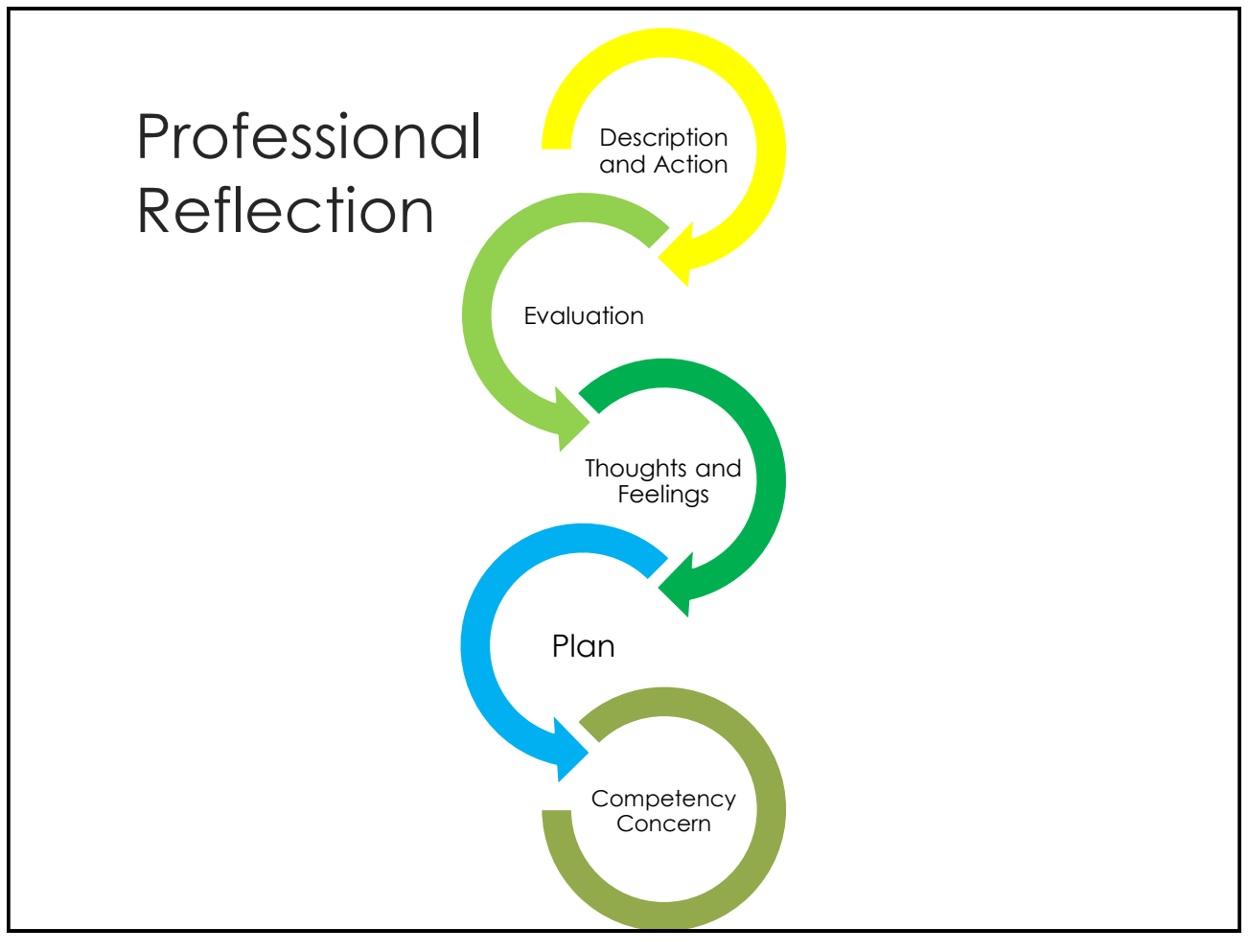
Which cyclic model outlines the five sequential steps of professional reflection?
The Professional Reflection Cycle (Description and Action, Evaluation, Thoughts and Feelings, Plan, Competency Concern).
How should the statement "I was nervous talking to the patient" be professionally reframed?
"This experience emphasized the importance of confident and effective patient communication."
How should the statement "I felt overwhelmed during the shift" be professionally reframed?
"This situation revealed the need to improve time management and prioritization skills."
What are the five recognized challenges of engaging in reflective practice?
Time and effort, bias and honesty, surface-level ("tick-box") reflection, emotional discomfort, and confidentiality risks.