Prokaryotic Diversity L10 P1
 Call Kai
 Learn
 Practice Test
 Spaced Repetition
 Match
 Flashcards
 Knowt Play
1/40

There's no tags or description
Looks like no tags are added yet.
41 Terms
Morphological Diversity
The diversity is based upon the visual appearance
Metabolic Diversity
Based upon how the microbes obtain energy
Ecological Diversity
Based upon what the cells are doing in the context of their environment and the microbes they interact with, often includes metabolic diversity.
What role they’re playing in the ecosystem
What are Chemotrophs and what are the two types
They obtain their ENERGY by oxidizing electron donors around them. (Oxidizing is removing electrons from atoms.)
Chemoorganotrophy
Chemolithotrophy
What is Chemoorganotrophy
They obtain their ENERGY by oxidizing ORGANIC compounds
What is Chemolithotrophy
They obtain their ENERGY by oxidizing INOORGANIC compounds
What are Phototrophs and what are the two types
They capture photons (light energy) to acquire energy
Photoheterotrophy
Photoautotrophy
What is Photoheterotrophy
They get their ENERGY from sunlight
They get their CARBONS from organic compounds
What is Photoautotrophy
They get their ENERGY from sunlight
They get their CARBONS from inoorganic compounds (CO2)
What is the diversity of phototrophic bacteria
How they use light energy to break down CO2 or organic compounds into sugar molecules and organic molecules
What is anoxygenic photosynthesis
This evolved first in the world
Oxygen is NOT produced as a product in photosynthesis
What is oxygenic photosynthesis
Oxygen is produces as a waste product due to the oxidation of H2O.
What is lit anoxic environments
They are environments with no oxygen.
Anoxygenic Phototrophs live here
Ex. Meromictic lakes, Hot spring mats
What is lit oxic environments
Environments with lots of oxygens
Cyanobacteria is here
Oxygen phototrophs are here
Thought to have made all the oxygen on the early earth
Many have HETEROCYTES used for nitrogen fixation
What are sulfate reducing bacteria
They reduce SO4 to H2S for energy
They are generally obligate anaerobes
they use H2 or ORGANIC compounds as electron donors
What are sulfur oxidizers
They get their energy from oxidizing H2S to S
Most are OBLIGATE aerobes and some can reduce NO3
some are obligate CHEMOLITHOTROPHS
Diversity of nitrogen fixers: What are diazotrophs
They are microorganisms that fix N2 gas into usable ammonia.
Nitrogen fixation requires ATP and nitrogenase.
Nitrogenase wont work if O2 is present
Nitrogen fixation is spread among bacteria and a few Archaea
What are nitrifiers
They grow chemolithotrophically
They oxidize Ammonia (NH3) to Nitrate (NO3) for energy during nitrification
They are OBLIGATE AEROBES
Nitrification uses TWO sets of reactions. Most can only catalyze one set of reactions
What are Denitrifiers
They grow by ANAEROBIC RESPIRATION
They use inorganic nitrogen (NO3, NO2) to gaseous NO, N2O, and N2 for energy.
Typically facultative aerobes and chemoorganotrophs
What are Microbial predators
They are bacteria that generally consumes other species of bacteria’s.
What are Epibiotic predators
They attach to the preys cell wall surface and acquire nutrients from their cytoplasm or periplasm.
What are Cyctoplasmic predators
They invade the host cell and replicate in the cytoplasm consuming the cell from within
What are Periplasmic predators
They invade the call and enter the periplasm and replicate within.
Ex. Bdellovibrio
What are Social predators.
They swarm and collectively feed upon lysed prey.
Ex. Lysobacter and Myxococcus
Phylogenic Diversity
This diversity is based upon the evolutionary relationship between microbes
What does phyolgenetic diversity look at
It looks at the 16s RNA genes
90% of bacteria fall into four PHYLA’s
Proteobacteria, Bacterioidetes, Actinobacteria, Firmicutes

Characteristics about Proteobacteria(Phyla)
All GRAM NEGATIVE bacteria
There are 6 classes based up 16S RNA
Every known type of metabolic/functional diversity is represented by species within this phyla
Abundant everywhere
Alpha Proteobacteria
Many are obligate or facultative intracellular bacteria
Some are oligotrophs (they thrive in low nutrients environments)
Beta Proteobacteria
diverse group
Wide range of metabolic strategies found in many environments
Gamma proteobacteria
Diverse group which includes a number of human pathogens
Delta Proteobacteria
Diverse group includes sulfate reducing bacteria
Has myxobacteria which can form fruiting bodies

Epsilon Proteobacteria
Microaerophilic bacteria (require low oxygen environments to survive)
Includes some important human pathogens
Description of Firmicutes (Phyla)
GRAM POSITIVE bacteria
Some species can produce ENDOSPORES
generally has low GC content
Description of Actinobacteria (Phyla)
GRAM POSITIVE bacteria
most harmless but not Mycobacterium tuberculosis
Primarily aerobic filamentous soil bacteria
Generally has a high GC content
Description of Bacteroidetes (Phyla)
GRAM NEGATIVE bacteria
Non sporulating rods
GLIDING motility is common
Many bacteria in this phylum is associated with the HUMAN gut
Description of Cyanobacteria
All OXYGENIC Phototrophs
Many are capable of gliding motility
Diazotrophs
contains gas vesicles
Description of Chlorobi
Anaerobic anoxygenic phototroph: GREEN SULFUR BACTERIA
Typically non-motile
Short to long rods
Oxidizes H2S to SO4 for autotrophy
Contains bacteriochlorophyll in chromosomes so its green in colour.
Description of Chloroflexi
Anoxygenic phototroph: GREEN NON-SULFUR BACTERIA
Aerobic and anaerobic chemoorganotrophs
All capable of gliding motility
Not all green in colour
Explain the relationship between diversity
Organisms closely related on the evolutionary family tree doesn’t mean they look, act, or function the same way
Closely related species can have different physiological properties (functional capabilities)
Distantly related species can have similar physiological properties
What explains the relationship between diversity
Gene loss (Loss of genes in some lineages)
Convergent evolution (independently evolution so separate organisms developed the exact same traits without having a common ancestor)
Horizontal gene transfer (Genetic exchange)
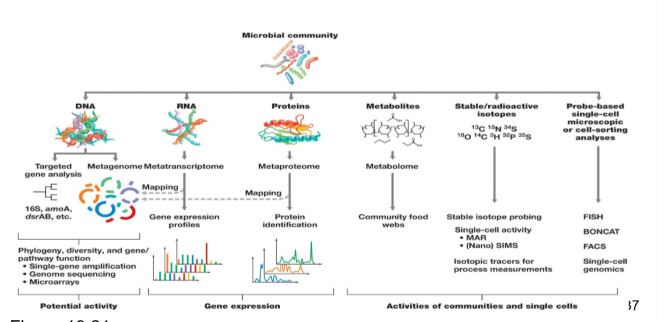
What is Metagenomics
It detects as many genes are possible and produces a picture of the gene pool in an environment.
This allows for a link to function and for the comparison of environments.
a powerful laboratory technique where scientists scoop up a sample of soil, water, or mud and sequence all the DNA inside it at the exact same time.