Week 6 - Nonobviousness III (Analogous Art and Secondary Indicia)
 Call Kai
 Learn
 Practice Test
 Spaced Repetition
 Match
 Flashcards
 Knowt Play
1/12

There's no tags or description
Looks like no tags are added yet.
13 Terms
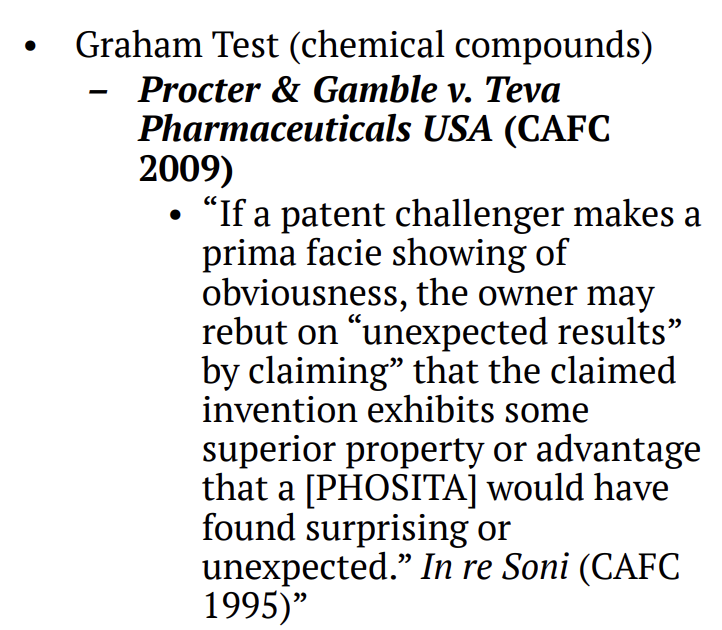
Procter & Gamble
Background of the Patent Lawsuit Procter & Gamble sued Teva to prevent them from selling a generic version of the osteoporosis drug Actonel. Teva argued that Procter & Gamble's patent was invalid because the drug was too similar to an older, expired patent.
The Two-Step Test for Chemical Obviousness
🎯 Lead Compound Selection: The patent challenger must prove that a chemist at the time would have selected a specific, known molecule as their starting point ("lead compound").
🔀 Motivation & Expected Success: The challenger must show that existing research gave chemists a concrete reason to modify that lead compound in a specific way, with a reasonable expectation that it would work.
The Ultimate Safeguard: Unexpected Results
Even if a challenger establishes an initial (prima facie) case of obviousness, the patent owner can fully defend the patent by proving unexpected results. Moving that single atom made risedronate substantially more effective at lower doses and far less toxic to animals—a result no chemist could have predicted. The patent was upheld!
In re Icon
Finding of Obviousness The legal dispute focuses entirely on the requirement for a gas spring to keep the treadmill upright. A patent examiner rejected Icon's claim, ruling that combining an existing folding treadmill advertisement with an older folding bed patent made the design obvious.
Analogous Art. Although beds and treadmills belong to different fields of endeavor, both addressed the exact same specific problem: supporting weight and keeping a folded structure stable
Standard for Combining References Multiple factors support the conclusion that combining the treadmill advertisement and the folding bed patent was an obvious step. Any known problem or need in the relevant field at the time can give an inventor a logical reason to combine existing ideas.
In re Klein
Overview of Klein's Nectar Patent Application Mr. Klein applied for a patent on a bird and butterfly nectar mixing device that uses a removable divider in slots to measure exact sugar and water ratios. Cited Prior Art: Card drawers, tool trays, and cabinet drawers with removable dividers
NOT Analogous Art. Drawers designed to hold dry solid objects (which contained holes, gaps, or notches) were not pertinent to the specific problem of holding and partitioning liquids.
For prior art from a different field to be considered analogous, it cannot just share a superficial physical feature (like "a divider"); it must be pertinent to the specific problem the inventor is trying to solve.
Transocean Background
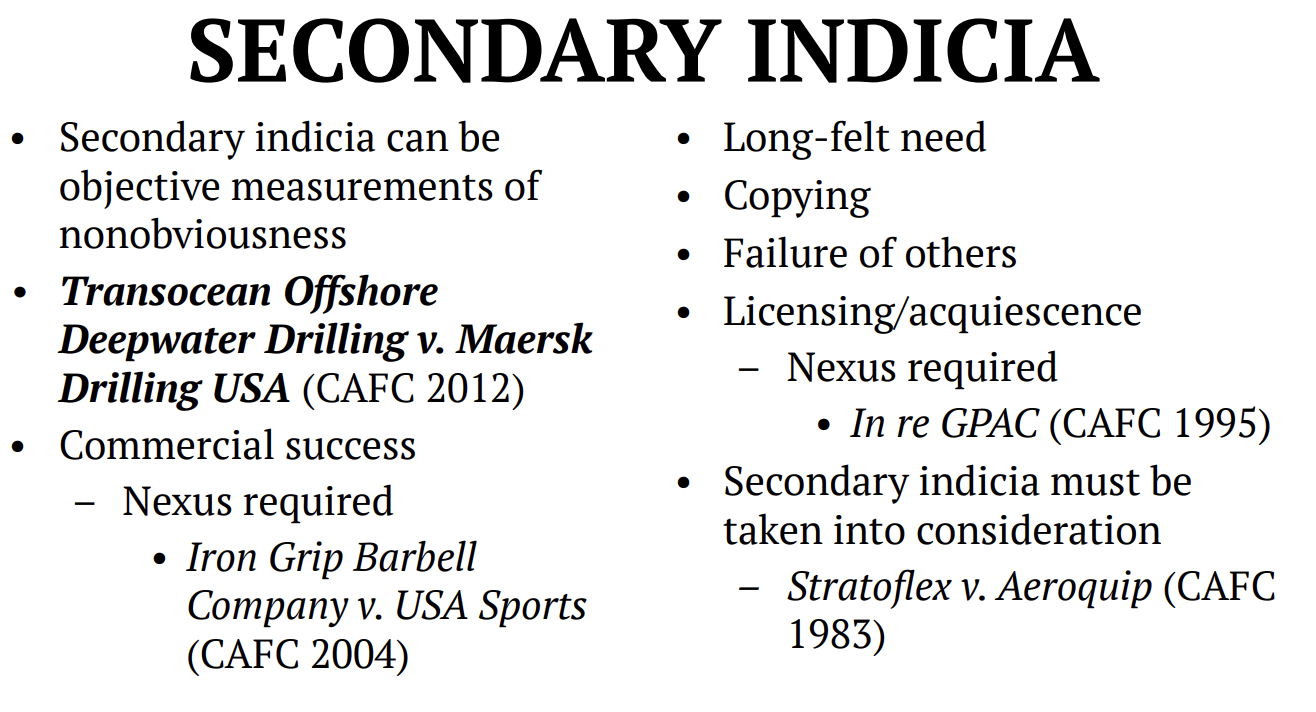
Transocean v. Maersk, Transocean patented a dual-activity offshore drilling rig that used two working stations simultaneously to cut drilling time by up to 40%. Even though older patents contained similar individual parts, Transocean proved non-obviousness by presenting real-world evidence across 7 secondary factors:
⏳ Long-Felt Need: The drilling industry sought deepwater efficiency solutions since the 1970s.
❌ Failure of Others: Previous attempts at offline pipe assembly failed.
⚡ Unexpected Results: Time savings surpassed original claims.
🏆 Industry Praise: Trade journals named it a top historic innovation.
📋 Copying: Competitors intentionally copied the dual-derrick layout.
🤨 Skepticism: Experts initially doubted it due to fears that underwater pipes would collide.
📈 Commercial Success: Customers paid premium rates specifically for dual-activity rigs.
Rebutting the Prima Facie Case Although older patents created an initial impression that the invention might be obvious, real-world evidence can overcome that presumption. The appeals court disagreed with the trial judge's ruling that Transocean's objective evidence was legally insufficient.
The Nexus Requirement
For secondary evidence to count, the patent owner must establish a nexus—a direct connection showing that the market success or copying was driven specifically by the patented feature, rather than general brand prestige or unrelated product traits.
Class Notes
Hatchman Waxman Act: Under act, if you want to make a generic drug, should do due diligence on the patent, if there is a good argument for invalidity, file a ANDA, and by filing it to FDA, it triggers infringement, if you successfully prevail, you get 180 day monopoly to be the only generic manufacturer
Procter: Have to apply Graham test within the context of the field, If a patent challenger makes a prima facie showing of obviousness, the owner may rebut on unexpected results
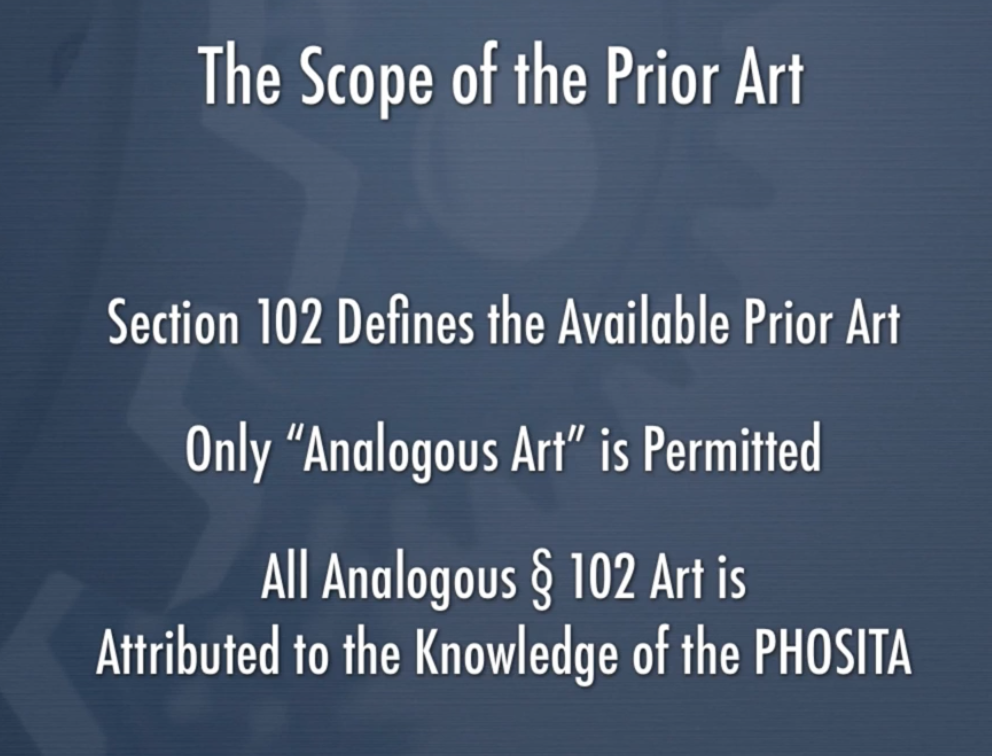
102 v 103 prior art: 103 is 102 art that you can combine together
In re Icon, would a PHOSITA naturally think of the analogous art
In re Klein, analogous art must be supported by substantial evidence
Obviousness a question of law, enablement question of law, written description question of fact, construing the meaning of a claim is between question of law and fact but if had the choose one is law
For licensing and commercial success, must have a nexus
Analogous Art

Scope of the Prior Art
Secondary Considerations

Secondary Indicia
Nonobviousness after KSR II
102/103 Prior Art I

102/103 Prior Art II

What art is appropriate for 103
