L13 play & gender development
 Call Kai
 Learn
 Practice Test
 Spaced Repetition
 Match
 Flashcards
 Knowt Play
1/17

There's no tags or description
Looks like no tags are added yet.
18 Terms
2 things in defining play
Context is important.
5 criteria
What are the five necessary criteria for recognizing play?
- Fun, not serious,
- not contributing to survival
- spontaneous,
- voluntary,
- repeated (not stereotyped)
7 intentions of play
- enhances EF (all3)
- supports lg/math skills
- social devmt / peer rs
- sense of agency
- phys dev/health
- promotes reciprocal interactions bw parents/children
- antedote toxic stress
What 3 challenges to play are mentioned?
- too much emphasis on learning in early childhood
- overscheduled child
- media
types of play?
-locomotor
-play fighting
-socio-dramatic / pretend play
locomotor play?
Large motor movements such as running, chasing, skipping, rolling, falling, and sliding.
play fighting?
Physically active play that resembles fighting, often with aggressive themes.
R&T play
socio-dramatic play?
Pretend play that transforms the meaning of objects, identities, situations, and time, peaking around age 6.
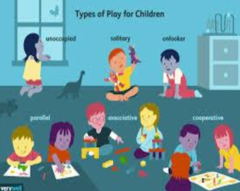
What are the stages of Parten's theory of social participation?
Solitary play
onlooker play
parallel play
associative play cooperative play (individual roles, defined rules)
4 gender differences in development
Males tend to have higher
verbal ability,
visual/spatial ability,
math ability,
aggression.
5 potential gender diffs
activity level (M>F)
fear, timidity & risk-taking (F>M)
devmtal vulnerability
emotional expressivity / sensitivity (F>M)
compliancy (F>M)
At what age do children typically acquire simple gender labels?
Around 2-3 years old.
How do gender role stereotypes evolve from ages 2 to 9?
They become more rigid from ages 2-7 (reject opposing gender, takes it seriously), then more flexible by ages 8-9.
How do gender roles stereotypes evolve past age 9
more flexible at 9, then puberty and they desire to be attractive to opposite gender ==> gender conformity++
Explanations behind children devmt gender mindset
gender stereotypes /. myths constantly surrounds us
Gender-typed behavior and play?
- gender segregation
- favor same-sex activities
- more tolerable for girls to get boy stuff than opposite
What does the nature vs. nurture debate in gendered play suggest?
unsettled: monkeys and girls went for gendered toys w.o nurture?
How do cultural practices influence gendered play preferences?
Different tribes exhibit distinct preferences based on their gender roles. eg. Hadza and Bayaka