Chapter 9.3: The Covalent Bonding Model
 Call Kai
 Learn
 Practice Test
 Spaced Repetition
 Match
 Flashcards
 Knowt Play
1/14

15 Terms

Covalent bond
A bond where two atoms share electrons, arising from the repulsing nuclei and attracting electrons
Results in greater electron density between nuclei

To form the bonds, energy from the atoms needs to be released, with some being released by heat through attraction.
Why does bond formation release energy?

To break the bonds, energy from the surroundings needs to be absorbed, enabling ionization.
Why does bond breakage absorb energy?

Bonding pair (shared pair)
The pair of electrons shared by atoms in a bond
Represented by a pair of dots or a line
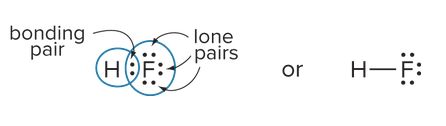
Lone pair (unshared pair)
A pair of outer-level electrons not involved in bonding
Generally shown as dots

Bond order
The number of electron pairs being shared by a given pair of atoms
Higher numbers result in greater bond energy and lower bond length
Single bond
One bonding pair of electrons with two electrons shared
Has a bond order of 1

Double bond
Two bonding pairs of electrons with four electrons shared
Has a bond order of 2

Triple bond
Three bonding pairs of electrons with 6 shared electrons
Has a bond order of 3

Bond energy (BE)
The input energy needed to break apart the bond of 1 mol of a gaseous compound
Stronger bonds have higher levels due to lower potential energy present (spent during formation)
Weaker bonds have lower levels due to higher potential energy present (reserved with fewer formations)

Bond length
The distance between the nuclei of two bonded atoms at a lowest energy point
Equal to the sum of radii
Inversely correlated to bond order and energy
Covalent bonding model
This explains the properties of covalent substances, with:
Low melting and boiling points, given weak intermolecular forces and strong bonding forces
Strong networked bonds in solids like quartz and diamond which do use covalent strength
Little conductivity due to localized electrons and few ions

Intermolecular forces
Unlike in ionic bonds, these are weak in covalent bonds, due to bonding forces being strong instead
Quartz and diamond are two exceptions
Electrical conductivity
Unlike in ionic bonds, this is weak for covalent substances, due to localized electrons and a lack of ions

Infrared spectroscopy (IR spectroscopy)
The observation of IR wavelengths passing through molecules as a fingerprint
Captures the vibration of atoms in different bonds as they stretch and bend bonds