NMJ, sliding filament theory, and Sarcomeres
 Call Kai
 Learn
 Practice Test
 Spaced Repetition
 Match
 Flashcards
 Knowt Play
1/33

There's no tags or description
Looks like no tags are added yet.
34 Terms
the Neuromuscular junction
where a nerve and muscle fiber join

motor end plate
specialized part of the sarcolemma located at the neuromuscular junction
has many folds

synaptic vesicles
where neurotransmitters are stored before being released into the synaptic cleft
synapse- synaptic cleft
a gap between the motor neuron endings and the motor end plate
acetylcholine
neurotransmitter that crosses synaptic cleft
cholinesterase
an enzyme that breaks down acetylcholine
sarcolemma
specialized cell membrane that surrounds a skeletal muscle fiber or cardiomyocyte
the steps of sliding filament theory
myosin head bonds with ATP
and hydrolyzes it to make ADP and P
myosin head binds to actin- cross bridge
phosphate is released
power stroke pulls actin
ADP is released
new ATP binds to myosin head so it can detach from actin
tropomyosin
actin’s regulatory protein that blocks myosin heads from bonding
troponin
more protein that blocks myosin building cites
role of calcium ions
are released when neuron stimulates muscle, bind to troponin and lets tropomyosin move so myosin heads can bind
sarcomere
the smallest functional and contractile unit of striated muscle tissue, between z bands
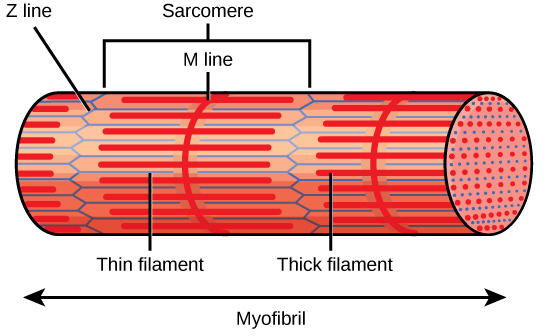

black diagonals = z bands
blue = actin
red = myosin
I band = lighter, only actin
A band = darker, myosin filaments
H zone = only myosin, lighter
myofilaments
actin and myosin
sarcomela
membrane of the muscle fiber
sarcoplasmic reticulum
parallel network of tubes used for transport
sarcoplasm
the specialized cytoplasm of a muscle cell
Duchenne Muscular Dystrophy
a mutation in the gene that codes for dystrophin (supports signaling, absorbs contraction stress, and conects cell framework)
the body cant repair muscle tears and cell death fast enough
muscle tissue is replaced with fat and scar tissue
leads to muscle weekness
motor unit
group of muscle fibers controlled by one motor nueron
action potential
triggers skeletal muscle contraction through a process called excitation-contraction coupling, converting an electrical signal from a motor neuron into a physical movement of the muscle
nicotinic receptors
ligand-gated ion channels on the end plate that acetylcholine binds to
when open allow sodium to enter, depolarizing the membrane, producing end-plate potential
process of neuromuscular junction
acetylcholine binds to nicotinic receptors on end plate
nicotinic receptors open to allow sodium to enter cell
sodium depolarizes the membrane → producing end-plate potential
when end-plate potential is high enough, voltage-gated sodium channels outside end plate activate
outside channels allow even more sodium in, fully reversing polarity of cell membrane
voltage gated potassium channels open so potassium can move out of cell → returning memrane voltage to original value
that generates action potential, which spreads through muscle via other channels and t tubules to reach sarcoplasmic reticulum
activates calcium channels to release calcium into cytosol of muscle cells
calcium sets off sliding filament theory
acetylcholinesterase
enzyme that removes all extra acetylcholine molecules that don’t bind with receptor or are done activating a receptor
terminates synaptic activation → gives muscle relaxation
SYNAPTIC VESICLES
where neurotransmitters are stored
*these are released into the cleft and tell the muscle to contract
Oxygen Debt
not have enough oxygen causes lactic acid to accumulate in the muscles → Soreness
Hypertrophy
muscles enlarge
Atrophy
muscles become small and weak due to disuse
Myasthenia Gravis
Means "grave muscular weakness."
Autoimmune disease
Acetylcholine receptors are damaged
ALS, or amyotrophic lateral sclerosis
a progressive neurodegenerative disease.
The motor nerves degenerate and stop sending messages to the muscles, causing atrophy.
Symptoms get worse over time
rigor mortis
adenosine triphosphate (ATP)—the energy molecule required for muscle fibers to relax—after breathing and blood circulation stop
muscles remain contracted after death
Tetanus
causes cholinesterase to not break down the acetylcholine in the synapse. This results in a person's muscles contracting and not relaxing.
Botulism
Prevents the release of acetylcholine at the neuromuscular junction, causing flaccid paralysis (paralization)
Strychnine
Lowers the threshold level for an action potential, making it more likely the muscles will contract
Blocks glycine receptors, preventing inhibition of motor neurons and causing severe muscle spasms
Curare
Blocks acetylcholine receptors on muscle cells, preventing stimulation of muscle contraction and causing flaccid paralysis