Exam 3
 Call Kai
 Learn
 Practice Test
 Spaced Repetition
 Match
 Flashcards
 Knowt Play
1/63

Earn XP
Description and Tags
Athletic Prevention Injury
64 Terms
the condition commonly known as “Little League Elbow” involves which of the following bony landmarks
medial humeral epicondyle
which of the following is the most commonly fractures bone in the wrist
scaphold
what can happen when an athlete tries to get something out of their eye by rubbing it
corneal abrasion
in football, the type of tackling know as “spearing” is associated with which of the following types of mechanism injury in the cervical spine
axial loading
which of the following if the correct number of vertebrae in the lumbar spine
5
what is an auricular hematoma more commonly known as
cauliflower ear
any form of lateral curvature in the spine is known as
scoliosis
which of the following injury is associated with the name jersey finger
dital flexor tendon rupture
which of the following is the correct name for and extensor tendon slip rupture
boutonnière deformity
a third degree AC joint injury may involve complete tearing of all but which of the following ligaments
stermoclavicular
which bones are fractured with a boxer’s fracture
4th and 5th metacarpal bones
what is the only joint in the body that has its own grading system
acromoclevicular
if an athlete reports having felt or heard something pop or snap in the back of their neck and feels burning, numbness, or tingling int he extremities and/or trunk, coaches should suspect a fracture of dislocation
false- trainers not coaches
Posterior dislocations of the sternoclavicular joint (collar bone) are common and not life-threatening
false - NOT common
Both little league and golfer’s elbow involve the alter humeral epicondyle
false- lateral not medial
a typical elbow dislocation involved the forearm bones
false- posterior not forearm bones
after a mallet finger injury, it is important to splint the distal phalix and that let the distal phalanx fall back into a fixed position
true
if an athlete reports the inability to move a limb or limbs or significant strength loss, the coach should stabilize the head and neck and call EMS
true
in the lumbar spine, the nerve root is about the corresponding vertebrae
false- theoretic not lumbar
helmets and mouth guards commonly used in sports and prevent concussions, teeth injuries, ear, noes, etc
true
the normal human thorax includes 12 pairs of ribs
true
what is the correct way to treat a nosebleed
head tilt forward pinch very top of nose breath through mouth and never tilt head back
what are the signs and symptoms of acute conjunctivitis (pink eye)
redness, itchy, discomfort, puss liquid, light sensitivity
lis the muscles of the rotator cuff
supraspinatus, infraspinatus, teres minor, and subscapularis
why should you never reduce a dislocated shoulder (without media training)? what is at risk?
there are many things in the way and you can’t see what’s there. joints, ligaments, muscles, blood vessels, tendons
what is the difference between passive stability and dynamic stability in the glenohumeral joint and give an example of type of structures
passive- being able to sit and keep it stable
shoulders not dropping, not feeling discomfort or feeling like you inhale to hold them up when just chilling
structures: ligaments, joint capsule
dynamic- moving arm where shoulder begins to move, shoulder stays stable throughout the movement with no pain or discomfort
structures: rotator cuff
what are the 4 bones in the shoulder
humerus
scapula
clavicle
sternum wh
what are the 4 joints in the shoulder
sternoclavicular
acromioclavicular
glenoumeral
scapulotheracic
what is the articulation in the shoulder
scapulotheracic
what are the 3 main ligaments in the acromioclavicular joint
acromioclavicular
coracoclavicular
coracoacromial
what are the 8 carpal bones
scaphoid
lunate
triquetral
pisiform
trapezium
trapezoid
capitate
hamate
thumb sprain, worst one
involves sprain of the ulnar collateral ligament of the thumb
gamekeepers thumb
distal extensor tendon rupture
involves distal phalanx and torn extensor tendon
mallet finger
distal flexor tendon rupture
involves the tearing away from a finger flexor tendon
jersey fingure
extensor slip rupture
tearing of the central band of the extensor digitorum tendon
boutonnière deformity
elevated, rounded, white, nodular, and firm abnormality of the helix or concha
auricular hematome (cauliflower ear)
water becomes trapped in ear canal by cuts, bone growths, ear wax,, swelling
otitis externa (swimmers ear)
accumulation of fluid in the middle ear caused by local and or systemic infection
otitis media (middle ear infection)
rubbing of eye while foreign body is present
corneal abrasion
direct blow to the eye or surrounding soft tissue
orbital hematoma (black eye)
irritation of conjunctiva
acute conjunctivitis (pink eye)
what are the bones in the spine
cervical- 7
thoracic- 12
lumbar- 5
sacrum- 5 fused together
coccyx- 2 fused together
excessive curvature of the lower back
lordosis
lateral curvature of the spine
scoliosis
point tenderness, pain with movement
no disruption of AC joint
grade 1
tear or rupture of AC ligament, pain, point tenderness, and decreased ROM (abd/add)
partial displacement of lateral end of clavicle
grade 2
rupture of AC and CC ligaments
AC joint separation
grade 3
posterior dislocation of clavicle
grade 4
rupture of AC and CC ligaments, tearing of deltoid and trapezius attachments, gross deformity, severe pain, decreased ROM
grade 5
displacement of clavicle begins the coracobrachialis
grade 6

name the 3 ligaments of the AC joint
pink- acromioclavicular
blue- coracoclavicluar
green- coracoacromial
what are the bones in the elbow
radius
humerus
ulna
what are the joints in the elbow
humeroulnar
humeroradial
radioulnar
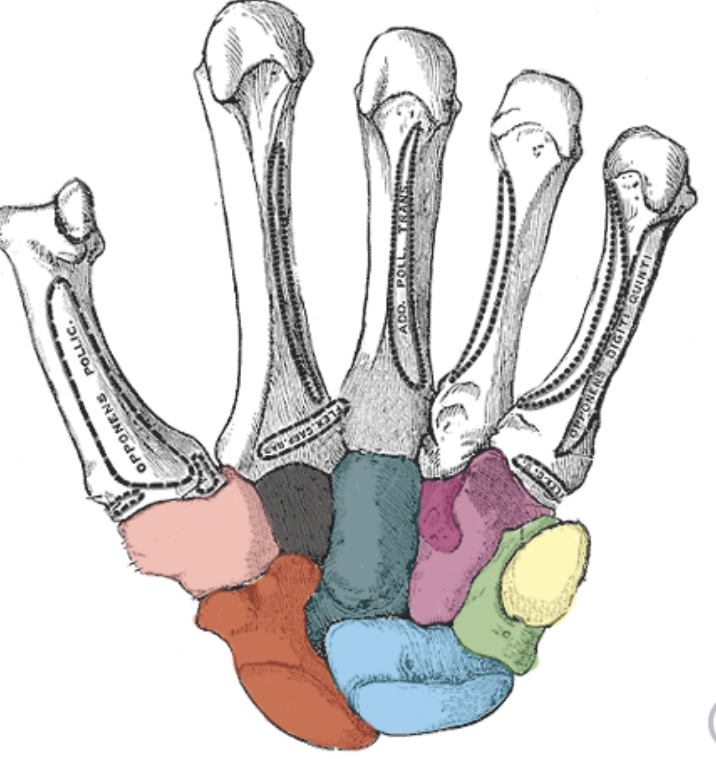
name the bones
orange- scaphoid
blue- lunate
green- triquetrum
yellow- pisiform
coral- trapezium
gray- trapezoid
blue/gray- capitate
purple- hamate
what is a bloody nose called
epistaxis
what are the bones in the wrist
radius
unla
1st metacarpal fracture into joint space of metacarpophalangeal joint
Bennetts fracture
fracture involves 4th and or 5th metacarpal bones near the proximal ends
boxers fracture
how many nerve roots are on the cervical spine and where are they count
8 and above
where for the thoracic and lumbar sections count
below
what section of the spine connect to the ribs
thoracic
ribs 1-7 are what
true ribs
ribs 8-10 are what
false ribs
ribs 11-12 are what
floating ribs