Psychological Descriptions
 Call Kai
 Learn
 Practice Test
 Spaced Repetition
 Match
 Flashcards
 Knowt Play
1/13

There's no tags or description
Looks like no tags are added yet.
14 Terms
What is knowledge of the mind based on?
Language + descriptions → how we describe things determines what we know about them
Which stages of psychological knowledge are related?
Descriptions (used in daily life) + formal concepts
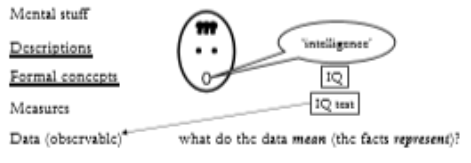
What are descriptions used for and what are the limitations of this?
Drawing maps of mental territory, reflect theoretical assumptions, refer to certain aspects of phenomenon (conceptual frame to view phenomena):
Depends on territory + how the map is drawn → can be selective
Describes particular features in particular ways
Not reality (map vs territory → must be aware of gap)
Metaphorical basis (e.g. outgoing → extroversion)→ implications
Change over time → definitions change = study changes
Definitions can vary depending on the subject area → defines object of study (data + measurement) + what the data represents
What are the further limitations of descriptions having a metaphorical basis?
Selected from available options → limits to how the mind can be viewed (e.g. computer analogy)
Prompt further thinking along similar lines (questions asked + how concepts are studied) → bind to metaphors which reflect/reinforce theoretical assumptions about phenomena
E.g. memory as container → capacity, recorder → accuracy, storage retrieval of info → episodic/semantic (kinds of info)
What is the problem with definitions changing over time?
Continue enquiry on a similar basis (follow underlying assumptions)
Risk of conflation of descriptions + phenomena (the mental thing itself)
Risk of reification of concepts (talk about their definition as being the definition)
Around what time did learning become a fundamental psychological concept?
After WW1 → no longer referred to a conscious process
What had the word learning been used before WW1?
New skills (training)
First stage of memorisation (1885)
Knowledge (educational)
How has learning been tied to behaviour?
Study of observable behaviour, not of mind
Focus on how behaviour could be adapted
Learning as adaptive behaviour (excluded mind + mental process)
Included humans + animals
Vs Piaget (learning as mental development)
How has memory previously been understood?
As a:
Wax tablet
Library
Photo
Computer
Mechanical piano
What did Wundt argue about memory?
Not a fundamental category of psychology
Who got memory recognised as a fundamental category in psychology?
Ebbinghaus (1885):
Memorising as performance (how much + how long?)
Quantity of (equally meaningless units) of info
How did Bartlett understand memory?
Process not performance
How we remember/distort meaningful info
Meaningful narratives (not nonsense syllables) → not about capacity to memorise neutral bits of info
Not learning (effect of stimuli on behaviour of organisms)
How is memory now understood?
Computer analogy (info-processing, cognitive revolution):
Memory as encoding, storage, retrieval
Distinction between LT + ST storage
Prompted new questions → capacity of STM, neural location of x
Memory not merely in the brain → extended mind (is embodied), discursive phenomenon
Memory in your mind vs shopping list vs phone (functionally the same)