pure november half term test
 Call Kai
 Learn
 Practice Test
 Spaced Repetition
 Match
 Flashcards
 Knowt Play
1/51

There's no tags or description
Looks like no tags are added yet.
52 Terms
logab=c
ac=b
cubic graph

quartic graph

y=1/x

y=-1/x

y=1/x²

y=-1/x²

y=2x

y=lnx vs y=ex

y=f(-x)
reflection in y-axis
y=-f(x)
reflection in x-axis
y=f(ax)
horizontal stretch by 1/a (BECOMES COMPRESSED INWARDS)
y=af(x)
vertical stretch by a (pulled taller)
y=f(x+a)
move graph a to the left (-a on x-axis)
y=f(x)+a
move graph up by a (+a on y-axis)
y=|f(x)|
reflect negative y-values in x-axis
y=f|x|
reflect the positive x side in y-axis
function types
one-to-one
many-to-one
for function to have an inverse
function must be one-to-one
composite function
fg(x)
self inverse function
f(x) = f-1(x)
ff(x)=x
it is self-inverse if the curve has y=x as line of symmetry
sine rule

cosine rule

area of triangle rule
1/2absinC
degrees to radians conversion
π radians = 180°

arc length formula in radians
rθ
area of sector in radians
1/2r2θ
area of segment in radians
1/2r2(θ-sinθ)
finding all values of x for sinx=__
degrees: 180-ans
radians: π-ans (gives first pair, then go to next cycle by adding 2π as sin repeats every 2π)
finding all values of x for cosx=__
degrees: 360-ans
radians: 2π-ans (gives first pair, then go to next cycle by adding 2π as cos repeats every 2π)
finding all values of x for tanx=___
degrees: ans +- 180
radians: ans +- π (tan repeats every π not 2π)
sin2x+cos2x =
1
sinx/cosx=
tanx
cosecθ
cosecant

secθ
secant

cotθ
cotangent

y=cosecθ

y=secθ

y=cotθ
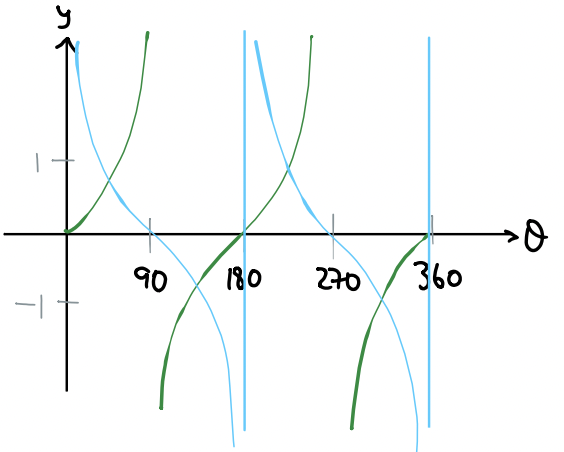
cotθ =
cosθ/sinθ
tan2θ+1=
sec2θ
1+cot2θ =
cosec2θ
sin(A+B) =
sinAcosB+sinBcosA
sin(A-B) =
sinAcosB-sinBcosA
cos(A+B) =
cosAcosB - sinAsinB
cos(A-B) =
cosAcosB + sinAsinB
tan(A+B) =

tan(A-B) =

sin2θ =
2sinθcosθ
cos2θ =
cos2θ - sin2θ
1-2sin2θ
2cos2θ-1
tan2θ =

arcsinx =
sin-1x