intro to equine sci: Exam 2
 Call Kai
 Learn
 Practice Test
 Spaced Repetition
 Match
 Flashcards
 Knowt Play
1/33

There's no tags or description
Looks like no tags are added yet.
34 Terms

What clipping is this?
Full body clipping: is a technique used in horse grooming where the entire body coat is clipped to a uniform length, often for show purposes or to manage excess fur.

What clipping is this?
Hunter clipping: is a grooming technique where the horse's body is clipped to provide a neat appearance while leaving the legs, mane, and tail untrimmed.
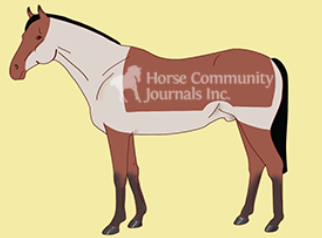
What clipping is this?
Blanket clipping: is a grooming method in which the horse's body is clipped, leaving a "blanket" of fur on the back and hindquarters to maintain warmth while reducing excess coat.

What clipping is this?
Trace clipping: a partial body clip for horses that removes hair from the areas where a horse sweats the most—such as the underside of the neck, chest, belly, and lower flank—while leaving the hair on the back, head, and legs untouched for warmth.

What clipping is this?
Irish clipping: a horse-clipping pattern that removes winter hair from the areas where a horse sweats the most—specifically the neck, shoulders, and belly—while leaving the rest of the coat intact for warmth.

What clipping is this?
strip clipping: a partial horse-clipping method that removes a thin strip of hair from the jowl down the underside of the neck, through the front of the chest, and optionally under the belly to the girth area.
what is the reason for clipping?
To help them regulate their body temperature, prevent overheating during work, and speed up drying times.
Some of the conditions of the horse and clippers you need in order to clip the horse?
Horse: clean and dry. If the horse needs to be groomed, you can just groom.
Clippers: sharp clipper blades; make sure you have a backup blade
clipper blade care
brush → black wash → oil
What does a number on the clipper blade mean?
In equestrian clipping, the number on a clipper blade indicates how much hair is removed and how short the remaining coat will be
The rule: The higher the number, the shorter the cut (more hair is removed). The lower the number, the longer the hair that is left behind.
What part of the bit affects the horse's external part vs internal
the mouthpiece versus the cheeks/shanks.
What should we be feeding then?
Forages (hay, grass, alfalfa)
Breed, history, age/ work load, easy keeper or hard keeper, body condition, season, and weather to burn calories to see if you need to provide more.
What is a normal rate for a horse's?
heart rate (28-48)
Range for resting temperature
(99-101)
Respatory rate
(10-24)
How Do we decide how many breaths
Count the breaths: Use a timer to count the number of breaths for 15 seconds (or 10 seconds).
Calculate the rate: Multiply your 15-second count by 4 to get the total number of breaths per minute (or multiply a 10-second count by 6)
What Is normal capillary
3 second
How to figure it out: press your finger against their gum. Their gum color is pink.
What do you do when your horse has an injury?
gotta assess the blood loss and medical history and what kind of wound it is, and how serious it is. Then, if it's not that bad, clean it, then apply an antibiotic ointment
If it needs stitches, pull one side of the skin, and if it doesn't close, then call a vet; no more than 12 hours to get stitches
parts of the bridle

Different types of bridles
From left to right: Drop Noseband, Figure-8 Noseband, Flash Noseband, Cavesson Noseband.

parts of the saddle

How to measure saddles?
Depth of Seat is measured by drawing a straight line from the pommel to
cantle and dropping a perpendicular line down to the deepest point of
the seat.
Seat size is measured by ½ inch increments (in the US) from the point of
saddle to the middle of the cantle. Sizes 16.5”-18.5” are typical
“adult” saddle sizes.
Saddles are also measured by gullet width to accommodate the size
of the horse’s back. More on the in-the-saddle fit section.
dressage saddle
Deepest seat
Long, fairly straight leg flaps
Short or Long Billet Systems
Allow the rider to have a long stirrup
length and open hip & knee angles to
accommodate the Dressage BBP

jump saddle
Flat/Shallow Seat, allows rider to get up into 2-point
Short, forward-cut leg flaps accommodate a short stirrup length and closed hip &
knee angles to accommodate the rider’s jumping BBP

All purpose saddle
Seat depth can vary by maker/brand, but it theoretically not too deep
to inhibit the rider moving into 2-point position
Saddle flaps are shorter than the dressage saddle, but not as forward
cut as the jumping saddle. Again, size and shape of flap vary by maker.
This is an in-between saddle designed to be comfortable for a variety
of rider’s conformations and disciplines.
This type of saddle can often still be too deep-seated for ease of 2-
point position.
Very short stirrups and long legged riders often have trouble fitting
their knee on the saddle flap (the knee will go past the flap and is very
uncomfortable).

What is a snaffle bit?
All snaffle bits work primarily on the
corners of the lips, but also on the bars,
tongue and soft palate.
Gives the horse the clearest signal to
turn.
Snaffle bits are not jointed in the case
of the Mullen Mouth Snaffle. Other
snaffles can be classified as Single
Jointed or Double Jointed.

what is a MULLEN MOUTH SNAFFLE?
Used to encourage a horse to move forwards and push his tongue against the bit.
Used for training young horses to accept contact with the bit. Often made of
vulcanite rubber (stiff, usually metal lined hard rubber), Happy Mouth (plastic) or
stainless steel.

what is SINGLE JOINTED SNAFFLE?
As the reins are pulled by the rider, the
joint lifts up, towards the soft palate into
a V shape, pinching the tongue & bars,
and even hitting the soft palate. This is
also known as the “nutcracker effect”.
The higher the riders lifts the hands, the
more action.
Name the cheekpiece to name the bit.
From top to bottom:
Full cheek snaffle
Eggbutt snaffle
Happy Mouth eggbutt snaffle

what is CHEEKED AND D-RING SNAFFLES?
The action of these bits will be the same as the single or double jointed snaffle, but
as the bit is used to turn, the cheekpiece puts pressure on the side of the face to
encourage the horse to turn.
Example: turning left the rider pulls on the left rein. The RIGHT side of the cheeked bit will press into the side of the horse’s face,
encouraging them to turn by “pushing” the face around the turn.
Cheeked bits have a flat sided cheek piece such as the Full Cheek, Fulmer Snaffle and D ring Snaffle (see below, in order)

what is DOUBLE JOINTED SNAFFLE?
The middle link follows the curve of the
tongue, allowing for more room than the
single jointed snaffle.
This takes more pressure off the bars
and eliminates the nutcracker effect.
Two types of double jointed snaffles
Dr. Bristol:
The central plate is set at an angle to
the rest of the mouth piece and is
designed to press into the tongue.
Used on horses that push against the bit
as a form of gaining control, they will
draw back and keep the chin tucked in,
which is a better place to gain control.
French Link Snaffle:
The smooth central plate of this bit,
often described as “lozenge” shaped,
follows the line of the horse’s tongue.
The joints should be as smooth as
possible and the middle piece no more
than 2.5 cm in length, keeping the plate
over the tongue, not the bars.
This bit has far less action than the Dr.
Bristol.

what is CURB ACTION BITS?
Act on the internal pressure points as well as when the rein is
pulled, the cheekpiece is shortened and pressure is now put on the
poll and chin.
Can by used with a double bridle as a Weymouth bit (important
concept: Double Bridle = 2 bits!) or with two reins on a single bit as
with a Pelham or Gag bit.

what is CURB ACTION BITS? continued
The Kimberwick
is a type of
leverage bit
used with only 1
set of reins. The
lower the slot
for the reins, the
more action the
bit has.
With the Pelham(above) the snaffle
rein is attached to the ring level
with the mouthpiece. The curb rein
will be attached at the bottom of
the shank, giving the rider the
opportunity to only activate the
snaffle, the curb, or both.
“Connectors” eliminate the ability
to use each rein independently and
are a crutch for an unskilled rider
who doesn’t possess quiet and
independent aids.

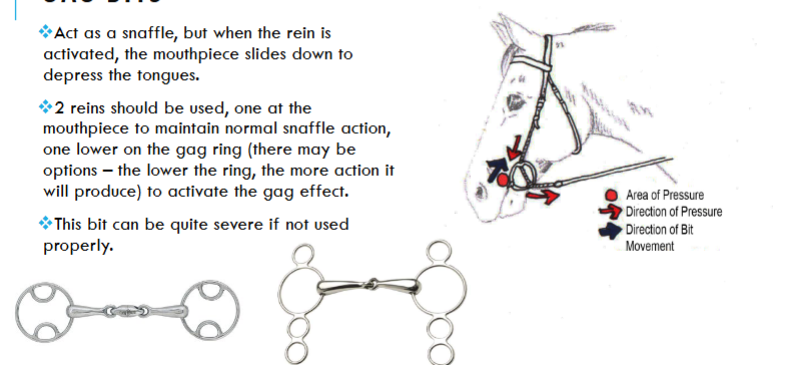
what is a GAG BITS?
Act as a snaffle, but when the rein is
activated, the mouthpiece slides down to
depress the tongues.
2 reins should be used, one at the
mouthpiece to maintain normal snaffle action,
one lower on the gag ring (there may be
options – the lower the ring, the more action it
will produce) to activate the gag effect.
This bit can be quite severe if not used
properly
what are PORTS
Stops the tongue from lying over the bars. Makes room for it by allowing the tongue
to fit up into it and not flatten out over the bars.
Shape of port has a direct bearing on the degree of pressure exerted on the bars.
Deep, wide port allows for more tongue room.
Large and high port, may hit the roof of the mouth when the bit is in action.
