studying disasters
 Call Kai
 Learn
 Practice Test
 Spaced Repetition
 Match
 Flashcards
 Knowt Play
1/70

There's no tags or description
Looks like no tags are added yet.
71 Terms
What is a disaster,
Krys Kaniasty (2020): from “disaster” for bad star - an unfavourable “ill starred” planetary event
Sudden calamity or mis-forture
types of disasters
“Natural” (Floods, earthquakes, tornadoes, hurricanes, volcanic eruptions, forest fires, blizzards, droughts, epidemics) Geophysical, hydrological, meteorological etc.
Technological (e.g. nuclear), not planned, tech leads to something that becomes a disaster
Human (e.g. terrorist attack, wars). Someone has made a decision to do this
But things overlap… cascading events…(e.g. tsunami -> nuclear risk as these are built near the see). Or flood/cholera
example of different events leading to disasters
volcanic eruption could have triggered europed black death plague
people move somewhere after volcano/earthquake. Brings people together in a way that could be problematic eg outbreak
geophysical disasters worldwide

deaths by disaster
drought one of the biggest factors
also earthqauakes
extreme weather events
disasters varying over time
drought quite serious over the years
also floods
big from 1920-1940
where do disasters cluster
usually around tectonic plate boundaries
eg china, japan, indonesia
dif types of disasters and their psych impact
“Natural” disaster (e.g. earthquake) -> Fear world is uncontrollable
Technological disaster (e.g. Fukushima): Radiation “invisible force”. Sometimes suspicion of malevolent forces. Can lead to community conflicts. Lack of control, don’t know how much is around you
Person-made disaster (e.g terrorism) -> leads us to particularly question benevolent nature of others. Eg 9/11
issues with the word natural as a disaster
Many argue there are no ‘natural’ disasters (UNDRR)
“Earthquakes don’t kill people, buildings do…”
Instead, better to say ‘natural hazards’… with human aspects
Disasters build up over time
Poor planning, system failures, corruption…
Disasters such as weather events and earthquakes often more serious because of social disadvantage
An example of a “natural disaster” (Kelman, 2020):
28 Feb 2001 (moderate earthquake, 6.7) shook Seattle in US. No-one died from building collapse, increased cardiac arrests.
2003 Iran earthquake 6.7. earthquake. 25000 killed. Iran had good engineers and seismologists but vulnerability because builders lacked incentive to build seismologically well-built structures.
Reflects failure to implement and enforce, not just the building codes rules.
What is a disaster risk - components
Risks are compounds, made up of different components
United Nations disaster risk programme (UNDRR): Risk = hazard x exposure x vulnerability
Hazard – “process, phenomenon or human activity that may cause loss of life, injury or other health impacts, property damage, social and economic disruption or environmental degradation” (UNDRR)
types of hazards
biological (e.g. bacteria, viral)
environmental
geological (e.g. tsunamis)
hydro-meteorological (e.g. floods)
technological (e.g. nuclear)
hazard
Hazard is almost entirely a human construction. We should have the resources to deal with a volcano.
exposure
Exposure – who is exposed to a disaster (can be a wide range of people).
Often people build in hazardous places e.g. by the coast, sometimes even more so in the richest countries
vulnerability
Vulnerability – you can be exposed but not harmed. Social/political process which means some can cope and some cannot.
Poor are usually most vulnerable, cannot afford insurance, often live in “riskier” areas
This can mean that ‘mild’ events can lead to great losses amongst the vulnerable.
This applies regionally too. (For example, mental illness rates were already high in the (poorer) Miyagi Prefecture area before the 2011 Great East Japan Earthquake. This made the region particularly vulnerable).
Disasters can be seen as cycles..
WHO Framework on Mental Health and Psychosocial Support in Radiological and Nuclear Emergencies (2020)
Have a preparedness stage (beforehand)
Then exposure - something happens, have a transition after that, then recovery

preparedness
Plethora of international indicators about health risks
In 2019 one major index noted “National health security is fundamentally weak around the world. No country is fully prepared for epidemics or pandemics, and every country has important gaps to address.” about 2 months before COVID, people had suspicions
And then of course COVID came..
GHS index 2019 for health security…
africa, asia and south america not prepared
Some are better prepared than others
There are particular resources in countries, and regions, allowing preparation.
A country which has experience in dealing with the threat and prepares for this does better (e.g builds houses well in case of earthquakes, such as Japan, or California or New Zealand)
Some countries are already divided (e.g. ethnic conflict and armed group rivalries exacerbated tackling Ebola). In Democratic Republic of Congo conflict events prevented disease control efforts. Hard to get people to hospital, lots of blame going on by dif groups
myanmar earthquake
military fired on convoy bringing aid to earthquake hit region
what can help with disaster response
The more resourced are in a better place to cope
Richer countries or communities, but also more equitable (equal) ones, tend to have more universal access to good health services. So can help everyone
Good, open government, which is trusted..
And cohesive social relations help
Japan AI effects of ash
Showed people a video
Encouraged them to stockpile food and masks
Japan is one of the best prepared countries
Prepare you when you check in to hotels
Can register phone to get alerts
Early warning systems
powerful earthquake and tsunami did not do much damage as people were notified eg russia
also alerts on phones
early warning system issues
turkey earthquake
lots of poeple unaware
But hard to predict earthquakes - usually only 10-20s notice. Can prepare people slightly better for aftershocks
Have an emergency kit
also earthquake predictions can be wrong
vulnerable people and disasters
Poor elderly community, tech wasn’t applied the right way
so even though they tried to be prepared, did not do it correctly
examples of physical infrastructure being a problem
(emergency “fire escape, Bangkok hotel, 2025”)
During earthquake use the fire escape
But fire escape is a ladder down the side of a building
People often know ahead about the risks, usually regulations that are enforced. Can do better in many cases
Eg removing animal habitats so in communities - risk of illness
During a disaster
Culture can have a big impact on what happens during a disaster. ‘Cultural baselines’ help guide our responses.
These may be rooted in both specific and broader historical experiences of disaster + current societal events and resources
In some cultures (e.g. Pakistan) strong belief that a disaster can be inevitable - that it is the result of a divine force.
Hungarian phrase: “today is worse than yesterday, better than tomorrow”. Things get worse everyday, inevitability of bad things
Japanese concept: shouganai It cannot be helped
more about culture
Japanese may be less likely to perceive negative life events but also less positive about positive events (Gierlach, Belsher & Beutler, 2010). Gierlach et al argue
“a country’s past exposure to certain events would influence risk perceptions among citizens of each culture”.
In coping with an event, we are also informed by our culture’s history of past struggles against dif types of disasters (Lazarus, 1991),
Coping may be more collective in collectivist, compared to individualist, societies (Chang & Sivam, 2004).
Groups bring shared histories (Li et al, 2022); transmission of trauma down generations (Hiroshima - deliberate use of nuclear weapons at the end of ww2, holocaust)…
japan and culture
Concept of ‘hibakusha’ 被爆者
Bomb-affected persons; obviously reminiscence of Hiroshima
May be implicated in greater distress experienced in Fukushima
Radiation-stigma of people who survived these events. Fear of unable to marry / have children; contamination. Irrational fear about it
Psychological impact of disaster
Vázquez, 2012: Much early research about the inevitable trauma following dramatic events.
Disasters seen as having wide ranging negative psychological effects, ‘shattering’ beliefs in a just, predictable world where bad things don’t happen to good people (Janoff-Bulman, 1992). Disrupts idea of a peaceful world
This the ‘headline’ reaction: intervention teams sent in, all affected are offered counselling, regardless of their needs ….
But maybe we’re more resilient
Biopsychosocial and resource models
Emphasises the role of our individual appraisal of an event. Something a challenge when there are sufficient resources to meet a situation.. But a threat when these are insufficient (Blascovich et al, 1999).
Conservation of resources theory: “psychological stress is a reaction to the threat of a net loss of resources, the net loss of resources, or a lack of resource gain following resource investment” (Hobfoll, 1989)
Focus on losses, including both material ones and personal factors (e.g self-esteem).
During COVID, Home working: Those privileged can manage more easily: with ability to work at home, exercise at home etc.
No simple pre-existing “resilience”
“there is currently no empirical support for the popular idea that resilience is a predisposition” (Kalisch et al, 2017). Instead, may be multiple but small predisposing factors.
Effective resilience involves
a) proficient choice of strategy for current threat
b) monitoring of those strategies and adjusting to the situation (Bonanno, 2021).
Flexible minds motivate us to take effective action
Bonanno (2021) suggests our long-term psychological well-being depends on a flexibility mindset
3 aspects of this, specific to a situation which interact and make a greater whole:
Optimism - i can deal with this and overcome it
A challenge orientation to a problem – particularly important with persistent stressors
Confidence in being able to cope
“Repertoires of action”
Bonanno then argues that we then need to be context sensitive – to detect accurately what is going on
This allows us to draw on a wide range of repertoires for coping – the best ones are ones that best fit the situation (including ‘coping ugly’ eg skip lectures)
We then go through feedback monitoring - modifying and updating our repertoires to make them better fit the situation.
repertoirs continued
Have the mindset: im optimistic, i can cope with this, i see this as a challenge rather than a threat, can overcome it
Context sensitive, What is it that i need to do here, what can i do about it, is that working, monitor it
Not a unique personality characteristic, but because you're sensitive to the situation
however
(Sometimes things are just scary)
There are situations which are just genuinely difficult, take a different approach, treat it differently, use dif resources

(most) people are generally pretty resilient
Not all suffer from an event: “although many people are psychologically harmed by disasters, a great many people also manage to endure their consequences with minimal psychological cost” (Bonanno et al., 2010).
Resilience is the norm; severe events only negatively impact on a minority. Most people, in most cultures, cope, over time
A year after a major terrorist event, only around 14% that were directly affected exhibited PTSD
Some even talk of unexpected post-traumatic growth after trauma e.g. a sense of group cohesion, growth in personal mastery, new strengths and skills
Following Fukushima a study of refugees found (on scale of distress from 0-24)
76% consistently showed no psychological distress in the years following the earthquake (Goodwin et al, 2020).
Bottom line is the resilient group (⅔ of respondents)
Also have a group of people which started off distressed, then recovered (9%)
People who were okay but got worse (about 9%)
About 10% had high levels of distress
Only about 25-33% that are distressed over time
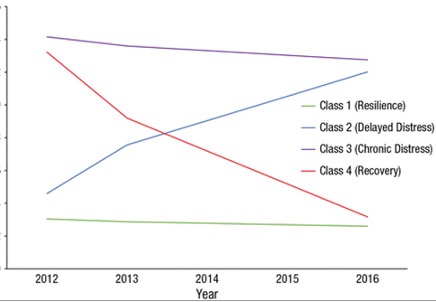
what does this research suggest
Over years most (> 3/4s) resilient
The resilient ones were more likely to be women..
..And to have great social support from others
Those living in temporary housing started off distressed..
.. But got better over time.
This may be because of increased community support. - in these cabin type of things they could support each other as they were surrounded by other people
Coping during conflict: Ukraine, April 2022
First weeks of wider Russian invasion, although conflict in the East/Crimea since 2014. Successful resistance against initial threat to Kyiv
Overwhelming majority see themselves as Ukrainians, but older people more likely to view themselves as Soviet Peoples (Rating Group, 2022).
High levels of population displacement (East to Western Ukraine, overseas)
Nevertheless very strong levels of national resilience.
People danced together despite this - high levels of resilience
Coping with Covid
“When individuals can proficiently assess their present situation, identify a coping strategy, and review or adjust these strategies until an effective strategy is employed, it is hypothesized that they will show greater probability of resilience after adversity” (Robinson et al, 2022).
BBC/Globescan (2022) found that more people reported feeling better rather than worse in June/July 2022 than they did before the pandemic (36% vs 27%)
but this varied by country (e.g 72% of those in Vietnam felt better, but only 7% in Japan),
Older people more likely to report that their mental health was not impacted (50% for those aged 65 and over))
Some other things that might be important in disasters
Previous experiences with event (e.g. earthquakes, terrorism). “Similar event inoculation”
Being close to an event generally means greater risk (“bulls-eye”)
Janoff-Bulman (1992): Where there have been moderate stressors in the past may be some inoculation against trauma, which help deal with new events. Build resilience
.. However, where the individual experienced extreme events, and no opportunity to build a more non -threatening world, they may be vulnerable. Poor mental health -> vulnerability.
Secure attachment with others. Can help you make good relationships and get support.
Being physically healthy! Particularly evident during COVID..
People with disabilities during COVID-19 (Tang & Goodwin, 2022)
People with disabilities particularly careful in avoiding the virus before the ending of restrictions (“freedom day”)
And remained so even when restrictions were lifted.
“impact of “Freedom Day” was decidedly unequal, and not everybody was freed in the same way and to the same extent”.
The role of values
Values help drive responses to threats.
In general, those high on conservation values (security, conformity and tradition values) worry more (Schwartz)
Some other influences: age and sex
During COVID-19 in US and UK
Women less comfortable using public transport, more likely to wear facemasks
Women maintained social distance, handwash regularly, avoided social gathering
Young were more prepared to go to restaurants/pubs
How does disaster impact on the psychology of a culture? (Gelfand, 2011)
Some cultures face considerable environmental threats. Disasters enable people to bind together but this needs to be done to reduce chaos, with non-normative deviant behaviour punished.
Possibly as a result of these threats those cultures which are ‘tight’ (strong norms, low tolerance of deviance) are also those that have suffered more
Floods, cyclones, droughts
Higher rates of communicable diseases, more pathogens in general.
The role of communication
Effective (comprehensible), trusted communication vital (e.g Shelter in place? Evacuate?).
During a nuclear disaster for example.. real risk of amplification of risk – making things potentially worse.
Media can accentuate sense of personal risk
communication cont
Different countries have access to different media sources for reliable information, and connectivity
And of course the past influences the present: Ipsos poll (2011) in 24 countries: support for nuclear power decreased following Fukushima
Slovic (2000): French trusted scientists more and saw greater benefits to nuclear power.
As a consequence good communication recognises cultural values
Communication needs to be culturally appropriate
During a crisis citizens instructed to act accordingly. COVID-19:
Restez prudents, ‘be careful’, France, use ‘common sense and personal responsibility’.
Germany, ‘Wer sich schützt, schützt uns alle’ (A person who protects themselves, protects all’),
Austria and Portugal ‘Schau auf dich, schau auf mich’ or ‘cuide de si, cuide de todos’ (‘take care of yourself, take care of everyone’).
‘Stay home and be kind’ and then ‘unite for recovery’ (New Zealand).
‘overcome together’ (Russia), ‘maintain physical not social distance’ (Georgia).
Economics: US, Trump - ‘Keep America Great’ by ‘Opening Up American Again’, (different in different States)
Things are particularly difficult when things are ambiguous..
Others help guide our responses. Emotions can be ‘contagious’; we observe others whose fears help guide our response (e.g. on an airplane).
“Observational fear learning”(also “emotional contagion”).
Mass Communication mediates responses
Finnish saying: “The one who adds information, adds pain”. Trust vital: communications must be trustworthy
Impacts of traumatic events widespread. Some evidence TV exposure better predictor of stress following 9/11 than direct exposure to events?
Social Media serves various function but can lead to problems.
After a typhoon and terror attacks: social media mediated relationship between disaster exposure and stress (More social media, more distress) (Goodwin et al, 2016).
So if exposed to event then went on social media, would be worse
How relationships may change after disasters
Change in relationships with others:
Those close to us,
Acquaintances
Those more distant (e.g. from an ‘outgroup’).
On one hand: we may seek comfort in others. Shared trauma create new liaisons
During covid-19 reports early in the lockdown of greater social cohesion.
ONS (2020): early on in lockdown 70% of people experienced increased kindness and sense of national unity.
Social support generally helps..
Social disruption and psychological distress 3 years after the 2004 Niigata-Chuetsu earthquake. Those who lost social networks after disaster at particular risk of psychological distress (Oyama et al, 2011).
Social support, particularly that offered by informal of friends and family networks, can moderate the impact of events
However, caution needed: Hobfoll & London (1986) study of Israeli women whose partners or relatives engaged in the 1982 Israel-Lebanon war. Turning to others suffering similar anxieties could lead to an exaggeration of the dangers faced by these men, perpetuating rumours and increasing anxieties
The role of communities and support
In some cultures, community support undoubtedly more important
In Japan, one year after the 2011 earthquake/tsunami, refugees in Miyagi Prefecture benefitted from having received social support
Support from a spouse, and to a lesser extent friend, associated with lower psychological distress up to five years later (Goodwin et al, 2019, BJP). However, support from a child or sibling had less impact
Indeed, support from some (e.g. daughter-in-law) may have a negative impact on psychological health.
Certain people help at dif times
In a review of the effect of being scared on relationships..
People try harder to start new relationships
And maintain existing ones (Plusnin et al, 2018)
However, this depends partly on whether they generally have secure attachments to others
Indeed, insecure people may be too afraid of rejection when they are stressed by thoughts of death
On the other hand..
Disruption to normal domestic practices - marital discord and increased domestic abuse eg covid
Community relations strained (is that 7 people in my neighbours garden?!)
Old tensions easily reignited (e.g. about suspicion that some groups are super spreaders, or hung to dry/die…)
Interviews a year after Fukushima:
On the one hand, relationship were closer
“Family is more important”
“Both my husband and I have jobs and didn’t speak to each other. Typical married couples in their 50s. During the 3.11 crisis, I figured that we have to rely on each other and to help each other. I found that family is very important. We didn’t need each other but after 3.11, we became much closer.”
On the other hand, relations strained
My parents-in-law let my children play in mud outside but I don’t want them to play in the mud because of possible high level of radiation. But I can’t tell them about that… Family members have different opinions about radiation which is difficult to deal with”
“My parents-in-law send us vegetables made in Fukushima but I don’t want my children to eat these Fukushima vegetables. But I can’t tell them not to send them to us”
In our Fukushima interviews
rejection and stigmatization of some..
Refugees vs. locals: “It becomes like our group and their group within the same community.”
“Too scared to say that I am from Fukushima”
“You’ve got money from TEPCO (company), treat us”
“Because of you guys in Fukushima, air got dirty even in Tokyo. Your fault. ”
Start stigmatizing people
‘Outsiders’
Disasters expose and augment preexisting social inequalities (Kaniasty & Norris). Reactions strongest amongst individuals suffering highest stress
“we lay the blame for the new threat on those outside one’s own community, the ‘other’” (Washer, 2004).
Post-disaster situation particularly difficult for those already marginalised;
“secondary victimisation” ‘anchored’ in pre-existing out-group attributions
Increased hate crimes to those perceived as Middle Eastern descent after 9/11 in US (Marshall et al, 2007).
Example: our work on terrorism
Attacks on January 7, 2015 on the satirical magazine ‘Charlie Hebdo’ and a kosher supermarket led to the death of 12 people.
Later, attacks in November by gunmen killed 130 on streets of Paris.
Online national panel survey in France four weeks after each attack (N= approx 2000 each time). Participants similar to the national population (on sex, age etc).
Psychological distress and post-traumatic stress were both related to an increase closeness with family members
But the more anxious also significantly less willing to have both occasional and more intimate relationships with the ‘out-group’
Some other findings from this terrorism study
Use of multiple media was related to greater distress. This was particularly the case for social media (particularly Facebook, Twitter)
Those most anxious were also more likely to report changing their political views.
Ideological intensification hypothesis. In response to terrorism, the conservative become more conservative, the liberal more liberal (Huddy & Feldman, 2011).
Our work in Ukraine
Questioned 2,000 people spread across Ukraine in an online survey, five weeks into the 2022 Russian invasion
Greater post-traumatic stress amongst those who were displaced from their homes, either within Ukraine or overseas
Women, and those who had lost a relative during the war, also more distressed.
On the other hand, evidence of national resilience was greater amongst the young, those who trusted others in their communities, lived in Ukrainian-speaking areas and were confident they could ‘bounce back’ from hardships.
In this same dataset
Asked about general difficulties in doing things as a measure of disability (walking a short distance, making social connections etc)
Those with any disability (including social difficulties in general) had higher levels of PTSD – it was the social difficulties rather than mobility etc. that was most predictive of this..
In another dataset of nearly 10,000 Ukrainian refugees across Europe we found poor visual health, those with pre-existing mental illness and those with restricted mobility had greater anxiety and poorer sleep…
We have recently collected in-depth qualitative data from Ukrainian war refugees with disabilities in the UK, and are doing the same now in Ukraine..
After the disaster
Sometimes a great deal of media attention
Communities may work together well at first to reconstruct
But things can soon change
In Poland after floods: “post-disaster bitterness”. (Kaniasty & Norris, 2009)
Result of lots of things, including
Complexities and liabilities involved in mobilizing help,
victim experiences of helpers,
disruption of usual communal activities and social life,
sense of disappointment about lack of expected aid,
sheer tiring weight of events…
Iceland, 2024
volcanic eruption
Emotions high when town was destroyed
Recovery from disasters
As ever, tougher for those already have it tough (e.g. the poor, some minority ethnic groups, many people with disabilities..)
Hobfoll talks about resource caravans – sets of resources that ‘travel together’ (e.g. status, family relations etc). Disasters can have a multi-level ‘domino’ effect.
Recovery depends on how long the ‘resource caravans’ can remain together and intact (Hobfoll et al, 2012). A lot of recovery depends even on the situation before the disaster
summary 1
There are different types of disasters (e.g. natural, technological, human-made)
.. But we have to be careful as ‘natural’ may be less natural than we think!
Human-made e.g, wars are often the most distressing
Risks are a mixture of the thing itself (hazard), our exposure and how vulnerable we are
We can think of a disaster as the before (preparedness), the event itself and the recovery
summary 2
Resource and culture are important throughout this process
Some e.g. people with disabilities, at particular risk
Psychologically, it is important to have a mindset which sees new threats as a challenge that can be overcome ..
And the ability to choose from a range of actions and then see which works – and change it if necessary
Most people are pretty resilient…
summary 3
Good and trusted communication is important during a pandemic
Close relationships with others can get closer – but there can be tensions too
And we can quickly blame those we disliked anyway!
Communities too can fragment, particularly when resources are tight
Recovery takes time, and effort - summary
Communities may come together initially after a disaster – but all communities contain different sub-groups, and pre-existing tensions can rapidly re-emerge (or worsen). Some rejected
Disasters can erode community sense, and sense of suspicion and cover ups.
Disasters can quickly undermine sense of well-being, and this might unfold over a long period of time, even if the disaster seems to be a ‘one-off’
Practical suggestions
Emergency planning must include campaigns targeting
those hardest to reach
Those with least resources
Must reassure already concerned individuals/groups – often these have values high in conservation values of security, conformity and tradition
Key communicators and community figures need to carefully monitor and react to social media to prevent damaging rumours.. even well after the initial disaster.
With resources and commitment, things can be done…
Eg new zealand christchurch rebuilding