Chapter 4: Energetics
 Call Kai
 Learn
 Practice Test
 Spaced Repetition
 Match
 Flashcards
 Knowt Play
1/18

Earn XP
Description and Tags
19 Terms
What is ΔH (enthalpy change)
the heat energy change measured under conditions of constant pressure
ΔcH
The Enthalpy change when one mole of a substance is completely burned in oxygen whilst under standard conditions
What are the standard states
298 K and 100kPa (1 atm)
ΔfH
The enthalpy change when 1 mole of Compound is formed from its elements whilst under standard conditions
What is the equation for ΔH
q = mcΔT
What does the letter Theta (θ) represent
Standard conditions
Bond enthalpies
Breaking bonds requires energy
Forming Bonds releases energy
When is a reaction exothermic
Breaking bonds>forming bonds
when is a reaction endothermic
Breaking<forming
What is the definition of Standard Enthalpy change of formation
The enthalpy change when one mole of a compound is formed in its standard state from its elements in their standard states
What is the definition of standard enthalpy change of combustion
The enthalpy change when one mole of a substance undergoes complete combustion under standard conditions and all reactants and products are in their standard states
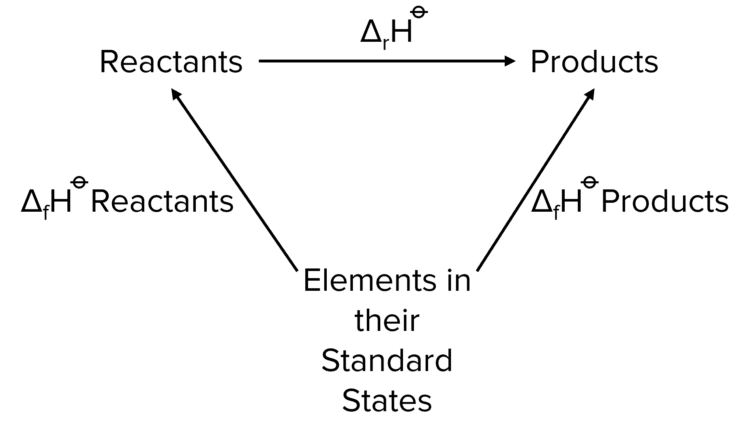
What type of Hess’ Cycle is this
Standard enthalpy of formation
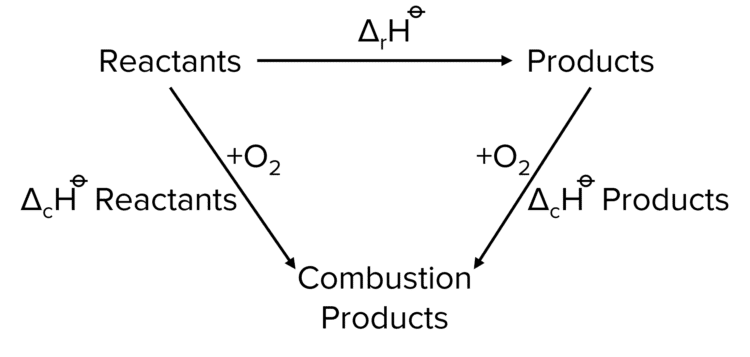
What type of Hess’ Cycle is this
Standard enthalpy of combustion
What are the most common errors in calorimetry
heat loss to the surroundings
Heat gained from the surroundings
When bonds are broken why do they not require the same amount of energy to break the bond every time
Every time a bond is broken within a compound the electron density changes
What is mean bond enthalpy
The average bond enthalpy over a range of compounds
what is the equation for uncertainty
Uncertainty = (uncertainty of instrument x number of times used) / quantity
Suggest two reasons why the value of enthalpy of combustion from an experiment is less exothermi
heat may have been lost to the surroundings
it may have undergone incomplete combustion
Why is incomplete combustion less exothermic than complete combustion
it is less efficient than complete combustion and therefore produces less energy