Bio2 Slides Exam 2
 Call Kai
 Learn
 Practice Test
 Spaced Repetition
 Match
 Flashcards
 Knowt Play
1/70

There's no tags or description
Looks like no tags are added yet.
71 Terms
What is homeostasis?
Steady state of physiological conditions in the body
SEQ GENERAL FEEDBACK REGULATION
STIMULUS (TRIGGER) —> RECEPTOR (DETECTS CHANGE) —> CONTROL CENTER (PROCESSES INFO) —→ EFFECTOR (CARRIES OUT RESPONSE)

What is the difference between positive & negative feedback mechanisms?
Negative feedback
Response to stimulus reduces stimulus (more common)
Positive feedback
Response to stimulus amplifies stimulus (less common)
Are living organisms open or closed systems?
Open systems that must exchange with their environment
For living organisms to exchange Nutrients, gases, & waste products, they must:
Must dissolve in aqueous solution before moving across the plasma membrane
What are Adapatations for exchange in internal exchange surfaces (increases surface area)
Branching (Alveoli in lungs)
Folding
Internal fluids
What are hormones, where are they released, and how do they function?
They are chemical signaling molecule messengers that allow for regulation in the body (basically allow cells to communicate w/ eachother)
they are secreted into the blood
they bind to target cells via the target cell’s specific receptors

What are receptors in cell communication? Are they used once and then replaced?
They are Large proteins or glycoproteins on/in target cells that recognize and bind to specific hormones.
They are Continually synthesized and degraded

In endocrine signaling, what is the type of secreting cell and the route taken to the target?
Endocrine cells secrete hormones into extracellular fluid
Hormones diffuse into the bloodstream & reach target cells
In paracrine & autocrine signaling, what is the type of secreting cell and the route taken to the target?
Cells produce & secrete local regulators
Act over short distances → diffusion (so acts on targets quickly)
In synaptic signaling, what is the type of secreting cell and the route taken to the target?
Neurons produce neurotransmitters (chemicals)
neurotransmitters Diffuse across a short distance of the synapse
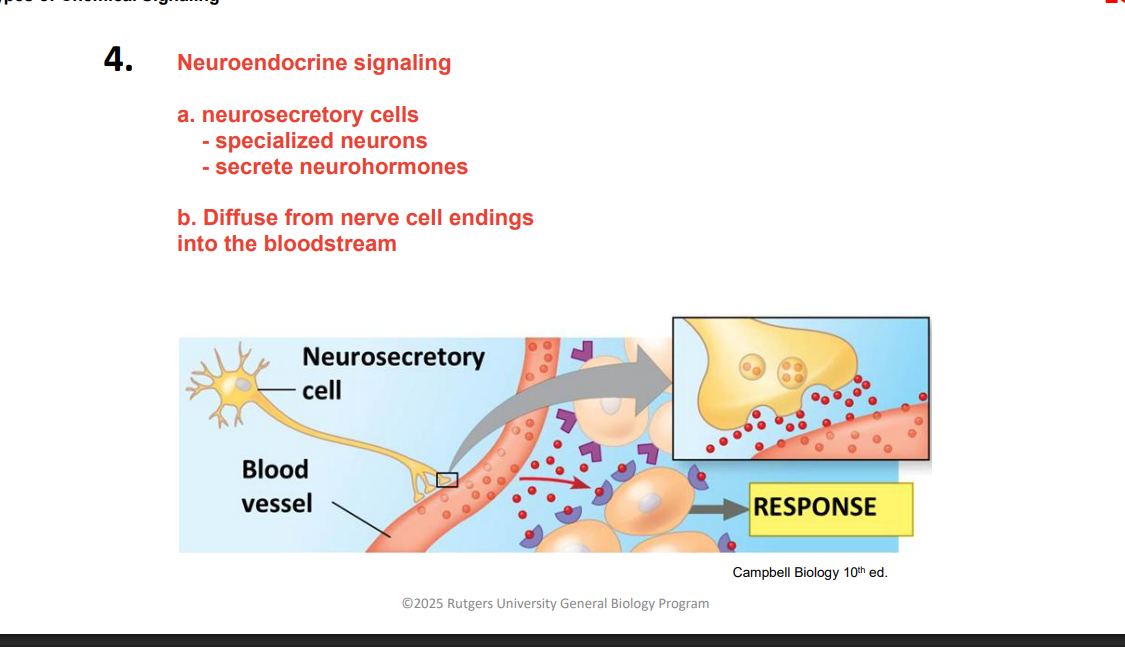
In neuroendocrine signaling, what is the type of secreting cell and the route taken to the target?
Neurosecretory cells secrete neurohormones
they diffuse from nerve cell endings into the bloodstream
What are the 4 major chemical classes of hormones and what are they made of?
Amine: single amino acid
Peptide : short chain of amino acids
Protein: long chain of amino acid
steroid: lipid with 4 fused c rings

What types of hormones are typically soluble in aqueous environments?
amine/ peptide/ protein hormones
What type of hormrones are Soluble in lipid-rich environments?
steroid hormones
The cellular response to pathways is based on:
solubility of the hormone
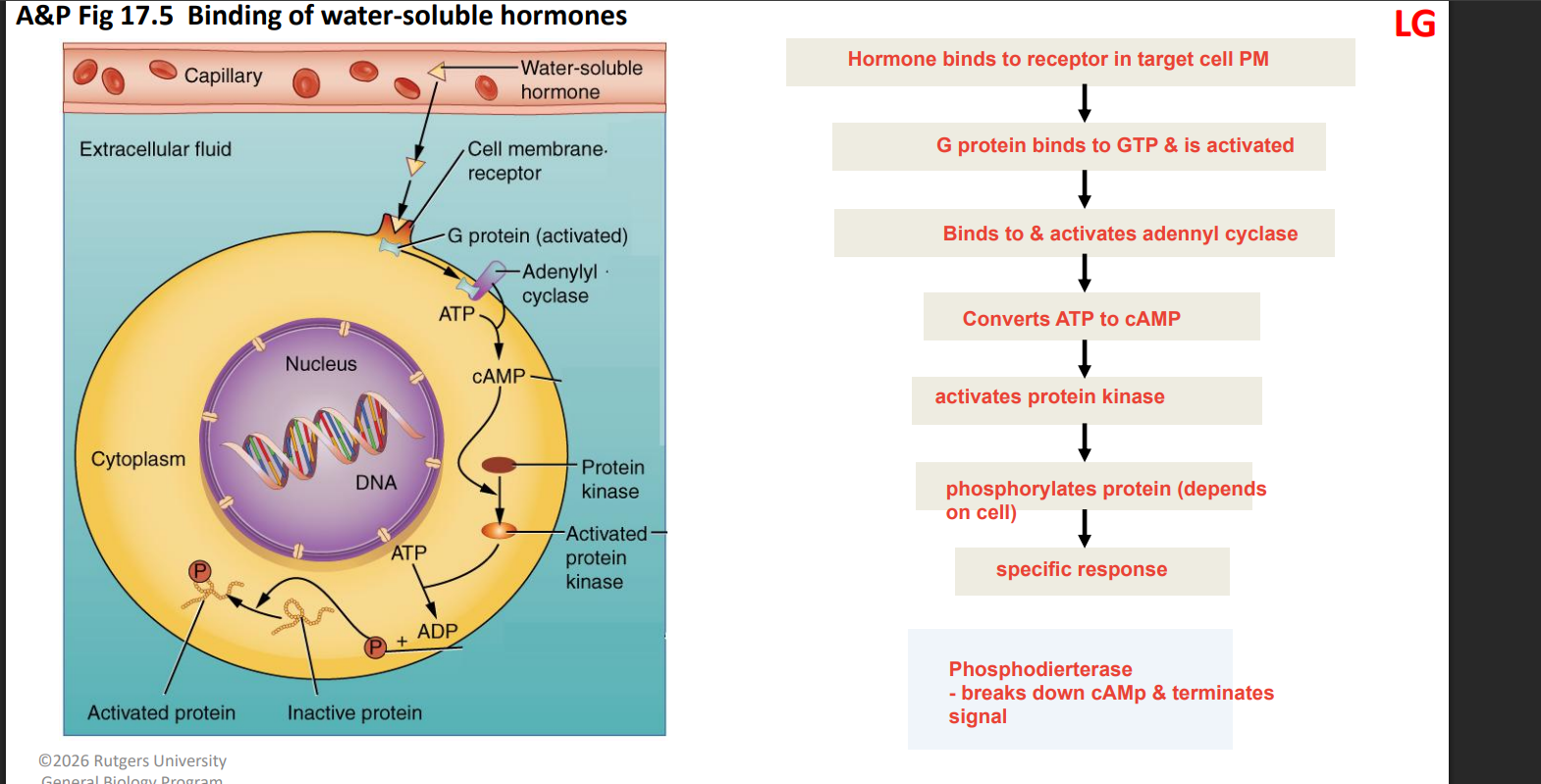
Explain these components of the water soluble pathway for hormones:
Hormone (does it enter cell?):
Receptor (where is located?):
G protein (Where is located, how does it change?):
Adenlyl cyclase (what is it, where is it?):
cAMP (where is it?)
Protein kinases (where, and what does it allow for?)

SEQ PATHWAY FOR WATER SOLUBLE HORMONES
SEQ PATHWAY FOR LIPID SOLUBLE HORMONES

What are the main differences between water soluble hormones and lipid soluble hormones? (where effect happens & how fast)
Water soluble hormones
Cause effects in the cytoplasm of target cells
Act faster
Lipid soluble hormones
Affect gene expression of target cells (get into nucleus and causes change to DNA)
Act slower, but longer lasting
What are the main differences between the Endocrine System and the Exocrine System? (mechanism of secretion, pathway, function)

What is the difference between tropic & non-tropic hormones?
Tropic: act on another endocrine gland to stimulate the release of other hormones
Non-tropic: act directly on target tissue
In vertebrate endocrine control, what is the hypothalamus (HYP), where is it located, what is it associated with, and what is its function?

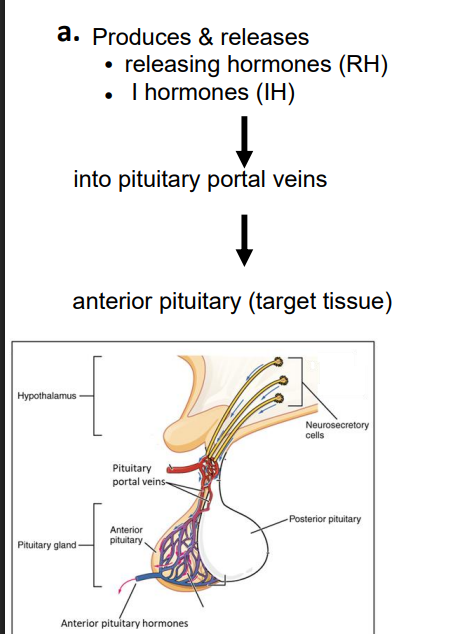
The hypothalamus (HYP) has two modes of action. SEQ the one that ends with the anterior pituitary
HYP Releases hormones (RH) and inhibiting hormones (IH)
into pituitary portal vessels
Direct path to anterior pituitary (AP)
Stimulate or inhibit release of specific hormones from AP
The hypothalamus (HYP) has two modes of action. SEQ the one that ends with the posterior pituitary
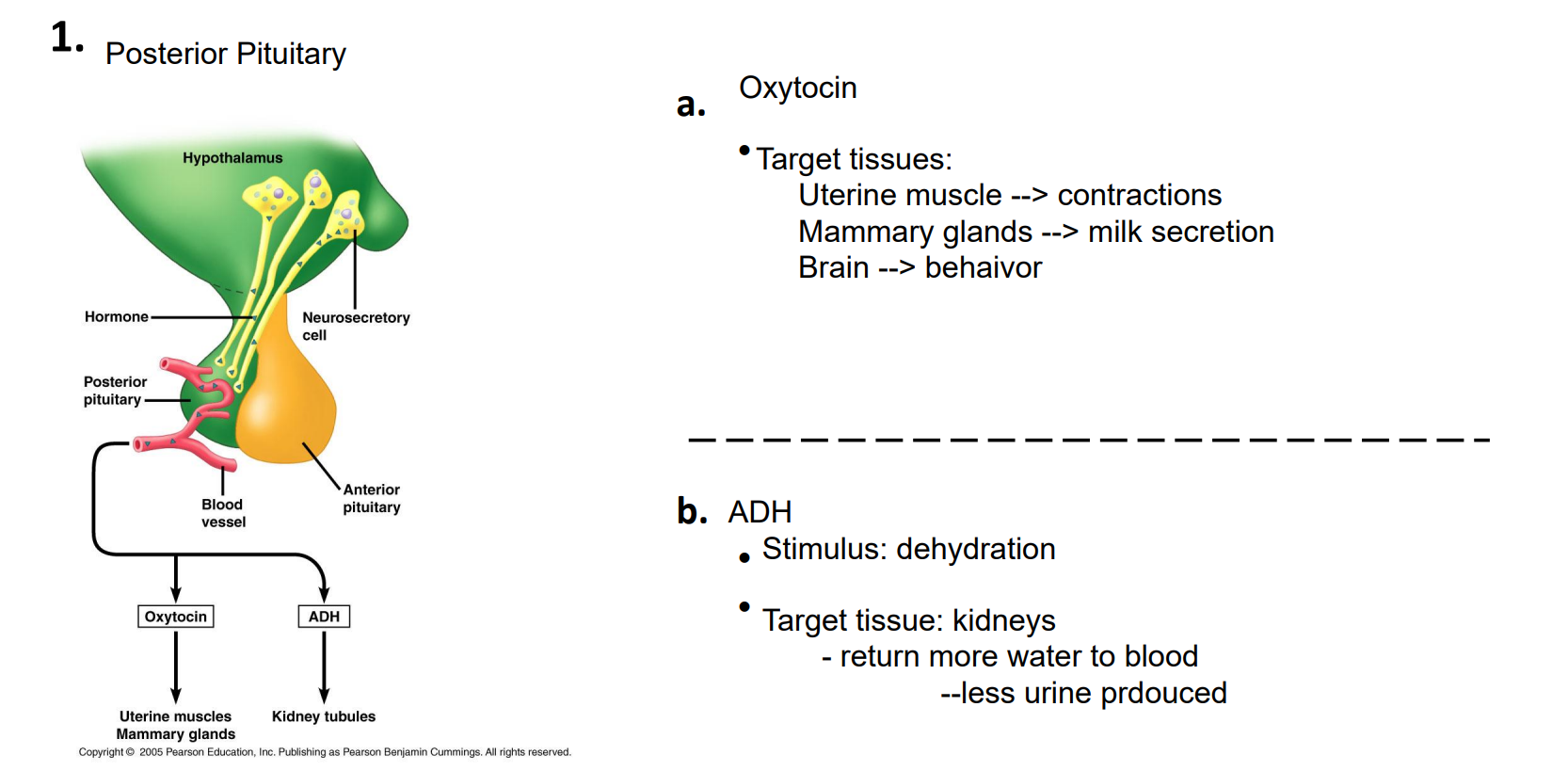
produces Antidiurectic Hormone (ADH) and oxytocin (OT)
Produced in cell bodies
Axons extend into posterior pituitary
Stored in vesicles until needed
Then released by the posterior pituitary

What are the 2 hormones released by the posterior pituitary and their target tissues?
What is the anterior pituiartary always influenced by?
The hypothalamus’s RELEASING HORMONES (RH) & sometimes INHIBITING HORMONES (IH)
THE HORMONE TRH (Thyrotropin RH) from the HYPOTHALAMUS (HYP) SHEET:
AFFECTS WHAT ANTERIOR PITUIARY HORMONE?
AFFECTS WHAT TARGET?
OVERALL EFFECT

THE HORMONE GH RH/IH (Growth Hormone RH/IH) from the HYPOTHALAMUS (HYP) SHEET:
AFFECTS WHAT ANTERIOR PITUIARY HORMONE?
AFFECTS WHAT TARGET?
OVERALL EFFECT

THE HORMONE CRH from the HYPOTHALAMUS (HYP) SHEET:
AFFECTS WHAT ANTERIOR PITUIARY HORMONE?
AFFECTS WHAT TARGET?
OVERALL EFFECT

THE HORMONE GnRH from the HYPOTHALAMUS (HYP) SHEET:
AFFECTS WHAT ANTERIOR PITUIARY HORMONE?
AFFECTS WHAT TARGET?
OVERALL EFFECT

What is thyroid and what type of hormones does it produce?

SEQ THRYOID HORMONE (TH) SECRETION

NOTE THE MAIN DIFFERENCES BETWEEN HYPO AND HYPERTHRYOIDISM

What happens if you have hyposecretion of the growth hormone in childhood?

How do you treat hyposecretion of the growth hormone in before puberty?
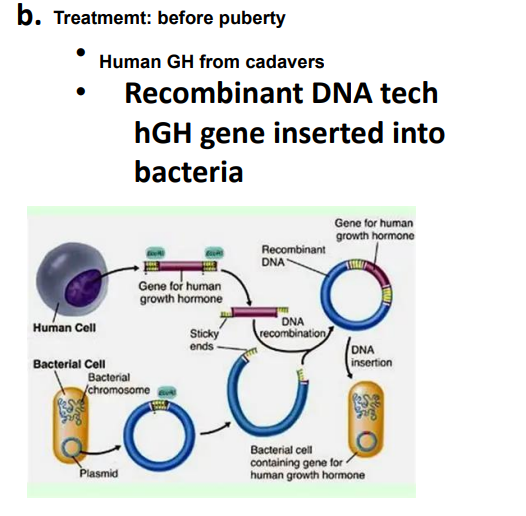
What happens if you have hypersecretion of the growth hormone in childhood?
Gigantism, normal proportions
What happens if you have hypersecretion of the growth hormone in childhood?

Where are the adrenal glands located, what 2 parts is it made of, and what is its function?
Adrenal cortex- Chronic stress
adrenal medulla -acute tress

SEQ HOW THE ADRENAL CORTEX MANAGES CHRONIC STRESS
During chronic stress
HYP secretes CRH
Ant pit releases ACTH
Adrenal cortex produces corticosteroids
SEQ HOW THE ADRENAL MEDULLA MANAGES ACUTE STRESS

wHAT ARE THE 2 MAIN TYPES OF Corticosteroids (rmbr that these are released by the Adrenal cortex, which manages chronic stress)
Glucocorticoids —> regulate glucose metabolism During stress → Energy for body cells
Mineralocorticoids → Regulate mineral metabolism —> Aldosterone —> Regulates H20 sodium balance in the blood (when stressed, dehydrated)
Where are the parathyroid glands and what is their funftion?

What do the parathyroid glands do if your blood calcium levels are too low? (Include indirect effects as well)

SEQ GLUCOSE HOMEOSTASIS BY THE PANCREAS (PLS MENTION 2 MAIN MOLECULES PRODUCED)

What is asexual reproduction? Is there meiosis? Is there fusion of gametes?
Single parent produces 2 or more offspring; clones are 100% genetically identical
No meiosis
No fusion of gametes
What are the 4 methods of asexual reproduction?
Budding: Small part of parent’s body
Fission: Parent separates into 2- equal individuals
Fragmentation & regeneration
Parent breaks into pieces —> Each produces missing parts
Parthenogenesis
Unfertilized egg (n) —> Undergoes mitosis —> Adult animal produced (n)
What are the advantages of asexual reproductiojn?
No mate needed
Rapid
100% of genes passed on
What are the two main parts of sexual reprdouction?
Production of gametes (meiosis)
Sperm
From male parent
Small, flagellated & motile
Egg (ovum)
Female parent
Large & nonmotile
Nutrients from embryo
Fertilization
Gametes fuse
Fertliized egg = zygote (2n)
What is the major disadvatnage of sexual repro?
Only 50% of genes passed on

What are the advantage of sexual reproduction for animals?
Promotes genetic recombination
Offspring better able to survive
Easier for population to get rid of harmful alleles
What is ploidy? CC haploid vs diploid

SEQ mitosis

SEQ meiosis

What are the two functions of the male reproductive system?
Spermatogenesis = process of sperm production
Deliver sperm to female reproductive tract
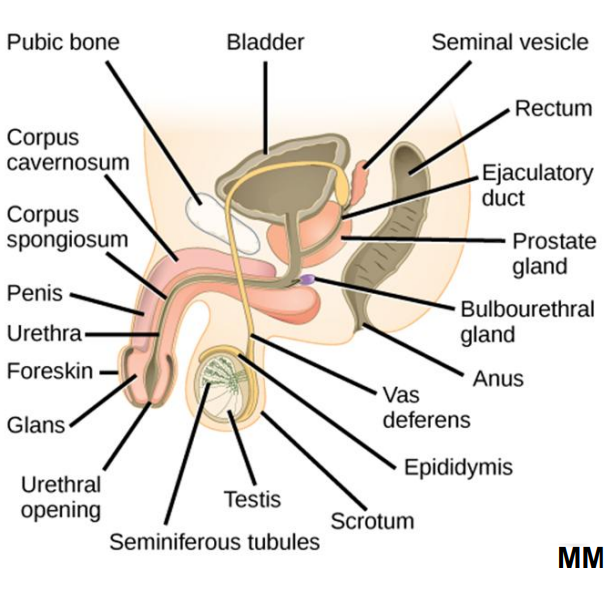
SEQ SPERM PATHWAY
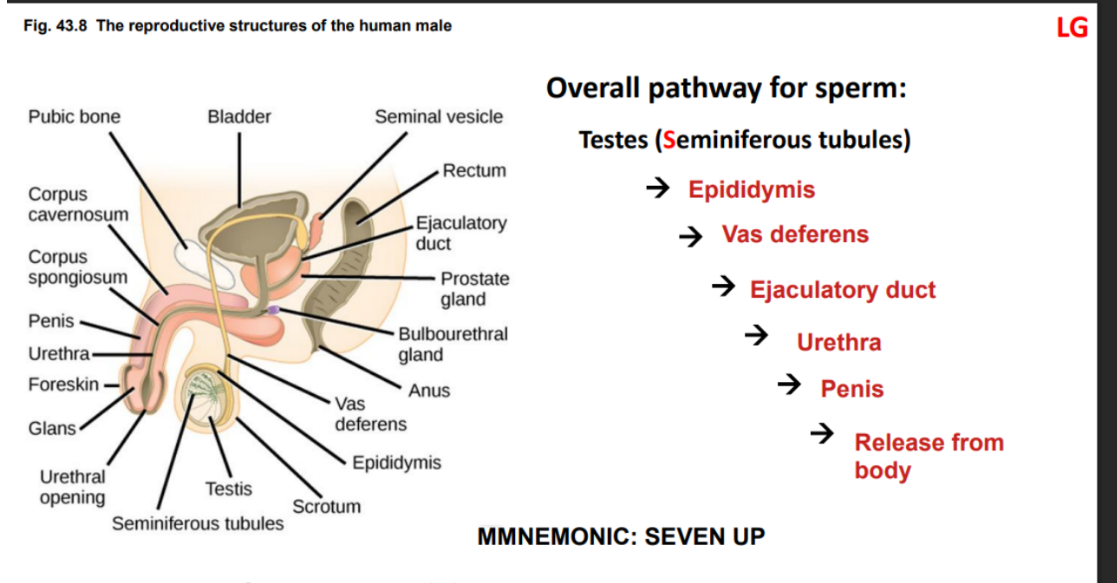
What do the testes in the male reproductive system consist of?
Semineferous tubules
Long & hollow tubes made up of Sertoli cells
Spermatogenesis happens in here
Leydig cells
Scattered between tubules
Testosterone & other sex hormones produced here

What is the epididymis in male reproductive system and its functions?
It is a coiled tube Coiled tube
Functions
Masturation: hanges the physical structure of the sperm so they gain the ability to swim forward.
Storage
Transport (-3 weeks

Both the testes & epididmyis in the male reproductive system are located where?
In the scrotum

4 key features of the scrotum
Suspended
1-2 degrees < body temp
Sperm production
Longetivity
What do the vas deferens in the male reproductive system consist of, and what is there function?
Sperm ducts (2)
Brings sperm from scrotum to pelvic cavity

What is a vasectomy, and what happens if you don’t get it?
Vasectomy (the cutting and tying off of the vas deferens)
If no vasectomy: the sperm can travel and empties into an ejaculatory duct
What is the ejucatlotry duct in the male reproductive system?

What is the urethra in the male reproductive system, where is it located, and what it is function
tube that goes Through penis
Urine & semen
What is the function if the penis in the male reproductive system and what does it consist of?
Copulatory organ
Sperm delivery
Glans
Most of sensory nerves
Foreskin
Loose-fitting skin
Circumcision
What are the 3 accessory glands in the male reproductive system and their functions (fluid + location of secretion)
Seminal vesicles (2)
Fluid made of Fructose (E) & Prostaglandins (uterine contractions that secrete into vas deferins
Prostate gland
Fluid with citrate *nutrient) that secretes into urethra
Bulbourethral glands (2)
Fluid with mucus (neutralizes acidic urine) that secretes into urethra
What is semen?
Mixture off sperm & fluids from glands
SEQ spermatogenesis/ sperm production

What are the components of a mture sperm cell?

What are androgens?
Male sex hormones such as testorene
SEQ HORMONAL CONTROL OF SPERM PRODUCTION
