Chapter 3: The Cellular Level of Organization
 Call Kai
 Learn
 Practice Test
 Spaced Repetition
 Match
 Flashcards
 Knowt Play
1/22

Earn XP
Description and Tags
Describe the structure and function of the cell membrane, including its regulation of materials into and out of the cell; describe the functions of the various cytoplasmic organelles; explain the structure and contents of the nucleus, as well as the process of DNA replication; explain the process by which a cell builds proteins using the DNA code; list the stages of the cell cycle in order, including the steps of cell division in somatic cells; discuss how a cell differentiates and becomes more specialized List the morphological and physiological characteristics of some representative cell types in the human body; describe the molecular components that make up the cell membrane; explain the major features and properties of the cell membrane; differentiate between materials that can and cannot diffuse through the lipid bilayer; compare and contrast different types of passive transport with active transport, providing examples of each
23 Terms
Cell Membrane
an extremely pliable structure composed primarily of back-to-back phospholipids (a “bilayer”)
Hydrophilic Molecule
one that is attracted to water
Hydrophobic Molecule
repels and is repelled by water
Amphipathic Molecule
one that contains both a hydrophilic and a hydrophobic region

phospholipid structure
Intracellular Fluid
(ICF) is the fluid interior of the cell
Extracellular Fluid
(ECF) is the fluid environment outside the enclosure of the cell membrane
Interstitial Fluid
(IF) is the term given to extracellular fluid not contained within blood vessels
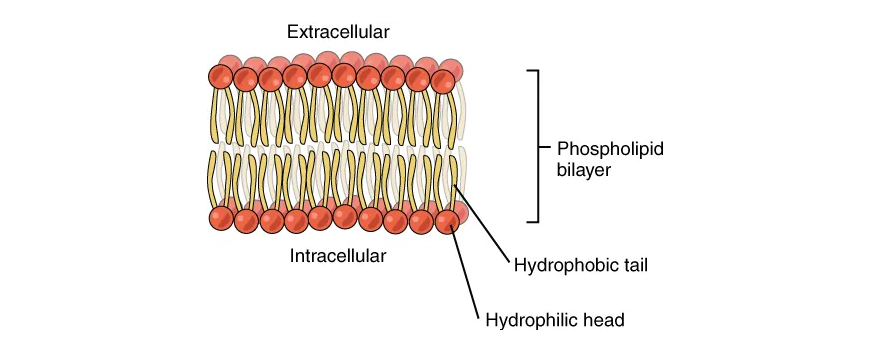
phospholipid bilayer
integral protein
a protein that is embedded in the membrane
Channel Protein
an example of an integral protein that selectively allows particular materials, such as certain ions, to pass into or out of the cell
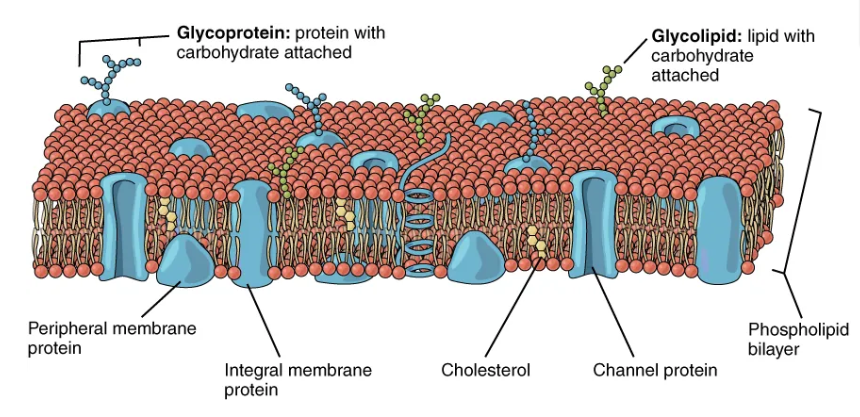
example of a cell membrane
Receptor
a type of recognition protein that can selectively bind a specific molecule outside the cell, and this binding induces a chemical reaction within the cell
Ligand
the specific molecule that binds to and activates a receptor
Glycoprotein
a protein that has carbohydrate molecules attached, which extend into the extracellular matrix
Glycocalyx
a fuzzy-appearing coating around the cell formed from glycoproteins and other carbohydrates attached to the cell membrane
Peripheral Proteins
found on the inner or outer surface of the lipid bilayer but can also be attached to the internal or external surface of an integral protein
Selective Permeability
allows only substances meeting certain criteria to pass through it unaided
Passive Transport
the movement of substances across the membrane without the expenditure of cellular energy
Active Transport
the movement of substances across the membrane using energy from adenosine triphosphate (ATP)
Concentration Gradient
the difference in concentration of a substance across a space

fluorescence-stained cell undergoing mitosis