Topic H - Transduction
 Call Kai
 Learn
 Practice Test
 Spaced Repetition
 Match
 Flashcards
 Knowt Play
1/29

There's no tags or description
Looks like no tags are added yet.
30 Terms
Transduction
Transfer of bacterial DNA from one cell to another by a bacteriophage
Transducing Particle
Phage particle carrying bacterial DNA
-Contains all normal phage coat proteins
-May or may not contain phage DNA
Transductant, Donor and Recipient
Donor Strain - Strain in which transducing particle is formed
Recipient Strains - Strain infected by transducing particle
-Receives donor DNA
Transductant - Cell that has received DNA by transduction and incorporated it into chromosome by recombination
-Altered genotype and phenotype
Types of Transduction
Generalized
Specialized
Types of Transduction - Generalized
Can transfer host DNA from anywhere on the donor chromosome
-Any gene can transfer (non-specific)
Transducing particle contains ONLY bacterial DNA
Types of Transduction - Specialized
Always transfers the same region of the donor chromosome
-Only certain genes are packaged and transferred (specific)
Transducing particle contains phage and bacterial DNA
Generalized Transducing Particle
Formed during Lytic cycle via rare error during headful packaging
-Contains only donor bacteria DNA (no phage DNA)
-DNA can be from anywhere on the donor chromosome
Contains all phage coat proteins —> Can adsorb to other bacterial cells and inject donor DNA
Generalized Transduction - Injection of DNA
When donor DNA is injected into the recipient cell:
Requires sequence similarity
Requires 2 crossovers
Results in transductants
-NO INFECTION occurs and NO phage particles are made in recipient
Headful Packaging and Generalized Transduction
Phage take up incorrect DNA due to errors in headful packaging
-Bacterial chromosome is fragmented at the beginning of the lytic infection
Concatemers will form during phage DNA replication
Mechanism of Generalized Transduction - Recognition
During packaging, phage nuclease recognizes either:
Packaging site (pac site) sequence
Nuclease cuts DNA at pac site → starts to fill phage head at the cut end
Recognizes a free end
Starts packaging at the end
Cuts DNA at set interval lengths that fill phage heads
Ex; T4 Phage
Mechanism of Generalized Transduction - Error in Recognition
Bacterial chromosome may get packaged instead of phage DNA
Nuclease recognizes pac site in bacterial chromosome fragment
Nuclease recognizes free end of bacterial chromosome fragments
Cuts chunks of chromosome for packaging into phage heads
Frequency of Generalized Transduction
Packaging of donor chromosome = very rare
-Most phage particles will be normal
-Only a few transducing particles formed
Each transducing particle will be different
Cotransduction
Transducing particles carry small pieces of donor DNA (50-100 genes)
-Genes only transduce if they are CLOSE enough to be on the SAME donor DNA fragment
Closer genes are = greater probability to be cotransduced
-Probability of coinfection by two transducing phages is 0 because transducing particles are so rare
Measuring Cotransduction
Infect donor cells (arg+/rifS) with phage
Purify progeny phage
Infect recipient cells (arg-/rifR) at low MOI (each cell infected ONCE)
Plate recipient cells on media on which ONLY transductants can grow
Select for ONE marker gene
Ex; Plate on MM —> Only arg+ transductants will grow
Screen for presence of second transduced gene
Replicate plate to plate with rifampicin: determine if transductants are rifS or rifR
Any cells that are arg+ and rifS are Cotransductants
Frequency of Co-transduction
% of total transductants selected for one marker that are also recombinant for the other marker
Formula:
CoF = # of CoF / # total transducants for ONE gene x 100%
-Higher CoF = Closer teh genes are
Opposite to RF, but same as cotransformation frequency
-BUT CoF is NOT the same as map units (in transformation)
Cotransduction Frequency Example
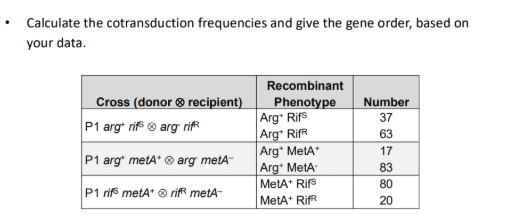
Cotransduction Frequency between Arg+ and RifS = 37 / 37 + 63 x 100% = 37%
-37% of bacteria that received arg+ also received rifS from the donor
Cotransduction Frequency between Arg+ and metA+ = 17 / 17 + 83 = 17%
Cotransduction Frequency between RifS and metA+ = 80 / 20 + 80 =80%
Gene Order is metA–RifS–Arg
Specialized Transduction
Occurs during the Lysogenic Cycle
-Result of incorrect excision of integrated prophage from host chromosome
-Produces a specialized transducing particle; contains both donor bacterial and phage DNA
Lysogenic Infection
Prophage integrates into bacterial chromosome
-Phage DNA circularizes
Integrates into host chromosome by recombination between attB and attP sites
-When induction occurs Lytic Cycle is initiated
-Phage DNA excised from host chromosome via recombination between attB/P and attP/B
Ex: attB is between gal and bio genes in E.Coli chromosome
Mistakes During Excision
Rare (1 in 1 million excisions)
-Recombination occurs at incorrect sites, some bacterial DNA removed from chromosome
-ALWAYS the DNA immediately next to the att sites, only from one side of prophage (gal OR bio)
Some phage DNA is left in the bacterial chromosome
-DNA is packaged in phage head and released by lysis
Aberrant Excision
Recombination occurs at the wrong spot
-attP and attB sites do not regenerate (remain attP/B and attB/P)
-Phage DNA excised carries a little bit of bacterial DNA
Phages produced are “defective” because they cannot make new viruses with their new genome (because they lack certain phage DNA)
Defective Transducing Particles
Some phage genes will be missing
-Which genes are missing depends on where aberrant excision occurs
-Phage particles will be defective
Defective Particle - λdgal
Dervied from the lambda (λ) phage
-d = defective, lacks tail genes
-gal = contains gal gene from bacterial DNA
Infection by a Specialized Transducing Particle
If specialized transducing particle infects recipient cell:
-Cannot produce functional phage particles because it is missing essential genes
Requires co-infection with a “helper phage” to produce more phage particles in subsequent infections
-Second phage provides missing proteins from the tranducing particle’s genome
Specialized Transduction - Forming Transducants
Donor DNA enters recipient cell, but does NOT integrate at att site in recipient chromosome (phage attP site is missing)
-Donor DNA enters genome via homologous recombination with bacterial genes
Double crossover replaces recipient gene with donor gene
Single crossover integrates entire DNA molecule
One crossover is more common than double crossover
λdgal Transductant Example - Double-Crossover
Double crossover between λdgal+ and gal- recipient chromosome, yields stable gal+ transductants
-Bacterial donor DNA carried by phage recombines into recipient chromosome
-NO prophage is present in transductant
If double crossover is present = gal+ phenotype is stable and maintained throughout generations
λdgal Transductant Example - Single-Crossover
Single crossover between λdgal+ and gal- gene on recipient chromosome
-Defective prophage is integrated into the chromosome
-Results in the duplication of the gal gene (recipient now has gal+/gal-), results in instability
Because intramolecular recombination can occur between gal+ on λdgal and gal- on recipient chromosome, one copy of the gene is lost (unstable)
-Resolution will often cause this cell to revert back to original genotype if selection is NOT present
Transduction and Resistance - Experiment 1
“How does phage metagenome change with antibiotic resistance”
-Mice treated with different antibiotics for 8 weeks w/ different mechanisms of action (cipro and amp)
-Collected fecal samples
-Purified phage/extracted phage DNA
-Sequence phage DNA ONLY (not bacterial DNA)
-Identifed genes involved in antibiotic resistance in bacteria
Results of Experiment 1
Phage from antibiotic-treated mice contained bacterial antibiotic resistance genes, conveying resistance to:
-Treatment drug
-Other drug classes
And a variety of different resistance mechanisms
-Phages carry genes for antibiotic resistance, but can they transfer them?
Transduction and Resistance - Experiment 2
“Can resistance genes be transferred from phage to bacteria”
-Cultured gut bacteria from mice NOT exposed to antibiotics (“naive microbiota”)
-Infected culture with phage isolated from antibiotic-treated mice
-Tested infected bacteria for antibiotic resistance
Results of Experiment 2
Bacteria infected with phage from treated mice acquired antibiotic resistance
-Phage transduction may be a mechanism for the spread of antibiotic resistance