Biology: Translation and Protein Synthesis in DNA
 Call Kai
 Learn
Learn Practice Test
 Spaced Repetition
 Match
Match Flashcards
 Knowt Play
1/25

There's no tags or description
Looks like no tags are added yet.
Name | Mastery | Learn | Test | Matching | Spaced | Call with Kai | Chat |
|---|
No analytics yet
Send a link to your students to track their progress
26 Terms
What is the Central Dogma of Biology?
DNA is transcribed into mRNA, which is then translated into proteins.
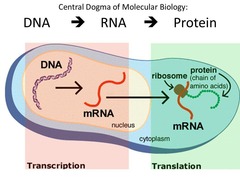
What is the purpose of translation?
To produce polypeptides (proteins) that carry out cellular functions.
What is the process of protein synthesis?
The process of using instructions carried on a gene to create proteins: DNA (gene) → RNA → Protein.

What is a codon?
A set of 3 bases from nucleic acids that corresponds to one amino acid.
How many amino acids are there?
There are 20 amino acids.
What are essential amino acids?
9 amino acids that cannot be made by the body and must be consumed.

What are nonessential amino acids?
11 amino acids that can be made by the body.
What is the genetic code?
A set of 3 nucleotide sequences (codons) that correspond to each amino acid.

What does it mean that the genetic code is redundant?
Some amino acids have more than one codon.
What is the role of tRNA in translation?
tRNA converts codons on mRNA to amino acids.

What are the components needed for translation?
mRNA, amino acid supply, tRNA, enzymes, and ribosomes.

What is the function of ribosomes?
Ribosomes coordinate the functioning of mRNA and tRNA and catalyze the synthesis of polypeptides.
What is the first step of translation?
Initiation, where mRNA, tRNA, and ribosomal subunits come together.
What signals the start of translation?
The AUG codon, which codes for Methionine (Met).
What happens during the elongation phase of translation?
Amino acids are added one-by-one to the growing polypeptide chain.

What occurs during termination of translation?
A stop codon reaches the ribosome's A site, signaling the end of translation.

What are stop codons?
Codons (UAA, UAG, UGA) that do not code for amino acids but signal the end of translation.
What is the role of enzymes in translation?
Enzymes are required to add amino acids to tRNA.
How does the ribosome facilitate peptide bond formation?
The ribosome catalyzes the formation of peptide bonds between amino acids.
What is the significance of the universality of the genetic code?
It suggests that all organisms share a common ancestor and is key to modern DNA technologies.
What is the role of ATP in translation?
ATP provides energy for attaching amino acids to tRNA.

What happens to the polypeptide after translation?
It coils and folds into a 3D shape, and several proteins can form larger complexes.
What is the anticodon?
A special triplet of bases on tRNA that is complementary to the codon on mRNA.
What is the significance of the P site and A site in ribosomes?
The P site holds the current tRNA of the growing peptide, while the A site receives the next tRNA.
What is the function of the small ribosomal subunit during initiation?
It attaches to the 5' end (cap) of mRNA to start translation.

How do codons and anticodons interact during translation?
They pair through hydrogen bonding, allowing tRNA to bring the correct amino acid to the ribosome.
