redox ii
 Call Kai
 Learn
Learn Practice Test
 Spaced Repetition
 Match
Match Flashcards
 Knowt Play
1/11

There's no tags or description
Looks like no tags are added yet.
Name | Mastery | Learn | Test | Matching | Spaced | Call with Kai | Chat |
|---|
No analytics yet
Send a link to your students to track their progress
12 Terms
Which blocks of periodic table undergo oxidation / reduction
Oxidation- s block, d block and p block
Reduction - p block
Standard electrode potential
The voltage or electromotive force of a half cell when it is connected to a standard hydrogen electrode under standard conditions
How do electrochemical cells work
Use redox reactions since the electron transfer between products creates a flow of electrons ( a current)
Standard hydrogen electrode and standard conditions
Used as a reference for all half cell potentials as it has a standard electrode potential of zero
Standard conditions:
-solutions of 1.0mol dm-3 conc
-298K
-100kPa pressure
Electrochemical cell set up
2 components called half cells, the potential difference is cell potentials

Salt bridge
Needed to complete the electrical circuit, usually made of a conc solution of potassium nitrate solution soaked by filter paper
Should contain ionic salt to allow ions to move but not one that will interfere w half cells
Eg potassium chloride cant be used w solution of silver nitrate
Signs of electrode potential values
Negative sign shows polarity to hydrogen, flow from neg to positive
Standard potential is measure whe. No electrons are flowing so both half cells are in equilibrium
Measuring standard electrode potential of systems involving gases
Different oxidation states
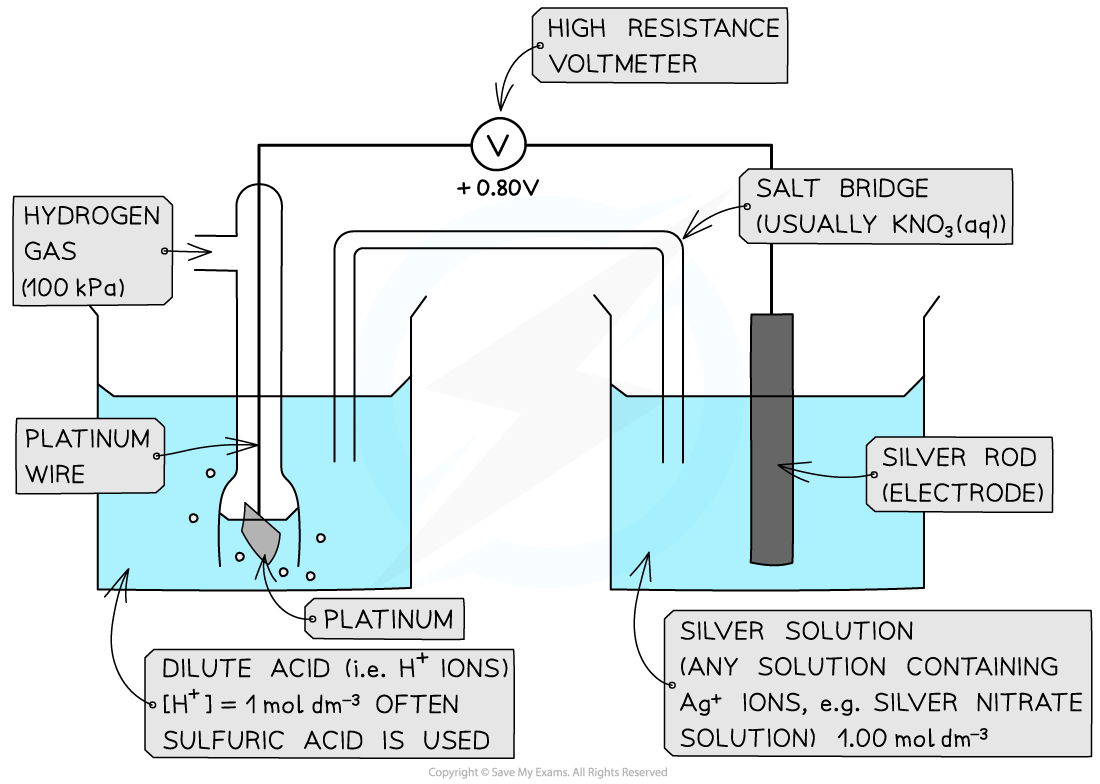
EMF definition
The electromotive force is the standard electrode potential of a half cell, measured under standard conditions of 298K, 100kPa, and conc of 1mol-3 connected to a standard hydrogen electrode
How to calculate e cell
Reduction - oxidation
How are electrode potentials listed as an electrochemical series
At the top, theres the most negative e so the equilibrium lies furthest to the left and it is best at releasing electrons and forming ions
At the bottom theres the most postitve e so equilibrium lies furthest to the right and it is reluctant to release electrons and form ions
Predicting feasibility
-the thermodynamic feasibility of a chemical reaction can be predicted using standard electrode potentials positive = feasible
However, a reaction may be thermodynamically feasible but might not take place because the reactants might be kinetically stable so the activation energy would be large and it would not take place at standard conditions pr it might not be taking place under standard conditions
Changing conditions may alter position of eq so the half cell changes and it might be feasible