Protein synthesis

0.0(0)
Studied by 1 person
call kaiCall Kai
learnLearn
examPractice Test
spaced repetitionSpaced Repetition
heart puzzleMatch
flashcardsFlashcards
GameKnowt Play
Card Sorting

1/18

encourage image

There's no tags or description

Looks like no tags are added yet.

19 Terms

1
New cards

DNA is master blueprint that holds the code for ________ ________

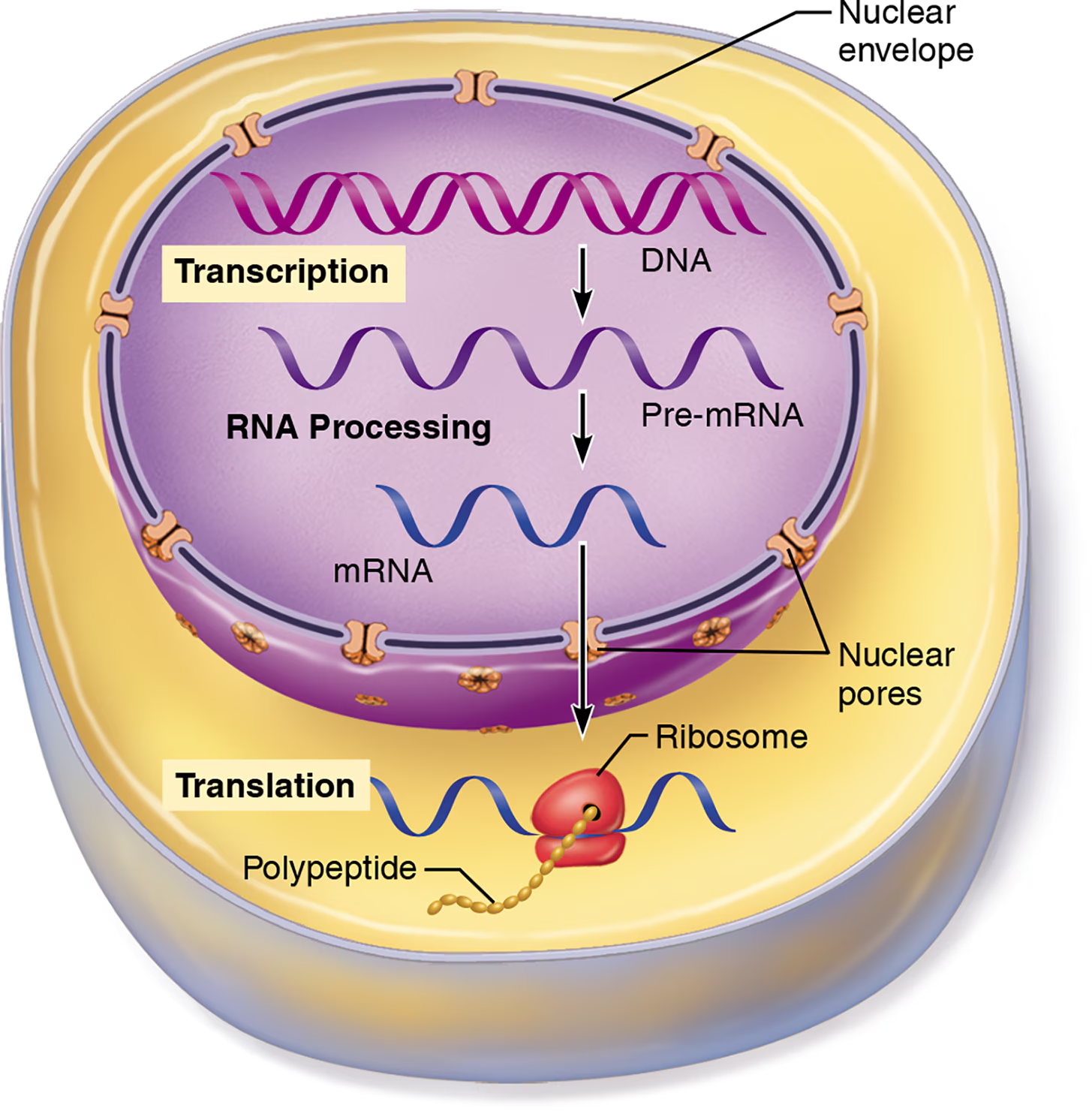
DNA is master blueprint that holds the code for protein synthesis

  • DNA directs the order (sequence) of amino acids in polypeptide

<p>DNA is master blueprint that holds the code for <strong>protein synthesis</strong></p><ul><li><p>DNA directs the order (sequence) of amino acids in polypeptide </p></li></ul><p></p>
2
New cards

What is a gene

  • A segment of DNA (sequence of nucleotides - ATCG) that holds the code for one polypeptide (protein) is referred to as a gene

  • The code is determined by the specific order of nitrogen bases (Adenine, Guanine, Thymine, and Cytosine) in the gene

    •  The code consists of 3 sequential bases (triplet code)

    • Each triplet specifies the code for a particular amino acid


3
New cards

Genes are composed of ______ and ______

  • Genes are composed of exons and Introns

    • Exons are part of gene that actually codes for amino acids

    • Introns are noncoding segments interspersed amongst exons


<ul><li><p><span style="background-color: transparent;">Genes are composed of <strong><u>exons </u></strong>and <strong><u>Introns</u></strong></span></p><ul><li><p><span style="background-color: transparent;"><strong><u>Exons</u> </strong>are part of gene that actually <u>codes</u> for amino acids</span></p></li><li><p><span style="background-color: transparent;"><strong><u>Introns</u>&nbsp;</strong>are <u>noncoding </u>segments interspersed amongst exons</span></p></li></ul></li></ul><p></p>
4
New cards

what is Role of RNA

  • RNA is the “go-between” molecule that links DNA to proteins

All RNA is formed in nucleus                      

ATC

  • A-U 

  • mRNA UAG

    • T-A

    • C-G

  • Three types of RNA

    • Messenger RNA (mRNA)

    • Ribosomal RNA (rRNA)

    • Transfer RNA (tRNA)


5
New cards

Messenger RNA mRNA

  • Single stranded; code from DNA template strand is copied with complementary base pairs, resulting in a strand of mRNA

    • Process is referred to as Transcription

  • mRNA maintains the triplet code (codon) from DNA


6
New cards

Ribosomal RNA rRNA

  • Structural component of ribosomes, the organelle where protein synthesis occurs

  • Along with tRNA (transfer RNA), helps to translate message from mRNA into polypeptide


7
New cards
<p><span style="background-color: transparent;"><strong>Transfer RNA (tRNA)</strong></span></p>

Transfer RNA (tRNA)

DNA  ATC

mRNA   UAG - codon

tRNA   AUC  - anti codon

  • Carrier of amino acid

  • Have special areas that contain a specific triplet code (anticodon) that allows each tRNA to carry only a specific amino acid

  • Anticodon of tRNA will complementary base-pair with codon of mRNA at ribosome, adding its specific amino acid to growing polypeptide chain

    • Process is referred to as Translation - happens at ribosome


8
New cards

Protein synthesis occurs in two steps:

  • Transcription - Nucleus

    • DNA information coded into mRNA

  •  Translation - Ribosome

    • mRNA decoded to assemble protein


9
New cards

Transcription

  • Process of transferring code held in DNA gene base sequence to complementary base sequence of mRNA

  • Transcription factors (protein complex) activate transcription by:

    • Loosening histones from DNA in area to be transcribed so DNA segment can be exposed

    • Binding to special sequence of gene to be transcribed, called Promoter (starting point)

      • Occurs only on DNA template strand

    • Mediating binding of RNA polymerase, enzyme that synthesizes mRNA, to promoter region

    • (DNA replication ->  DNA Polymerase)


10
New cards

Transcription is broken down into three phases:

  • Initiation

    • RNA polymerase separates DNA strands

  • Elongation

    • RNA polymerase adds complementary nucleotides to growing mRNA matching sequence of based on DNA template strand strand

  • Termination

    • Transcription stops when RNA polymerase reaches special Termination signal code code


<ul><li><p><span style="background-color: transparent;"><strong><u>Initiation</u></strong></span></p><ul><li><p><span style="background-color: transparent;"><strong>RNA polymerase separates DNA strands</strong></span></p></li></ul></li><li><p><span style="background-color: transparent;"><strong><u>Elongation</u></strong></span></p><ul><li><p><span style="background-color: transparent;">RNA polymerase adds <strong><u>complementary nucleotides</u> </strong>to growing mRNA matching sequence of based on <strong>DNA template strand</strong> strand</span></p></li></ul></li><li><p><span style="background-color: transparent;"><strong><u>Termination</u></strong></span></p><ul><li><p><span style="background-color: transparent;">Transcription stops when RNA polymerase reaches special <strong>Termination signal code</strong> code</span></p></li></ul></li></ul><p></p>
11
New cards

Processing of mRNA

  • Newly formed mRNA is then edited and processed before translation can begin

    • Before processing, it is referred to as pre-mRNA

  • Introns are removed by special proteins called Spliceosomes, leaving only exon coding regions


12
New cards
<p><span style="background-color: transparent;"><strong>Translation</strong></span></p>

Translation

  • Step of protein synthesis where the language of nucleic acids (base sequence) is translated into the language of proteins (amino acid sequence)

  • Process involves:

    •  mRNA

    •  Genetic code

    •  tRNA and ribosomes

    • Translating events

    • and sometimes the rough ER


<ul><li><p><span style="background-color: transparent;">Step of protein synthesis where the language of nucleic acids (base sequence) is translated into the language of proteins (amino acid sequence)</span></p></li><li><p><span style="background-color: transparent;">Process involves:</span></p><ul><li><p><span style="background-color: transparent;">&nbsp;mRNA</span></p></li><li><p><span style="background-color: transparent;">&nbsp;Genetic code</span></p></li><li><p><span style="background-color: transparent;">&nbsp;tRNA and ribosomes</span></p></li><li><p><span style="background-color: transparent;">Translating events</span></p></li><li><p><span style="background-color: transparent;">and sometimes the rough ER</span></p></li></ul></li></ul><p></p>
13
New cards

Genetic code

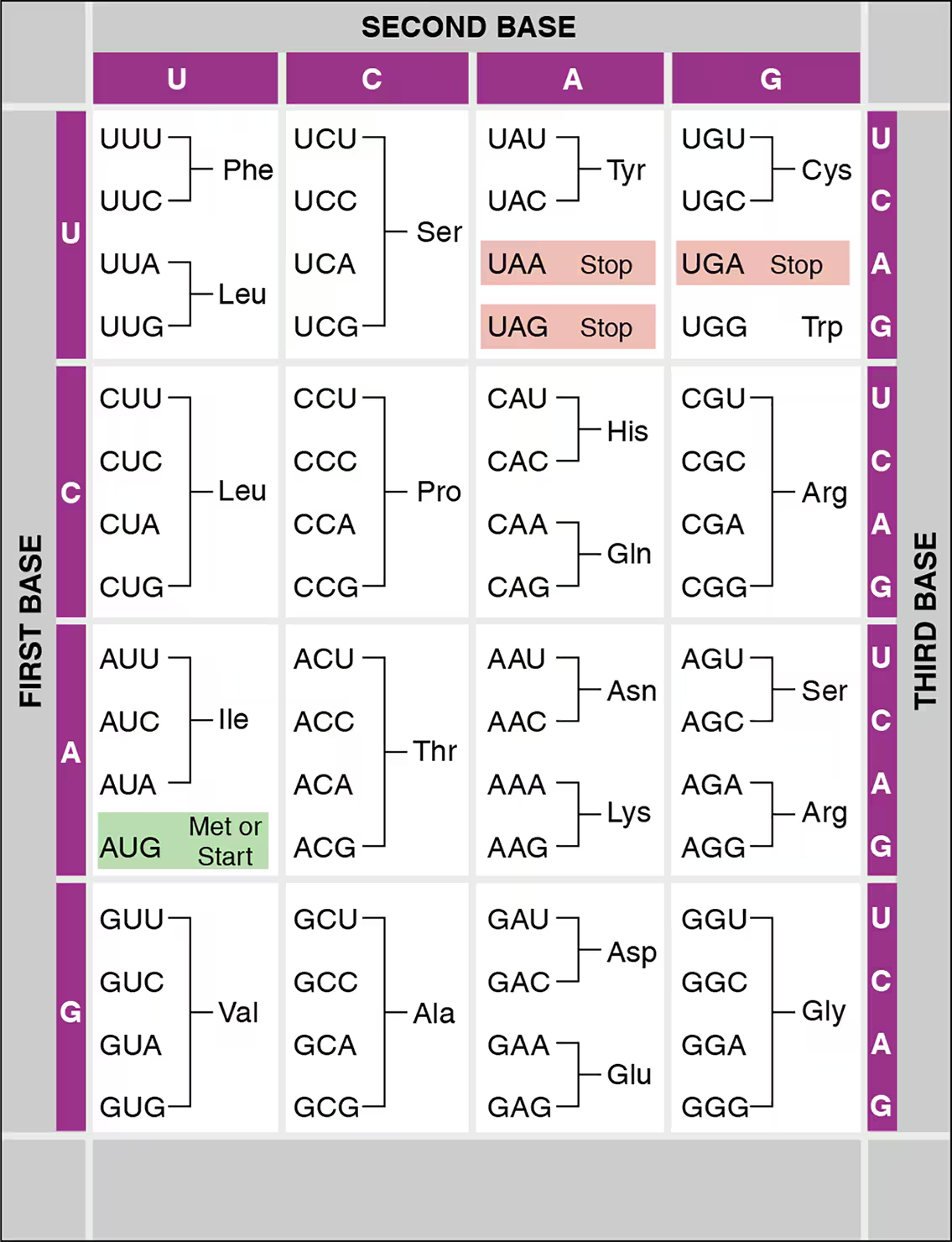
  • Each three-base sequence on DNA (triplet code) is represented by a complementary three-base sequence on mRNA called codon

  • There are 64 possible codons

    • (genetic code as a language, has 4 letters) , 4 bases (A, U, C, G) and 3 places, so 43 = 64 - words or combinations

  • There are 3 “stop” codons but rest are codons for amino acids

  • There are only 20 possible amino acids, so this means that some amino acids are represented by more than one codon

    •  Redundancy helps protect against transcription errors

<ul><li><p><span style="background-color: transparent;">Each three-base sequence on DNA (triplet code) is represented by a complementary three-base sequence on <u>mRNA called </u><strong><u>codon</u></strong></span></p></li></ul><ul><li><p><span style="background-color: transparent;">There are<u> 64 possible codons</u></span></p><ul><li><p><span style="background-color: transparent;">(genetic code as a language, has 4 letters) , 4 bases (A, U, C, G) and 3 places, so 4<sup>3</sup> = 64 - words or combinations</span></p></li></ul></li><li><p><span style="background-color: transparent;">There are 3 <u>“stop” codons </u>but rest are codons for amino acids</span></p></li><li><p><span style="background-color: transparent;">There are only 20 possible amino acids, so this means that some amino acids are represented by more than one codon</span></p><ul><li><p><span style="background-color: transparent;">&nbsp;<strong>Redundancy helps protect against transcription errors</strong></span></p></li></ul></li></ul><p></p>
14
New cards
<p><span style="background-color: transparent;"><strong>Role of tRNA</strong></span></p>

Role of tRNA

  • tRNA binds a specific amino acid at one end (stem); once amino acid is loaded onto tRNA, molecule is now called an animoacyl-tRNA

  • Anticodon at other end (head) is triplet code that determines which amino acid will be bound at stem 

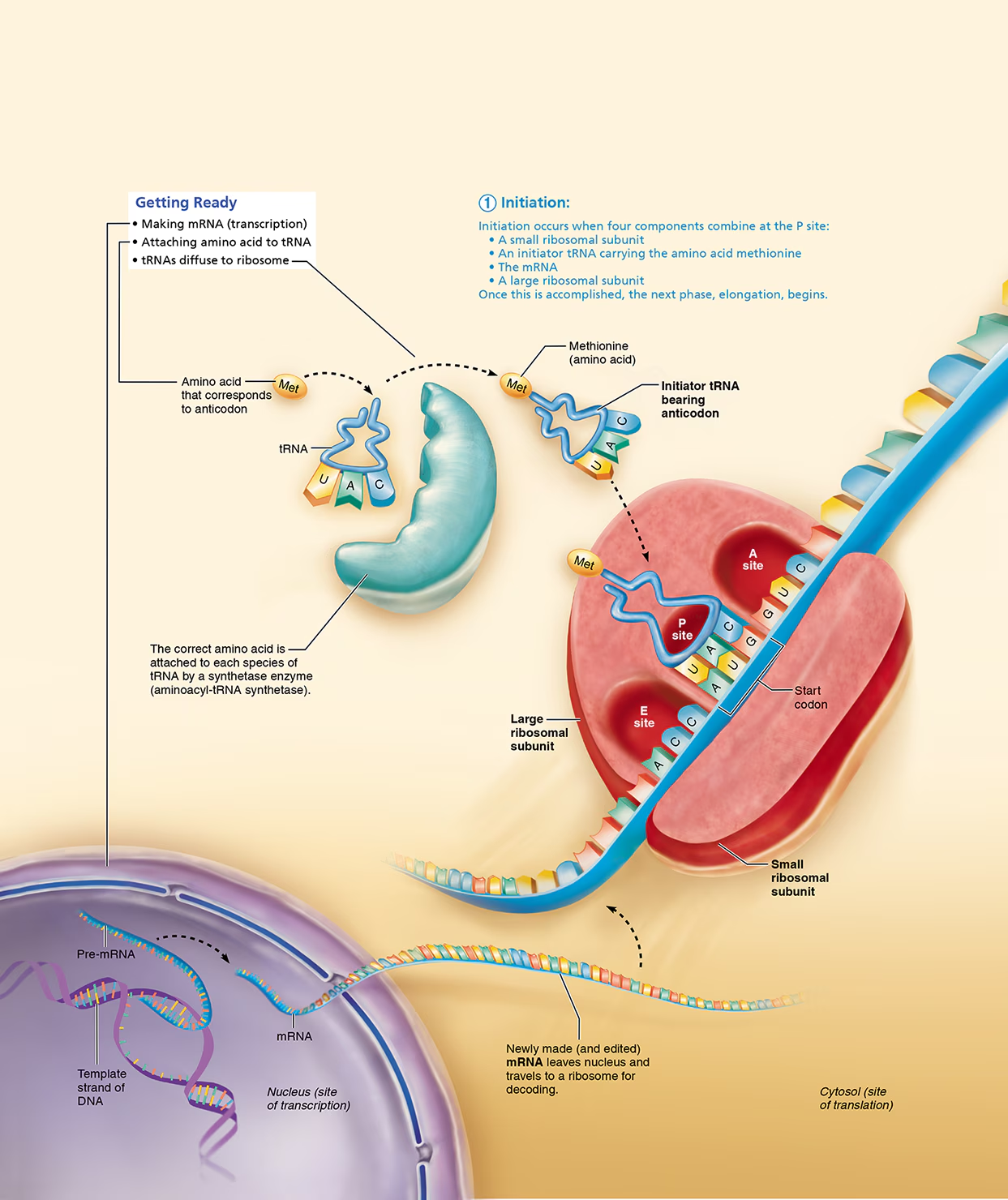
    • Example: tRNA with anticodon UAC will only be able to load a methionine amino acid to its stem region

  • Anticodon of tRNA will bind only to codon on mRNA that is that is complementary

    • Example: if codon is AUA, only a tRNA with anticodon UAU will be able to bond

  • Ribosomes coordinate coupling of mRNA and tRNA

  • Ribosomes contain one binding site for mRNA and three binding sites for tRNA:

    • Aminoacyl site for incoming aminoacyl-tRNA

    • Peptidyl site site for tRNA linked to growing polypeptide chain -peptide bond

    • Exit site site for outgoing tRNA


<ul><li><p><span style="background-color: transparent;">tRNA binds a specific<em> amino acid</em> at one end (stem); once amino acid is loaded onto tRNA, molecule is now called an <strong>animoacyl-tRNA</strong></span></p></li><li><p><span style="background-color: transparent;"><strong>Anticodon </strong>at other end (head) is triplet code that determines <em>which amino acid </em>will be bound at stem&nbsp;</span></p><ul><li><p><span style="background-color: transparent;">Example: tRNA with anticodon UAC will only be able to load a <strong>methionine</strong> amino acid to its stem region</span></p></li></ul></li><li><p><span style="background-color: transparent;">Anticodon of tRNA will bind only to codon on mRNA that is <strong>that is complementary</strong></span></p><ul><li><p><span style="background-color: transparent;">Example: if codon is AUA, only a tRNA with anticodon UAU will be able to bond</span></p></li></ul></li><li><p><span style="background-color: transparent;"><strong>Ribosomes </strong>coordinate coupling of mRNA and tRNA</span></p></li><li><p><span style="background-color: transparent;">Ribosomes contain one binding site for mRNA and three binding sites for tRNA:</span></p><ul><li><p><span style="background-color: transparent;"><strong><u>Aminoacyl</u></strong><u> site</u> for incoming aminoacyl-tRNA</span></p></li><li><p><span style="background-color: transparent;"><strong><u>Peptidyl site</u> </strong>site for tRNA linked to growing polypeptide chain -peptide bond</span></p></li><li><p><span style="background-color: transparent;"><strong><u>Exit site</u> </strong>site for outgoing tRNA</span></p></li></ul></li></ul><p></p>
15
New cards

Sequence of events in translation

  • Translation occurs in three phases that require ATP, protein factors, and enzymes

    • Initiation

    • Elongation

    • Termination


16
New cards

Initiation

  • Small ribosomal subunit binds to a special initiator tRNA (methionine) and then to the mRNA to be decoded

    • Ribosome scans mRNA looking for first methionine codon, which is referred to as the start codon

  • When anticodon of initiator tRNA binds to start codon, large ribosomal unit can then attach to small ribosomal unit forming a functional ribosome

  • At end of initiation, initiator tRNA is in P site of ribosome, and A and E sites are empty


17
New cards

Elongation—involves three steps:

  • 2a.  Codon recognition : tRNA binds complementary codon in A site of ribosome

  • 2b.  Peptide bond formation : Ribosomal enzymes transfer and attach growing polypeptide chain from tRNA in P site over to amino acid of tRNA in A site

  • 2c.  Translocation : ribosome shifts down three bases of mRNA, displacing tRNAs by one position

Once A site is empty, a new tRNA can enter, bringing its amino acid cargo, and whole process starts over

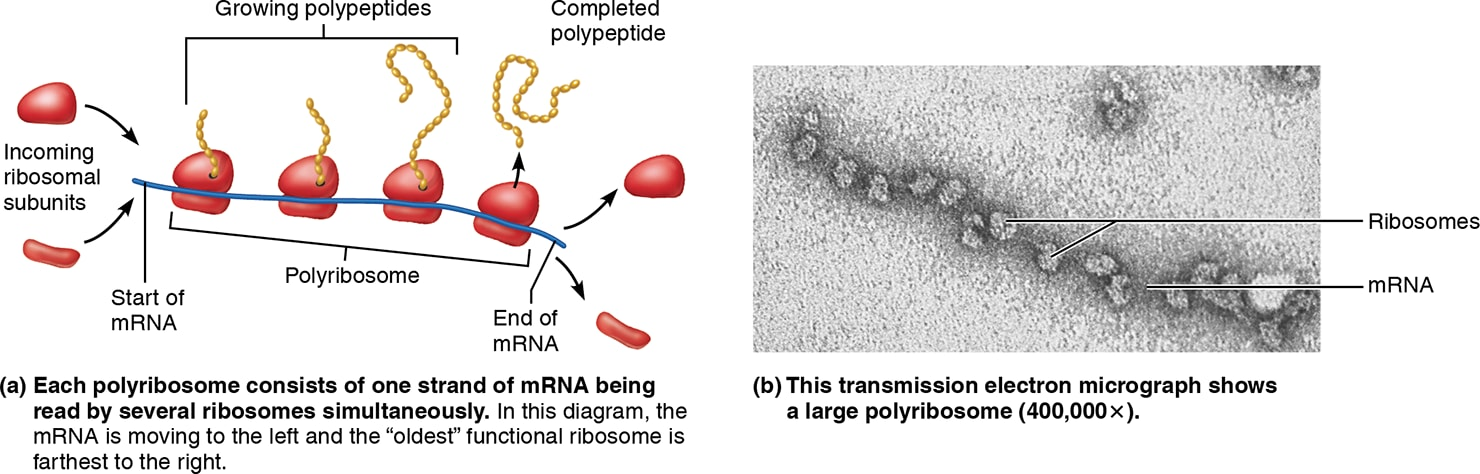
After a portion of mRNA is “read,” additional ribosomes may attach to already read part and start another round of translation of same mRNA: called polyribosomes

<ul><li><p><span style="background-color: transparent;"><strong>2a.&nbsp; Codon recognition : </strong>tRNA binds complementary codon in A site of ribosome</span></p></li><li><p><span style="background-color: transparent;"><strong>2b.&nbsp; Peptide bond formation : </strong>Ribosomal enzymes transfer and attach growing polypeptide chain from tRNA in P site over to amino acid of tRNA in A site</span></p></li><li><p><span style="background-color: transparent;"><strong>2c.&nbsp; Translocation : </strong>ribosome shifts down three bases of mRNA, displacing tRNAs by one position</span></p></li></ul><p><span style="background-color: transparent;">Once A site is empty, a new tRNA can enter, bringing its amino acid cargo, and whole process starts over</span></p><p><span style="background-color: transparent;">After a portion of mRNA is “read,” additional ribosomes may attach to already read part and start another round of translation of same mRNA: called <strong><u>polyribosomes</u></strong></span></p><p></p>
18
New cards

Termination

  • When one of three stop codons (UGA, UAA, UAG) on mRNA enters A site, translation ends

  • Protein release factor binds to stop codon, causing water to be added to chain instead of another tRNA

  • Causes release of polypeptide chain as well as separation of ribosome subunits and degradation of mRNA

  • Final polypeptide product will be further processed by other cell structures into functional 3-D protein


19
New cards

Summary: From DNA to Proteins

  • Complementary base pairing directs transfer of genetic information in DNA into amino acid sequence of protein

    •  DNA triplets are coded to mRNA codons

    • mRNA codons are base-paired w tRNA anticodons  to ensure correct amino acid sequence

      • Anticodon sequence of tRNA is identical to DNA sequence, except uracil is substituted for thymine
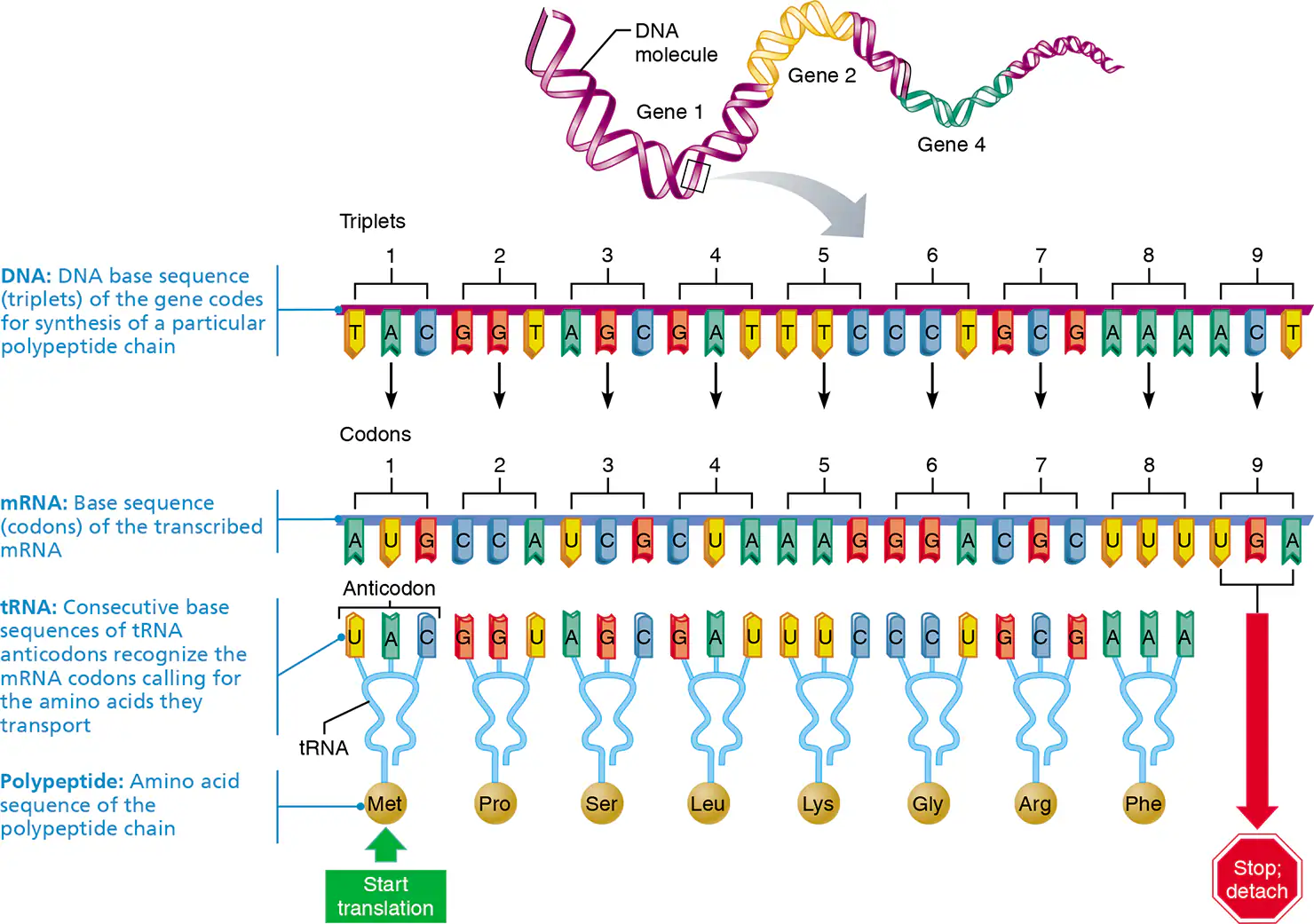

<ul><li><p><span style="background-color: transparent;">Complementary base pairing directs transfer of genetic information in DNA into amino acid sequence of protein</span></p><ul><li><p><span style="background-color: transparent;">&nbsp;<strong>DNA triplets are coded to mRNA codons</strong></span></p></li><li><p><span style="background-color: transparent;"><strong>mRNA codons are base-paired w tRNA anticodons&nbsp; </strong>to ensure correct amino acid sequence</span></p><ul><li><p><span style="background-color: transparent;">Anticodon sequence of tRNA is identical to DNA sequence, except <strong>uracil </strong>is substituted for <strong>thymine</strong></span></p></li></ul></li></ul></li></ul><p></p>