biology transport in cells
 Call Kai
 Learn
 Practice Test
 Spaced Repetition
 Match
 Flashcards
 Knowt Play
 Podcast
1/27

There's no tags or description
Looks like no tags are added yet.
28 Terms
define diffusion
diffusion is the net movement of particles from an area of high concentration to an area of low concentration. the particles move down their concentration gradient. it is passive- does not require energy.
what are some examples of diffusion occuring in animals
small intestine: glucose moves from the small intestine into the blood
alveoli in lungs: O2 diffuses into the blood from the alveoli / CO2 moves from the blood into the alveoli, where it is breathed out.
what is an example of diffusion occuring in plants?
in plants, gas exchange occurs, with oxygen leaving the plant, moving from a high concentration to a low concentration of oxygen.
what accelerates the rate of diffusion?
increasing the temperature of the particles to make them move faster
making the surface area of the membrane greater
a larger difference in concentrations (concentration gradient)
define osomosis
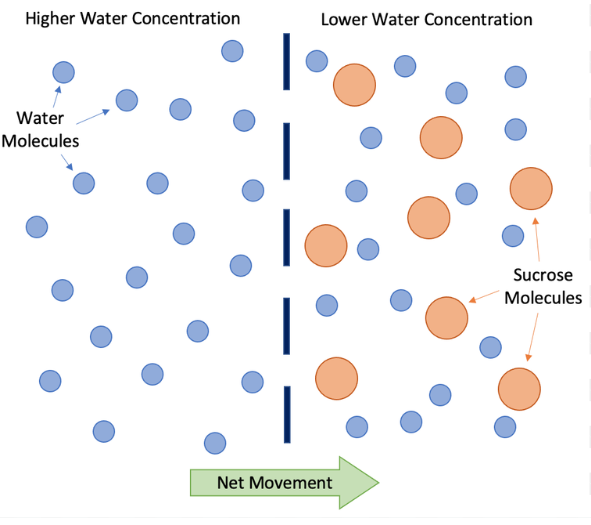
osmosis is the net/ overall movement of water from a region of higher water concentration (or water potential) to a region of lower water concentration through a partially permeable membrane. it moves down its concentration gradient.
what are two examples of osmosis occcuring?
Root hair cells: Absorb water from moist soil as cytoplasm inside has more solutes than the soil.
Turgor: Water enters plant cells, making them firm (turgid), due to the cell wall preventing bursting.
turgid
enlarged and swollen with water
give an example of an animal cell being damaged by osmosis.
Red blood cells burst in distilled water due to osmosis: the water, having a higher water potential outside the cell, rushes in to dilute the cell's interior, causing it to swell and, lacking a rigid cell wall, eventually rupture from the internal pressure.
what is an isotonic solution?
concentration of solutes in the solution outside the cell is the same as internal concentration of solutes.
what is a hypotonic solution?
concentration of solutes in the solution outside the cell is lower than internal concentration of solutes.
what is a hypertonic solution?
concentration of solutes in the solution outside the cell is higher than internal concentration of solutes.
what is active transport
movement of a substance from a low concentration to a high concentration,against the concentration gradient, which requires energy from respiration.

give two examples of active transport
active transport allows mineral ions to be absorbed from plant root hairs from very dilute solutions in soil.
it is also us
ed for sugar mollecules to be absorbed into the bloodstream from the small intestine.

what will affect the speed of active transport?
active transport needs energy so the more mitochondria are present- the more energy will be released which can be used in active transport.
what is surface area to volume ratio
The surface area to volume ratio (SA:V) is the comparison between an object's outer surface area and its internal volume, calculated by dividing surface area by volume, indicating how much surface is available for exchange (like nutrients, gases) per unit of mass or space
how do you calculate surface area to volume ratio?
surface area/volume
how does SA:V ration change as an organism gets larger?
the larger the organism the smaller the SA:V ratio.
Smaller objects have a larger SA:V ratio, meaning more surface area relative to their volume, which allows for faster substance exchange, while larger objects have a smaller ratio as volume increases faster than surface area, making efficient exchange harder
why would a red blood cell burst in water but a plant cell would not?
water enters both cells by osmosis
plant cell has a cell wall
cell wall stops the plant cell from bursting
red blood cell has no cell wall
red blood cell swells and bursts
Describe at least three adaptations of the lungs that help to make them efficient at exchanging gas by diffusion. Explain how those adaptations aid the efficient exchange of gases via diffusion.
many alveoli
provide a large surface area to volume ratio
alveoli walls are thin- one cell thick. thin walls provide a short diffusion path for O2 and CO2
good blood supply removes oxygenated blood quickly
breathing mechanism moves air in and out OR lungs are ventilated. ventilation brings in O2 AND removes CO2
in the osmosis practical, why do you blot the potato cylinders dry?
to remove excess liquid from the potato surface, which would make the potato weigh more.
how do you calculate percentage change in mass?

why do we calculate the percentage change in mass?
to allow results to be compared
because they had different masses at the start
explain what happens to potato cells when they are placed in increasing sugar concentrations.
they lose water via osmosis, causing them to decrease in mass, shrink in volume, and become flaccid (soft). This occurs because the surrounding sugar solution becomes increasingly hypertonic (higher solute concentration) compared to the internal environment of the potato cells, forcing water to move out through the partially permeable membrane
main hazards and precautions of osmosis required practical
Cuts:
Hazard: Using scalpels or cork borers to cut potato cylinders.
Precaution: Cut away from your body/hands, use a white tile as a cutting surface, and ensure equipment is handled carefully.
Slips/Trips/Spills:
Hazard: Spilling water or solutions, especially on electrical equipment.
Precaution: Place equipment on a stable surface, keep the work area tidy, and dry up spills immediately.
Chemical/Solution Exposure:
Hazard: Solutions (sugar/salt) can irritate eyes or skin; ingesting them is unsafe.
Precaution: Wear eye protection (goggles) and gloves; do not taste or consume any solutions or potato chips.
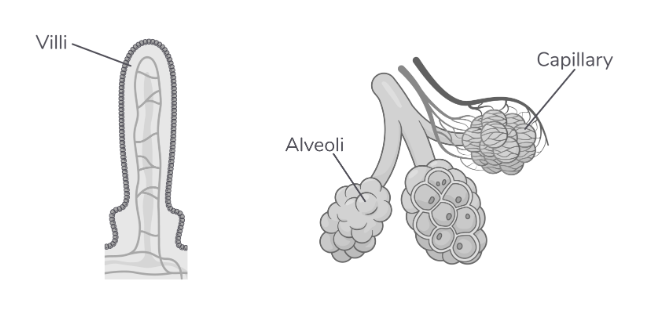
Explain how these two exchange surfaces- villi and alveoli- are adapted to absorb different molecules into the bloodstream
both:
have a large surface area
'good blood supply' or 'capillaries near the surface'
capillaries maintain concentration gradient
both have thin walls- one cell thick
thin walls provide a short diffusion distance for molecules to travel
villi:
have many mitochondria
mitochondria provide energy for active transport of food molecules
have many microvilli
microvilli maximise absorption of food molecules
what do we mean by “against the concentration gradient”?
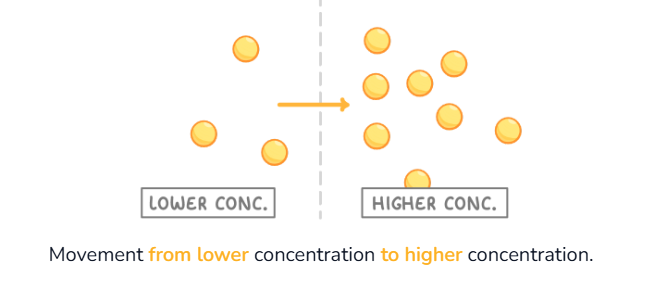
how are diffusion and active transport involved in glucose being absorbed in the gut?
At first, the glucose is absorbed by diffusion, because there is a higher concentration in the small intestine than in the bloodstream.
However, once most of the glucose has been absorbed, there will be a higher concentration in the bloodstream and so the remaining glucose will have to be absorbed by active transport.