Unit 2 PE Training Methods
 Call Kai
 Learn
 Practice Test
 Spaced Repetition
 Match
 Flashcards
 Knowt Play
1/27

There's no tags or description
Looks like no tags are added yet.
28 Terms
What are the characteristics of continuous training? What does it improve?
Involves exercising for 20 minutes minimum between 70-85% MHR (aerobic training zone)
Trains aerobic energy system and improves aerobic power
What is the aerobic training zone?
Submaximal HR zone at 70-85% MHR
Used in training methods designed to train the aerobic energy system (continuous training)
What are the characteristics of fartlek training? What does it improve?
Swedish for speed play (changing speed), improves aerobic power
Involves training in changing activity intensity (must stay in aerobic training zone of 70-85% MHR)
Aerobic training method and therefore must be minimum 20 mins of exercise to have an effect
EG Jog then sprint, sprint against wind then go with wind, change surface
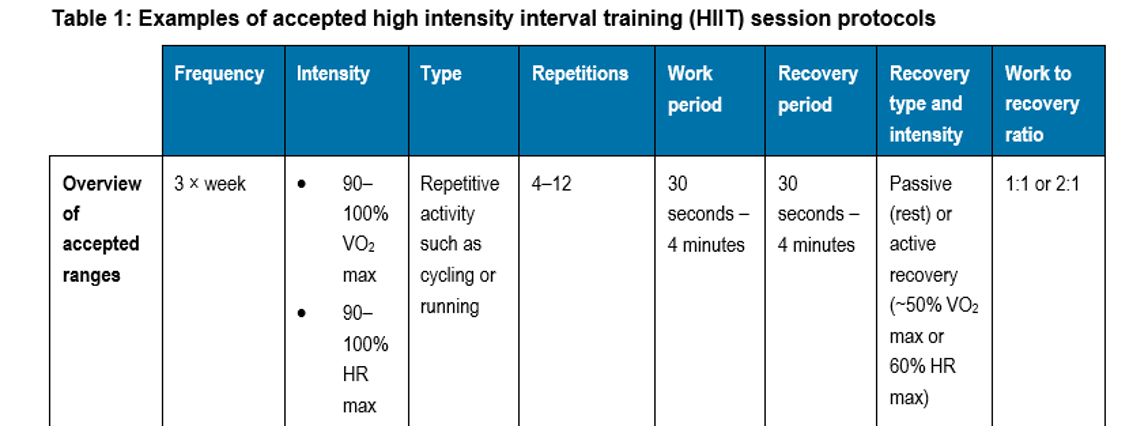
What are the characteristics of HIIT training? What does it improve?
HIIT = High intensity interval training
Involves short bursts of high intensity exercise interspersed with periods of rest or low intensity exercise
Fastest way to improve aerobic power + aerobic energy system however trains it outside aerobic training zone

What are the benefits of HIIT to aerobic power and the aerobic energy system?
Rapid aerobic improvements (6 weeks)
Short training sessions (10-15mins)
Highly motivational and easy to do (often done on a bike)
Fastest way to improve aerobic power + aerobic energy system however trains it outside aerobic training zone

What are the conditions/requirements of HIIT training to see improvement?
Must be performed at ≥ 90% MHR (outside ATZ) but often as high as 90-100% of MHR for repetitive work efforts
Rest can be passive or below 60% MHR
Must achieve V02 max for combined time of 5mins to see improvement
Work to recovery ratio: 1:1 or 2:1

What are the characteristics of interval training?
Repeated intervals of work followed by intervals of recovery
Can train aerobic and anaerobic energy systems depending on the intensity
3 types: Short (ATP-PC system = anaerobic capacity, speed), intermediate (anaerobic glycolysis = anaerobic capacity), long (aerobic = aerobic power)
What are the characteristics of short interval training? What does it improve?
Involves short periods of work at maximal intensity with long periods of rest
Energy system trained: ATP-PC system (improves speed and anaerobic capacity)
intensity (% MHR): Maximal HR
Time: 2-10 sec duration (PC depletion + become anaerobic glycoly
sis)
Work to rest ratio: 1:5-10 (to replenish CP stores)
Suited sports: Sprints, some teams
What are the characteristics of intermediate interval training? What does it improve?
Involves intermediate periods of work at high intensity with intermediate periods of rest
Energy system trained: Anaerobic glycolysis system (anaerobic capacity)
Intensity (% MHR): 85-90% MHR (above aerobic training zone)
Time: 10-60 sec duration (long enough to be anaerobic glycolysis)
Work to rest ratio: 1:2-4
Suited sports: Intermittent team sports (AFL, netball)
What are the characteristics of long interval training? What does it improve?
Involves long periods of work, relatively short periods of rest at lower intensities
Energy system trained: Aerobic system (aerobic power)
Intensity (% MHR): Higher end of aerobic training zone, 80-85% MHR
Time: 1-5mins duration
Work to rest ratio: 1:1 or lower
Suited sports: Long distance events
What are some ways to measure training intensity? Why do we measure them?
% Maximum Heart Rate (%MHR): Percentage of peak heart rate
Load in % 1 Repetition Maximum (1RM): % of the maximum amount of weight lifted in one lift
Rate of Percieved Exertion (RPE): Scale from 1-10 based on subjective exercise intensity and effort
What is resistance training and what fitness components does it training improve? How can it improve multiple different ones?
Involves muscles working against an external resistance/load (e.g. free weights, machines, resistance bands, medicine balls or body weight) to improve muscular strength, power and endurance
Trains muscular strength, power and endurance
Component trained depends on load (% 1RM), reps, sets, rest and speed of contraction
What are the characteristics of resistance training for muscular strength?
Load (% 1RM): 80-100%
Reps: 1-6
Sets: 3-6
Rest between sets: 3 mins
Speed of contraction: Slow
What are the characteristics of resistance training for muscular power?
Load (% 1RM): 30-70% (variable as it is combo of speed + strength)
Reps: 3-10
Sets: 3-6
Rest between sets: 3 mins
Speed of contraction: Fast (KEY)
What are the characteristics of resistance training for muscular endurance?
Load (% 1RM): 40-60%
Reps: 15-25
Sets: 3-6
Rest between sets: 1 minute
Speed of contraction: moderate
What are the characteristics of resistance training for muscular strength, power and endurance? (best way to remember them)
Load (% 1RM):
Strength highest by 40% (80-100%), endurance (40-60%)
Both strength and endurance range of 20%
Power has a great range that starts + ends 10% below the minimum of the other two (30-70%)
Due to Power = Force x Velocity means great range
Reps:
Strength the least (due to high %1RM), 1-6
Power middle (3-10) and endurance high (15-25)
Sets:
All same number of sets (3-6)
Rest between sets:
Both speed + power 3 mins rest
Endurance 1 minute to train body under fatigue
Speed of contraction:
Speed = slow (heavy so doesn’t matter how long it takes)
Power = fast (force produced rapidly)
Endurance = moderate (moderate like the intensity)
What characteristics of resistance training for muscular strength, power and endurance can I use to remember them?
Muscular Strength:
Very heavy weights (80-100% 1RM)
Low reps (1-6)
Sets (3-6)
Long rest due to ATP-PC system (3 minutes)
Slow contraction speed (slow)
Muscular Power:
Light to heavyish weights as it Force x Velocity (30-70% 1RM)
Therefore large rep range (3-10)
Sets (3-6)
Rest (3 minutes)
Fast contraction speed - KEY (fast)
Muscular Endurance:
Light weights as need to do many reps whilst fatigued (40-60% 1RM)
Many reps to train whilst fatigued (15-25)
Sets (3-6)
Little rest to train whilst fatigued (1 minute)
Moderate contraction speed as has to do many reps (moderate)
What are the characteristics of plyometrics training? What does it improve?
Most effective way to train muscular power
Involves an eccentric followed by concentric contraction
Harnessing the stretch reflex (myotatic stretch reflex) to provide neuromuscular adaptations
EG Skipping, medicine ball throws, leg bounding, box jumps
What are the characteristics of circuit training? What does it improve?
Working at a number of activity stations in sequence
Able to train all fitness components
3 main types:
Fixed Time Circuit: 4 sec on and off
Fixed Load: 10 push ups, 25 bicep curls
Individual load: Based on fitness
What are the characteristics of flexibility training? What does it improve?
Improves flexibility (range of motion possible at various joints) by training joints to move through a range of motion
4 methods: Static, dynamic, ballistic, PNF (most effective)

Don’t really need to know What are the VCAA recognised fitness tests for aerobic power?
20m multi-stage fitness test/20m shuttle run test
Yo-yo intermittent recovery test
Copper 12-minute run test
V02 max Astrand-Rhyming cycle ergometer test
V02 max treadmill test
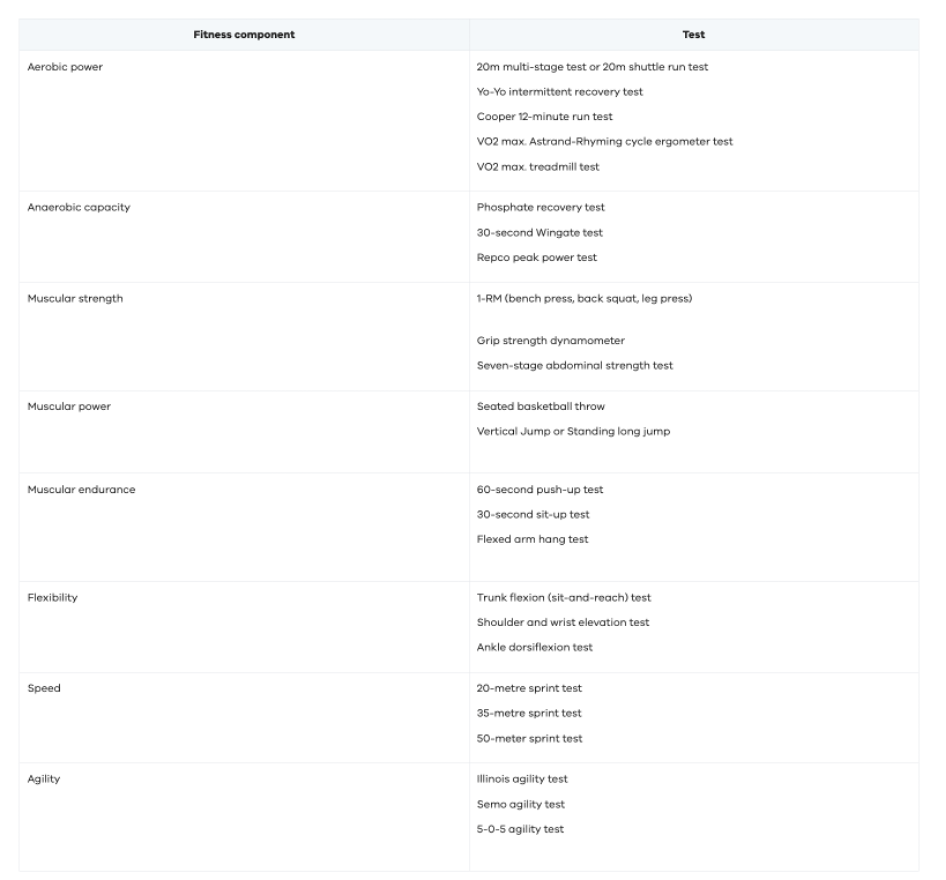
Don’t really need to know What are the VCAA recognised fitness tests for anaerobic capacity?
Phosphate recovery test
30-sec wingate test
Repco peak power test
Don’t really need to know What are the VCAA recognised fitness tests for muscular strength?
1RM (bench press, back squat, leg press)
Grip strength dynamometer
Seven-stage abdominal strength test
Don’t really need to know What are the VCAA recognised fitness tests for muscular power?
Seated basketball throw
Vertical jump
Standing long jump
Don’t really need to know What are the VCAA recognised fitness tests for muscular endurance?
60-sec push-up test
30-sec sit up test
Flexed arm hang test
Don’t really need to know What are the VCAA recognised fitness tests for flexibility?
Trunk flexion (sit-and-reach) test
Shoulder and wrist elevation test
Ankle dorsiflexion test
Don’t really need to know What are the VCAA recognised fitness tests for speed?
20m sprint test
35m sprint test
50m sprint test
Don’t really need to know What are the VCAA recognised fitness tests for agility?
Illinois agility test
Semo agility test
5-0-5 agility test