classification and assessment in clinical psychology (chapter 2.1 - Davey) | Quizlet
 Call Kai
 Learn
Learn Practice Test
 Spaced Repetition
 Match
Match Flashcards
 Knowt Play
1/29

There's no tags or description
Looks like no tags are added yet.
Name | Mastery | Learn | Test | Matching | Spaced | Call with Kai | Chat |
|---|
No analytics yet
Send a link to your students to track their progress
30 Terms
aim of psychopathology
-understand causes of mental health problems to develop prevention strategies and effective treatments addressing roots of problems
reasons to classify and categorise psychopathology
- first step in pursuit of knowledge
- to differentiate different kind of problems and determine different kinds of support
- to provide common language for reporting, monitoring, sharing and comparing of mental health problems all over the world
- to evaluate the effectiveness of support interventions and action plans
- required by modern society
Emil Kraepelin (1919)
- first developed psychopathological classification system
- suggested mental illness can be treated just like other medical illnesses
- syndrome: a distinct set of symptoms
WHO (1939)
- extended the system by adding psychological disorders to the ICD
- international list of causes of death (ICD)
-> was the international standard diagnostic classification system
APA (1952)
- published first Diagnostic and Statistical Manual (DSM)
- DSM:
-> extended the ICD that includes a more widely accepted section of mental disorders
APA (1980)
- produced a revised and expanded a third version DSM-III
APA (2013)
- most recent version is the DSM-5
DSM-5
- defines what is considered to be a mental disorder
- tries to exclude behaviours which are simply deviant from the social norm
- avoids suggestions about causes of a disorder unless cause has been securely established
- diagnosis on basis of observable behavioural symptoms rather than any supposition about underlying cause of symptoms
DSM-5 focuses rather on
- distress: chronic experience of pain / distressing emotions
- disability: distress can lead to impairment in 1 or more ways of functioning (e.g. in education, employment, social responsibilities, dealing with family)
four aims of DSM-5
1. provide necessary and sufficient criteria for correct differential diagnosis
2. distinguish true psychopathology (in medical or dysfunctional sense) from non-disordered human conditions, which are often labelled as "everyday problems of living"
3. provides diagnostic criteria allowing to be applied by different clinicians in different settings
4. provide diagnostic criteria theoretically neutral, not favour theoretical approach over another
chapters in DSM-5
-Neurodevelopmental Disorders
- Schizophrenia
- Spectrum and Other Psychotic Disorders
- Bipolar and Related Disorders
- Depressive Disorders
- Anxiety Disorders
- Obsessive-Compulsive and Related Disorders
- Trauma- and Stressor-Related Disorders
- Dissociative Disorders
- Elimination Disorders
- Sleep-Wake Disorders
- Sexual Dysfunctions
- Somatic Symptom Disorders
- Feeding and Eating Disorders
- Gender Dysphoria
- Neurocognitive Disorders
- Personality Disorders
- Paraphilic Disorders
- Disruptive, Impulse Control and Conduct Disorders
- Substance-Related and Addictive Disorders
- Other Disorders
DSM-5 provides following chapter information
- essential features of the disorder (which define the disorder)
- associated features (which are usual, but not always present)
- diagnostic criteria (symptoms that must be present to give diagnostic label)
- information on differential diagnosis (which differentiates this disorder from similar others)
general problems with classification
- diagnosis of symptoms gives illusion of explanation even though just redercription
-> no causal relationships explained
- labelling people is stigmatising and harmful
-> encourages individuals to adopt a "sick" role, results in adopting and identifying with role which is perceived as an illness
- Psychopathology more dimensional rather than discrete entity as in DSM
-> DSM either diagnoses or not diagnoses, but thinking in black/white is not good - that's why dimensional measures have been included in DSM-5 to specify severity of the disorder
- cut-off points for defining an activity (e.g. worrying) as a disorder becomes arbitrary
comorbidity
- co-occurrence of two or more distinct psychological disorders
- super common, is the norm rather than exception
- the frequency of comorbidity suggests that disorders aren't independent discrete disorders, but may rather represent symptoms of hybrid disorders (contain elements of several disorders)
mixed anxiety-depressive disorder
- a hybrid disorder, whereby people exhibit symptoms of both anxiety and depression, but do not meet threshold for either an anxiety or a depression diagnosis
syndrome/disorder spectrum
- higher-order categorical class of symptoms
- psychopathology may occur in a spectrum with hierarchical structure rather than consisting merely of numerous discrete disorders, e.g.. depression and anxiety more members of a larger spectrum of emotional disorders
- benefit of explaining and predicting comorbidity and it begins to provide some theoretical insight into how different symptoms may be related
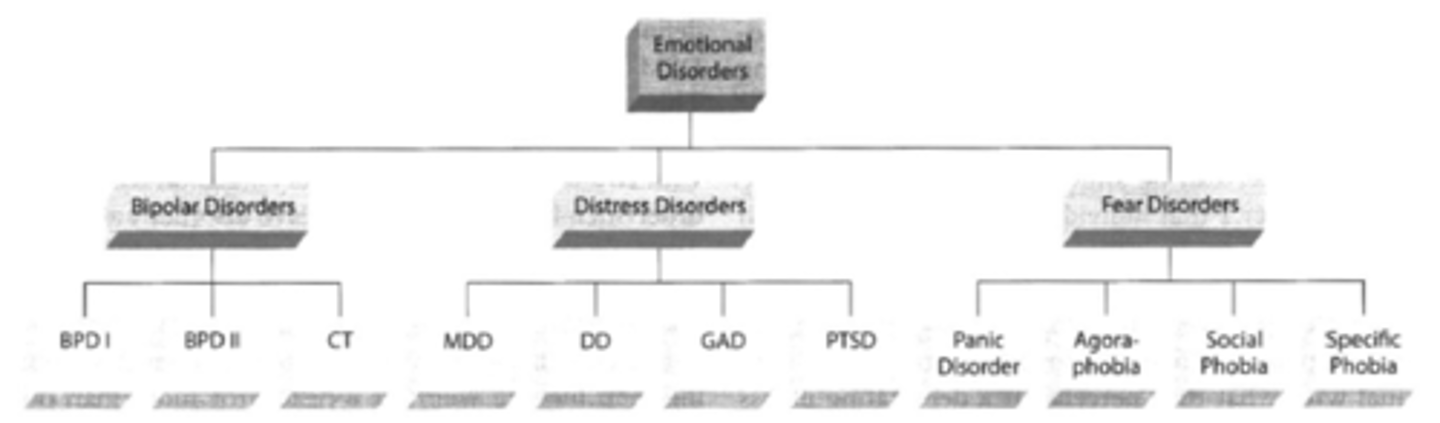
"the hodgepodge view"
- it's almost impossible to define what a mental health problem actually is
changes in DSM-5 to the predecessors
- axes I (clinical disorders), II (dev. and personality) and III (medical conditions) combined
- no significant difference between them anymore
- encouraged to rate severity rather along continuum for each disorder
new chapters for OCD and trauma and stress-related disorders
- confirms the growing importance of these types of disorder as possibly independent of other anxiety-based problems
autism spectrum disorder will incorporate many previously separate labels
- e.g., Asperger's disorder)
- important to make diagnosis for children easier
new disruptive mood dysregulation disorder
- diagnoses children with persistent irritability
binge eating disorder, hoarding disorder and skin-picking disorder included
- all recognized as new independent disorder categories
PTSD included in new chapter on stress
- emphasizes the importance of trauma-related disorders
removal of bereavement exclusion in major depression
- allows bereavement to be included as a contributor to major depression
criticism of these chapter changes
- reduce criteria necessary to diagnose or future diagnose (pre stages of disorders) -> increasement of people having disorders -> extremizing normal emotions sometimes
- some people will 'loose' their diagnosis because of changed criteria
- uses too much evidence from neuroscience even though its very limited
- most mental health problems not viewed as dimensional
critics about these changes
- many of the diagnostics changes reduce number of criteria needed to establish a diagnosis
- leads to medicalising many everyday emotional experiences and creating "false-positive" diagnosis
attenuated-psychosis syndrome
- is seen as a potential precursor to psychotic episodes
- DSM has introduced disorder categories that are designed to identify populations that are at risk for future mental health problems
specific learning disabilities
- disorders such as dyslexia and communication disabilities
dyslexia
- persistent, chronic learning disability in which there are developmental deficits in spelling, reading and writing abilities
over-diagnosis rather than under-diagnosis
- DSM is still the most widely adopted classification and diagnostic system for mental health problems
- many clinical psychologists prefer not to use diagnostic systems such as DSM-5, but instead prefer to treat each client as someone with a unique mental health problem that can best be described and treated using other means such as case formulation