Calc 1 - Exam 2
 Call Kai
 Learn
 Practice Test
 Spaced Repetition
 Match
 Flashcards
 Knowt Play
1/34

There's no tags or description
Looks like no tags are added yet.
35 Terms
Unit Circle

A function is continuous at c if
f(c) is defined
Lim F(x) exists
Lim f(x) = f(c)
Ln1, Ln>!, Ln<1
Ln 1 = 0 and Ln >1 = + and Ln < 1 = -
logaxy =

loga(x/y) =

logaxn =

Derivative of a constant
0
Derivative of A linear (y = mx + b) function
m (slope)
Power Rule
(xn) = nxn-1or (axn) = (an)xn-1
Sum and difference rule
The derivative of f + or - g = the sum/diff of the derivative of f and g.
Derivative of ex
ex
Product Rule
[f(x)g(x)] = f’(x)g(x) + f(x)g’(x)
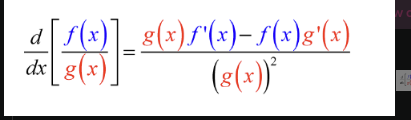
Quotient Rule
(Low)(Dee High) - (high)(dee low) all dived by (low) squared
Use when functions being divided by each other
Chain Rule
f’(g(x)) ⋅ g’(x)
Where:
f(x) = outer (momma) function
g(x) = inner baby function
Equation For Linearization
if f is diff at x = c, then the equation of the tangent line, L(x) = f(c) + f’(c)(x-c)defines the linear approximation of f at c Where:
x is the number you’re trying to approximate
c is the number you are using to approximate x, where f(c) and f’(c)
L(x) is the approximate value of f at x
Steps for linearization
Find a function in the problem
Ex. if you’re trying to find 3√1003 or 10031/3 the function would be x1/3
Write your goal
i.e. what value you want to approximate
Pick a i.e where you’re gonna draw your tangent line
If trying to find 10031/3 then your number would be 1000
a should be near the approximation x
you should know f(a)
You should know f’(a)
Write the tangent line
Current example:
L(x) = f(a) + f’(a)(x-a)
L(1003) = f(1000) + f’(1000)(1003-1000)
Find f(1000)
10001/3 = 10
Find f’(1000)
f’(x) = ⅓x-⅔ = ⅓/ (1/x⅔)
f’(1000) = ⅓ (1/10002/3)
f’(1000) = 1/300
Fill in the variables:
L(x) = 10 + (1/300) (x - 1000)
Write: f(x) ≈ L(x) for all x near a
10031/3 ≈ 10 + (1/300) (x - 1000) for all x near 1000
Do the approximation:
10031/3 ≈ 10 + 1/300 (1003 - 1000) = 10 + .01 = 10.01
How do we know if we over/under approximate the linearization? And do we need the second derivative?
At the value we’re estimating…
If f''(x)<0 → Concave DOWN → Tangent line is ABOVE the curve → OVERESTIMATE
If f''(x)>0 → Concave UP → Tangent line is BELOW the curve → UNDERESTIMATE
U don’t even need the second derivative, just look at graphic concavity
Local Extrema vs Absolute Extrema
Local -
Relative to nearby points (peakers/valleys/end points only)
Occurs at critical point(s)
Absolute -
Over the entire domain or specified interval
Either at critical points in (x,y) or could be end points in [x.y]
Critical Point
Points in the domain of f where f’(x) = 0 or where f’ ( x) doesn’t exists, therefore:
If f has a relative max at x=c, c is critical # of f
To find local Extrema
Use First Derivative Test with Number Line or Second Derivative Test with T Chart
First Derivative Test with Number Line
Set f’(x) = 0 or DNE
Find critical numbers
Draw number line of f’(x) with critical numbers
Do test values in between each critical number and see if neg/pos/0

Since f’(x) pos = increasing and neg = decreasing
Where it goes from pos to neg is a local max; where it goes from neg to pos is a local min at c
Second Derivative Test With T Chart
Set f’(x) = 0 or DNE
Find critical numbers
Draw T chart and for each Crit plug in f’’(x)
If f’’(x) > 0, f(x) is concave up meaning there is local min at x = c
If f’’(x) < 0, f(x) is concave down meaning there is local max at x = c
If f’’(x) = 0, inconclusive, use first derivative test with number line instead
Extreme Value Theorem - EVT
If f is a function that is CONTINUOUS on a CLOSED interval, then f must have an an absolute maximum and an absolute minimum
To find Absolute Extrema On A Closed Interval
The Closed Interval Method: First Derivative Test With Closed Interval: T Chart
The Closed Interval Method: First Derivative Test With Closed Interval: T Chart
If f is continuous on a closed interval [a,b], to find the absolute extrema on [a,b]:
Find Critical Points
Plug critical points and endpoints into f(x)
The largest is the absolute max, the smallest is the absolute min
Which test to use when for optimization
1st Derivative Test or 2nd Derivative Test: Only When there is exactly one CP and it is the one you want
Closed interval method: Needs a domain
Optimization Steps For Credit
Write a goal
What you are maximizing or minimizing
Draw a picture and assign variables
Write down an expression for the function in your GOAL that you are trying to optimize
Use data from the problem and picture to write the function from step 3 as a function of one variable
Find the critical points for the function from step 4
Use either 1st or 2nd derivative test, the closed interval method, or a graph
Ensure you answer in the context of the question WITH UNITS (Closing Statement)
Trig Derivatives

Implicit Differentiation Steps
Differentiate both sides of the equation
Bring all dy/dx terms to one side
Factor out dy/dx from those terms
Solve for dy/dx by dividing both sides by the remaining factor
Derivative of lnx
Derivative of lnx = 1/x
Chain rule: ln(u) = 1/u ⋅ (u’)
(u’)/u
Again, just the same thing times the derivative of the thing inside
Derivaitve of au
Derivative of au = au ⋅ lna
Chain Rule: au = au ⋅ lna ⋅u’
Chain rule: au ⋅ lna ⋅ u’
Again, just the same thing times the derivative of the thing inside
Derivative of [logau]
Derivative of [logau] = 1/(u ⋅ lna)
Chain rule: 1/(u ⋅ lna) ⋅ u’
u’/(u ⋅ lna)
Again, just the same thing times the derivative of the thing inside
Derivative of inverse sin

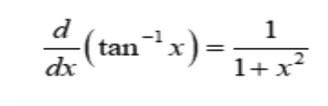
Derivative of inverse tan
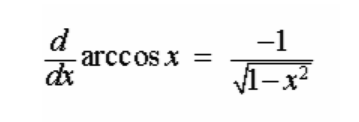
Derivative of inverse cos