chapter 5 membranes and energy study guide
 Call Kai
 Learn
 Practice Test
 Spaced Repetition
 Match
 Flashcards
 Knowt Play
1/60

There's no tags or description
Looks like no tags are added yet.
61 Terms
what is a fluid mosaic model?
scientific description of the structure of membranes;
fluid: flexible phospholipid layer
mosaic: diverse protein molecules suspended in the membrane
what is selective permeability?
The plasma membrane allows some substances to cross more easily than others
what is diffusion?
the tendency for particles of a substance to spread out into available space
what is dynamic equilibrium?
when molecules move back and forth but theres no net concentration change on either side
membranes enclose…
all living cells
membranes are also composed of
phospholipid bilayer (hydrophobic tails, hydrophilic heads)
their function is to control what comes in and out of a cell
they have proteins and other molecules embedded in them
membrane transport is broken into two parts such as
transport of small things (monomers, small molecules, ions)
transport of large things (polymers, cells, large particles)
transporting things without using energy is known as
passive transport; moving things down a concentration gradient
concentration gradient means….
moving stuff from an area of high to low concentration (molecules naturally want to move this way which is why it dosent require energy)
transporting things with energy is known as
active transport; moving things against or up concentration gradient
to move against concentration gradient means
moving things from low to high area of concentration which is against the way they molecules want to move
simple diffusion is
usually when things crossing the membrane are small or nonpolar
theyre nonpolar because polar molecules are unable to react with the fatty acid tails of the phospholipid easily, but nonpolar molecules can do this. includes things like oxygen and carbon dioxide
facilitated diffusion is
diffusion with help of a protein, its the way you can move things that are polar/ charged like an ion, across a membrane (passive transport)
osmosis is
the movement of a solvent; movement of water across a membrane, its diffusion specifically of water
to transport something out of a cell is
exocytosis
to transport something into a cell is
endocytosis
types of endocytosis consist of
phagocytosis (cell eating), pinocytosis (cell drinking), receptor-mediated (cell can get specific molecules)
isotonic is
about equal environment, so the cell gains and loses water at the same rate
hypotonic is
Solute concentration of the cell is higher than the solute concentration of the environment (solution), so water moves from the solution into the cell.
what is an aquaporin
specialized, integral membrane proteins that act as selective water channels ("the plumbing system for cells") to facilitate the rapid passage of water molecules across biological cell membranes
what is a hypertonic solution
Solute concentration of the environment (solution) is higher than the solute concentration inside the cell, so water moves out of the cell into the environment.
what is turgid
the ideal condition for plant cells, as the cell swells but the cell wall exerts back pressure (turgor pressure), so prevent the cell from taking in too much water and lysing
what is plasmolysis
when plant cells also shrivel and the plasma membrane pulls away from the cell wall
what is phagocytosis
(“cell eating”) when a cell engulfs a particle by wrapping pseudopodia (cellular extensions) around it and packaging it into a vesicle
receptor mediated endocytosis
a way for the cell to take in specific solutes
what is kinetic energy
energy of motion
potential energy
energy that matter possesses as a result of location/structure (stored energy)
exergonic reaction is a…
a chemical reaction that releases energy (energy exits)
endergonic reaction is a
chemical reaction that requires an input of energy (energy enters)
ATP…
adenosine triphosphate; molecule that powers nearly all forms of cellular work
activation energy is
the energy absorbed to weaken bonds in reactant molecules so that they can break and new bonds can form
enzymes are
Protein catalysts that decrease activation energy needed to begin a reaction
what is inhibition
a process where a molecule—called an inhibitor—decreases, slows down, or completely stops the activity of a biological process, cell, or enzyme
competitive inhibitor
blocks substrate binding to the active site (competes with a substrate for the active site)
noncompetitive inhibitor
binds to a secondary site (allosteric site) on an enzyme and changes its conformation so the substrate no longer fits in the active site
what does hypertonic solution mean for animal cells
They become shriveled and can die from water loss (crenation).
what does hypertonic solution mean for plant cells
plant cells also shrivel and the plasma membrane pulls away from the cell wall (plasmolysis), which can kill the plant cell.
what does isotonic solution mean for animal cells
this is the ideal condition to keep cells at a normal volume (eg. IV fluids are isotonic to blood cells)
what does isotonic solution mean for plant cells
they become flaccid (limp)
net movement is from ….
high concentration to low concentration
diffusion is passive transport which means
no ATP is required
diffusion looks like what overtime
initially there are more molecules then once theyre at equilibrium they have approximately equal concentrations (same amount of molecules) this dosent mean molecules stop moving
water moves from a solution with lower solute concentration to
higher solute concentration, assuming the membrane allows water throuh but not the solute (water follows solute)
plant cells become turgid in
hypotonic solutions
plant cells become flaccid in
isotonic solutions
plant cells are plasmolyzed in
hypertonic solutions
transport proteins help substances…
move across the cell membrane, especially substances that cannot easily pass through the phospholipid bilayer
an aquaporin is a transport protein used for
water; specifically to move it across the cell membrane quickly
whatre the steps of active transport
solute molecules in cytoplasm bind to specific sites on the transport proteins → energy from ATP helps the protein to change shape and release solute → transport protein returns to normal
how does exocytosis work?
A transport vesicle from the Golgi apparatus fuses with the plasma membrane and the contents are released
whats the purpose of exocytosis
to export materials such as proteins and polysaccharides
how do receptor mediated endocytosis work
Receptor proteins are embedded in regions of the membrane lined by a layer of coat proteins. The plasma membrane indents and forms a coated pit to take in specific molecules, which then pinches off to form a vesicle that releases contents into cytoplasm.
whatre the products of ATP hydrolysis
adenosine diphosphate + inorganic phosphate + and energy (exergonic; releases energy)
how do enzymes speed up chemical reactions
by lowering activation energy
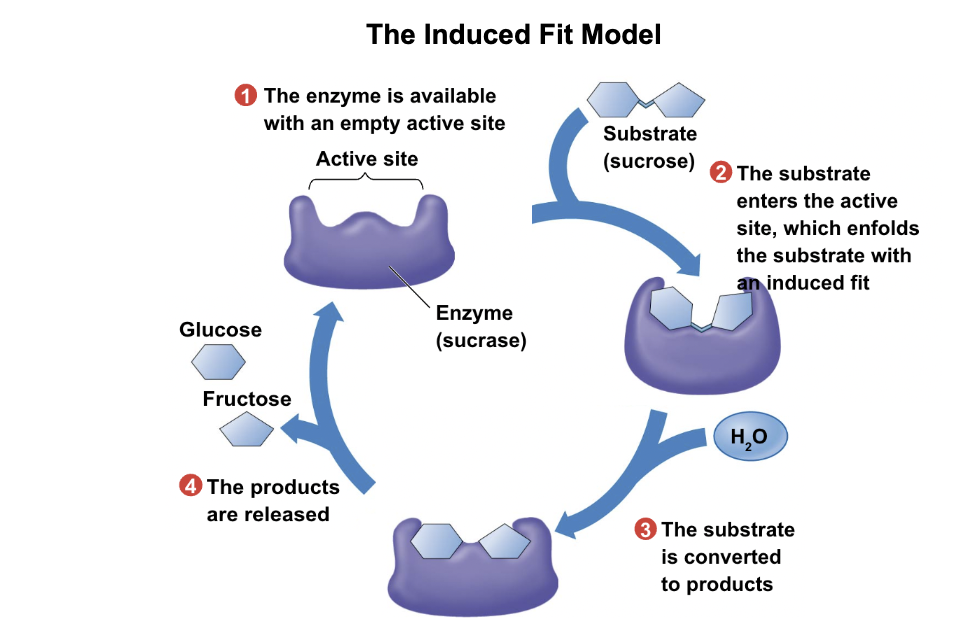
The induced fit model for enzyme catalysis
explains how an enzyme binds to substrate and catalyzes a reaction
Substrate: The reactant an enzyme acts on.
Active site: The specific pocket or groove on an enzyme where the substrate binds.
In passive transport, do molecules move down or against their concentration gradients? What about during active transport?
passive transport; down concentration gradient
active transport; against/up concentration gradient
A cell is placed into a solution that has a lower solute concentration than the solute concentration inside the cell. What type of solution is this (what is the tonicity)? Will water move into the cell, out of the cell, or neither?
hypotonic solution, water will move into the cell
Which type of membrane transport uses ATP?
active transport
Which type of transport uses pseudopodia to engulf large substances and take them in?
phagocytosis
A chemical reaction takes place where the products have more potential energy than the reactants. Is this reaction endergonic or exergonic?
endergonic
What is the difference between a competitive and a non-competitive enzyme inhibitor?
where the inhibitor binds on the enzyme and how it affects the reaction kinetics