Test 4
 Call Kai
 Learn
 Practice Test
 Spaced Repetition
 Match
 Flashcards
 Knowt Play
1/149

There's no tags or description
Looks like no tags are added yet.
150 Terms
sexual selection
form of NS that acts on heritable traits that affect reproduction via mate competition (intra) and mate choice (inter)
mate competition
selection in which one sex competes with other members of the same sex for access to the other sex for reproduction
mate choice
selection by one sex for members of the other sex for reproduction
isogamy
a form of sexual reproduction where the fusing gametes (sex cells) are morphologically identical in size and shape
anisogamy
a form of sexual reproduction involving the fusion of two gametes (reproductive cells) that differ in size, form, or both
assumptions to why there are 2 sexes
in the ancestral marine env, indiv in a pop prod diff sized games
each parent has a fixed amt of energy to allocate to gamete prod, resulting in a size number tradeoff: as the num of gametes prod increased, their size will decrease
zygote viability is related to its size, larger zygotes have higher viability bc they contain more resources for survival
batemans hypothesis and parental investment
H suggests that there is typically a greater variance in reprod success among M in a sp compared to F
also, in many sp, some M have many offspring, while others have very few or none, leading to a skewed distribution of reprod success among M

biologists divided into 2 groups on batemans hypothesis
those who praise bateman as one of the founding fathers of the discipline of behavioural ecology and those who claim that batemans paper was empirically or theoretically flawed, or that modern data do not support his paradigm
meanwhile, his citations have reached unprecedented levels, with more than 100 citations per year after 2005, even reaching more than 200 citations in 2012, 2013, and 2017
Triver’s parental investment theory
the sex that pays the higher cost of parental investment should be choosier in selection mates, the other sex will experience more intense sexual selection
operational sex ratio
the ratio of the number of sexually receptive M to sexually receptive F in a pop
O and RQ of antlers as weapons in red deer
O: lifetime breeding success and antler size, red deer M possess large antlers lacking in F
RQ: are antlers weapons used in mate competition
M of antlers as weapons in red deer
red deer
collect and weigh antlers shed
use blood samples to determine reproductive success
R and C of antlers as weapons in red deer
the average antler mass over an indiv lifetime was positively correlated w his total lifetime breeding success, each dot represents one M

RQ, H, and P of weapon size and mating success in dung beetles
RQ: what is the role of M horn-like projection
H: large horns provide an advantage in mate competition
P: M w the larger horn will win most fights
M of weapon size and mating success in dung beetles
dung beetles focal sp
staged fights bw M matched for body size but not horn length
recorded outcomes of interactions and mating success
R and C of weapon size and mating success in dung beetles
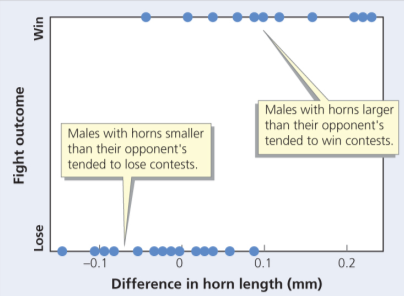
M w horns smaller than their opponents tended to lose contests
M w horns larger than their opponents tended to win contests
RQ of ornaments and mate choice in peafowl
are peacock tails an ornament used in mate choice?
M of ornaments and mate choice in peafowl
peacocks focal sp
measured:
tail length and M body size
number and duration of tail displays
Number of vocalization and copulations
R and C of ornaments and mate choice in peafowl
C: mate competition and mate choice are important in evolution of peacock tail

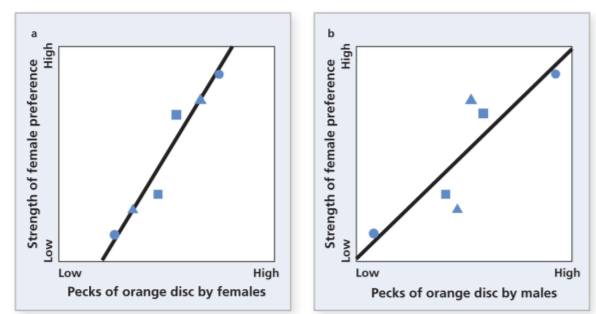
RQ, H, and P of the origin of sexually selected traits: the sensory bias hypothesis in guppies
RQ: how does a M trait become selected in F mate preference
H: sensory bias hypothesis-F mating preferences are a by-product of pre-existing biases in a F sensory system
P: M and F should be attracted to orange-coloured objects bc orange is associated w carotenoids
M of the origin of sexually selected traits: the sensory bias hypothesis in guppies
guppies are focal sp
several populations
placed small colour discs on leaf in water
recorded all approaches and pecks
R and C of the origin of sexually selected traits: the sensory bias hypothesis in guppies
direct material benefits
material resources obtained by a F from mating w a particular M
indirect material benefits
genetic benefits F can obtain for their offspring by mating w M that have high genetic quality
nuptial gift
a physical resource such as a food item that a M provides to a F to enhance his mating success. example is a spermatophore
spermatophore
structure or package containing sperm, which is transferred from a M to a F during reproduction in some animal sp
specific structure and function can vary among diff sp, but their primary purpose is to deliver sperm to the F reproductive organs
in many cases, M prod it as part of his reprod strategy
may contain not only sperm but also other substances that provide nutrients or protection for the sperm
when M encounters a receptive F, he transfers spermatophore to her, often through specialized reprod organs or structures
F then takes up the spermatophore and its contents, which can fertilize her eggs when she is ready to reprod
transfer of spermatophores
can involve a range of mechanisms and structures depending on the specific reproductive strategies of the organisms involved:
direct insertion
capsule placement
transfer via a spermatophore structure
sperm web or sperm packet
direct insertion
in some sp, such as certain insects, M reprod organs can directly insert spermatophore into F reprod tract. this is a common method in many insects like beetles and some butterflies
capsule placement
in other cases, the M places the spermatophore in a location where the F can access it.
the F may then take up the spermatophore on her own
this method is found in certain arachnids, such as some scorpions
transfer via spermatophore structure
in some sp of squids and octopuses, the M transfers a spermatophore by using specialized structures, such as an elongated arm called an hectocotylus, to place the spermatophore into the F reprod tract
sperm web or packet
certain spider sp create a sperm web or packet which is essentially a silk structure containing the spermatophore
M deposits the spermatophore on the web or packet and then guides F to it, where she retrieves and takes it up
RQ of F choice and nuptial gifts in fireflies
how does the variation in the duration of M flashes affect F choice and fitness
M of F choice and nuptial gifts in fireflies
fireflies focal sp
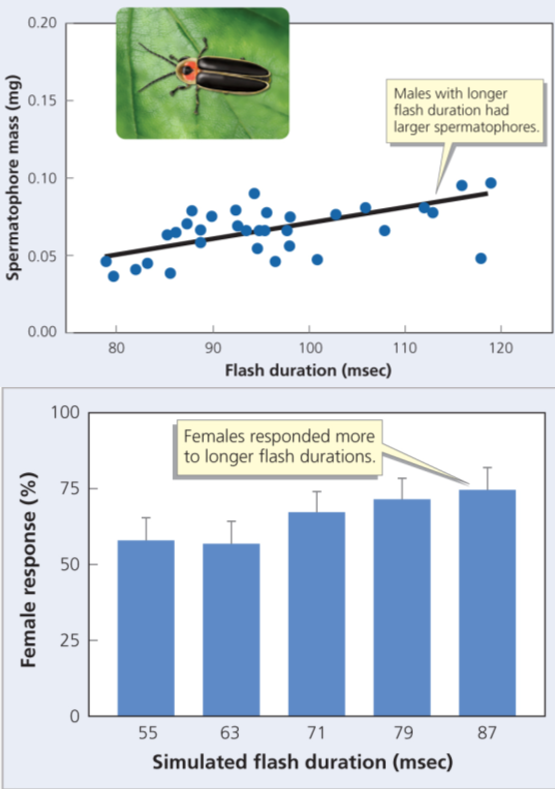
measured M flash duration and spermatophore size
created flashes of diff lengths and measured F response

R and C of F choice and nuptial gifts in fireflies
M w longer flash duration had larger spermatophores
F responded more to longer flash durations
O and RQ of F choice and nuptial gifts in butterflies
O: M green-veined white butterflies provide a spermatophore as a nuptial gift. it disintegrates inside F releasing its nutrients
RQ: do nuptial gifts enhance F reproductive success?
M of F choice and nuptial gifts in butterflies
fed M radioactively labeled leaves which became incorp into spermatophore
calc rate of spermatophore disintegration (amt of spermatophore recieved)
conducted matings and collected eggs
tested F for radioactivity
R and C of F choice and nuptial gifts in butterflies
R: F receiving larger spermatophores prod more eggs
C: nuptial gifts are a direct benefit for F and increase their reprod success

RQ and P of F choice & territory quality in lizards
RQ: how does territory quality affect F choice and fitness?
P: territory quality is based on rockiness (microclimates)
M of F choice & territory quality in lizards
side-blotched lizards
larger M have territories w more rocks
researchers manipulated territory quality
added rocks to small M territories
removed rocks from large M territories
obs F mate choice
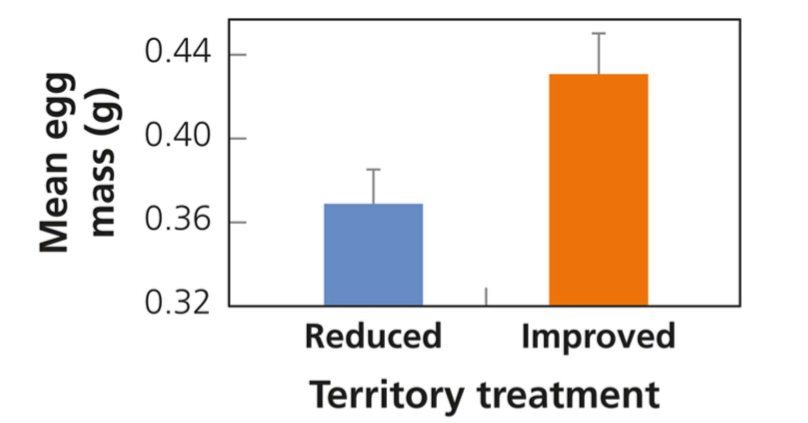
measured egg-laying and egg mass of F
R and C of F choice & territory quality in lizards
R: F preferred improved territories, F on improved territories laid eggs sooner and prod larger egg masses
C: F select M based on territory quality and there seems to be a fitness gain by doing so
Indirect genetic benefits
genetic benefits F can obtain for their offspring by mating w M that have high genetic quality
F choosing M
F mate choice can evolve via indirect benefits to offspring. F may select M based on secondary sexual characteristics
Fisherian Runaway process
an evolutionary process in which a M trait co-evolved w a F preference for it and becomes increasingly exaggerated
handicap principle
well-developed secondary sexual characteristics are costly to survival but reliable signals of fitness
good genes
the alleles of high-quality indiv
Ob and M of mate choice for good genes in frogs
O: F select M based on vocalizations
M:
european tree frogs
captured and identified M from 4 ponds
obs number of matings
collected egg masses and reared in lab
measured tadpole growth rate and survival
genotyped tadpoles to determine parentage
R and C of mate choice for good genes in frogs
R: M that sired more offspring prod tadpoles w higher growth rates
C: therefore, F could be selecting M for genetic benefits

RQ, H, and Ps of good genes and immune system function in birds
RQ: how does parasite load affect mate choice?
H: hamilton-zuk hypothesis predicts that F prefer M that have greatest expression of secondary sexual traits bc such M have high immunocompetence if M immunity is a heritable trait
P:
1) F should prefer to mate w M that have the greatest exp of secondary sexual traits
2) high parasite loads will reduce that exp in M
M of good genes and immune system function in birds
red junglefowl focal sp
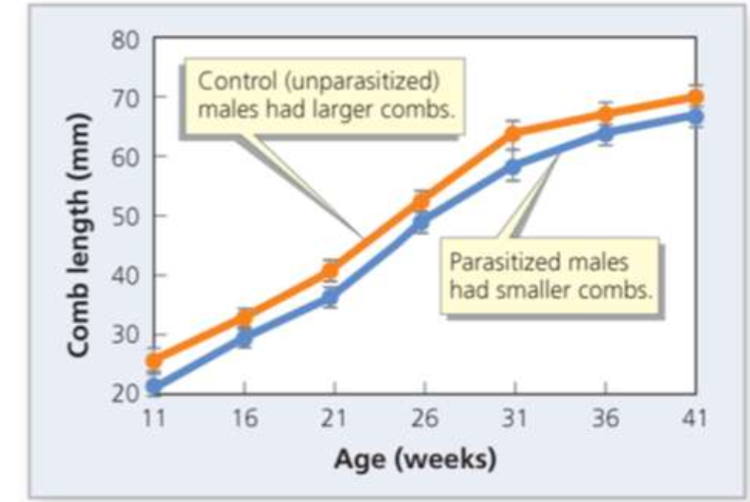
infected half the M w intestinal nematode
measured size and colour intensity of comb
conducted mate choice trials w infected and control M
R and C of good genes and immune system function in birds
C: in the choice tests, F exhibited a strong mating preference for control M
RQ of mate choice benefits in spiders
what is the importance of pheromones as signals of M quality in mate choice
M of mate choice benefits in spiders
spitting spider focal sp
mate choice experiment in Y test chamber
Phase 1: two M at end of arms (chemical cues only no visual contact). foam on floor prevented tactile signals
Phase 2: pheromones of M only at end of arms (on filter paper)
same F in both phases
Mating experiment, half F mated w preferred M, half w unpreferred M

R and C of mate choice benefits in spiders
R: in p2, almost all F chose the pheromone of the M they chose in p1
C: F mated w preferred M had larger egg sacs, more and heavier eggs, and higher hatch rate

mate choice in conservation breeding programs
captive breeding programs are used to increase the pop size of endangered sp
mate choice and genetic diversity should both be considered in these programs
mate guarding
when a M follows his mate to prevent her from mating w rivals
extra-pair young
offspring of a pair-bonded F prod outside the pair bond by a third-party M
RQ of mate guarding in black-throated blue warblers
how effective is mate guarding?
R and C of mate guarding in warblers
R:
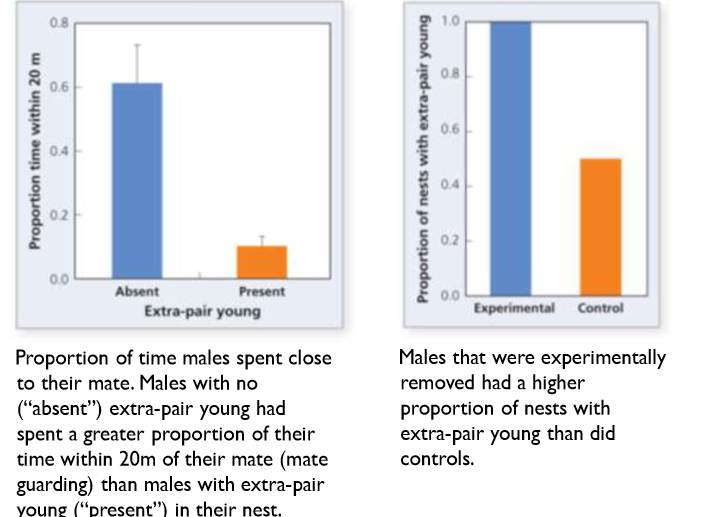
M who spent more time mate guarding had fewer extra-pair offspring
experimentally removed M had more extra-pair offspring
C:
mate guarding can be an effective strategy for increasing paternity assurance
Sperm competition
competition bw sperm of diff M to fertilize eggs
cryptic F choice
when F influences the fertilization success of sperm from one M over others
inbreeding depression
a reduction in fitness as a result of mating w close relatives
RQ of sperm competition in tree swallows
Does M standing on or hovering over backs of F increase copulation?
R and C of sperm competition in tree swallows
R: increases in copulation rate resulted in decrease of extra-pair offspring
C: M can reduce paternity loss from sperm competition by increasing their copulation freq

alternative mating tactics
multiple behavioural mating phenotypes in a pop
satellite M
alternative, parasitic mating tactic in which a M remains near a bourgeois M to intercept F that are attracted to the bourgeois M (dominant)
sneaker M
alternative, parasitic mating tactic in which a M attempts to avoid detection so that he can quickly enter a bourgeois territory to fertilize eggs being deposited in a nest
conditional strategy
the flexibility w which one chooses a particular strategy based on an indiv condition
ESS
evolutionary stable strategy. a strategy that, if adopted by indiv in a pop, cannot be trumped by another strategy bc it yields the highest fitness
Obs of conditional satellite M in tree frogs
M exhibit both a bourgeois calling tactic and a parasitic satellite tactic
bourgeois M call to attract F
satellite M take up residence near a calling M, remain silent, presumably to intercept F attracted to the caller
some M exhibit both strategies
M of conditional satellite M in tree frogs
green tree frogs focal sp
recorded calls of bourgeois and satellite M
created synthesized calls
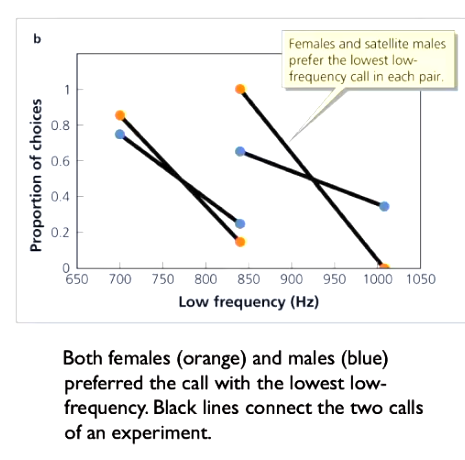
conducted choice tests for calls w F and satellite M
R and C of conditional satellite M in tree frogs
R:
bourgeois M larger and prod lower freq calls than satellite M
M adopt a conditional strategy if bourgeois M is removed
F and satellite M preferred lowest freq calls
RQ of ESS and sunfish sneaker M
What is the reproductive success of parental and sneaker M pumpkinseed sunfish?
M of ESS and sunfish sneaker M
pumpkinseed sunfish focal sp
mapped all nest locations
captured nesting M (parentals), F, and sneakers at nest and all developing eggs
genotype analysis
R of ESS and sunfish sneaker M
(1) age distribution for sneaker and parental M and weight distribution for sneakers, F, and parental M
(2)
(3) paternity

RQ of mate choice affected by mating decisions of others
do F copy the mate choice of other F
M of mate choice affected by mating decisions of others
focal F placed in a mate choice test w M matched for size and colouration
model F placed next to non-chosen M w focal F observing
focal F was given a mate choice test

R and C of mate choice affected by mating decisions of others
R: most F spent more time near the M that had been near the model F
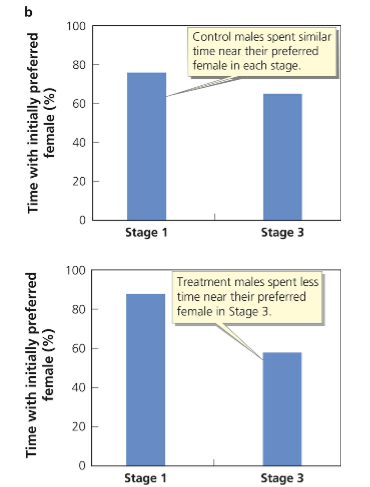
C: F switched their mate choice preference to copy the mate choice of the model F
RQ of nonindependent M mate choice in mosquitofish
does the risk of sperm competition affect mate choice by M?
M of nonindependent M mate choice in mosquitofish
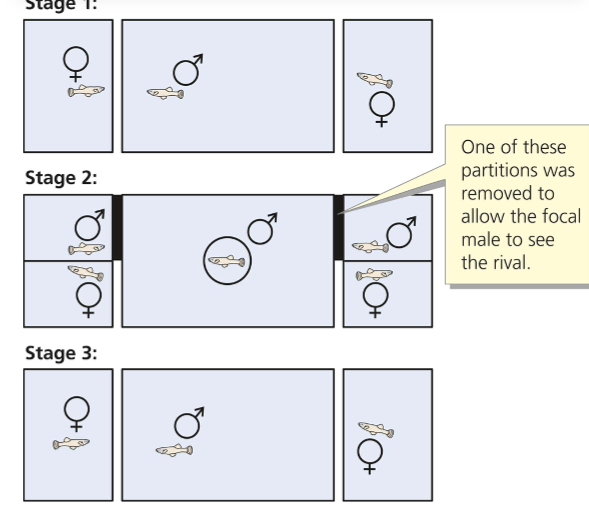
focal M mate choice test
rival M then placed next to each F
focal M mate choice test
Exp 1: focal M cannot see rival
Exp 2: focal M observed rival near chosen F
Exp 3: focal M observes rival near nonchosen F
R and C of nonindependent M mate choice in mosquitofish
R:
Exp 1 and 2: M preferred larger F
Exp 2: focal M spent less time w chosen F during last stage
C: M mate choice is affected by risk of sperm competition
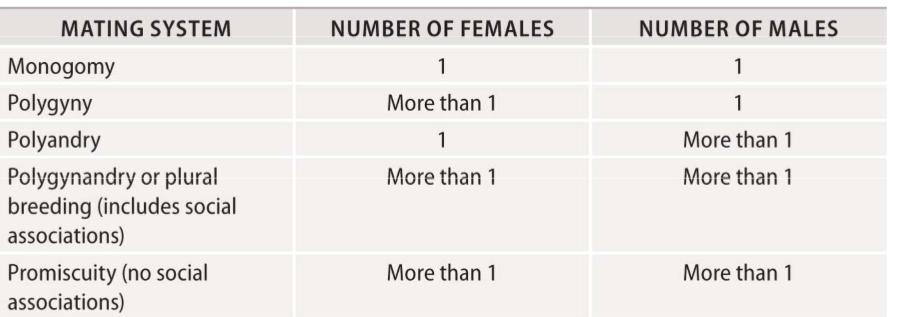
types of mating systems
monogomy, polygyny, polyandry, polygynandry or plural breeding (social associations), and promiscuity (no social associations)
monogamy
F:1, M:1
if a Fs partner offers high resource and parental care
also favoured if resources are poor and predation is high

polygyny
F: more than 1, M: 1
M dominance: M advertise to F in a group
resource or F defense

polygyny resource or F defense
aggregation of F: 1. to lower predation risk. 2. avoid harassment from M. 3. access to resources
resource defense polygyny: M defends a territory, attracts multiple F
F defense polygyny: M directly defend a group of F (harem)

polyandry
F: 1. M: more than 1. multiple M provide care to Fs offspring

polygynandry or plural breeding
F: more than 1, M: more than 1. includes social associations
promiscuity
F: more than 1, M: more than 1. low benefit to social living bc density too high. no social associations
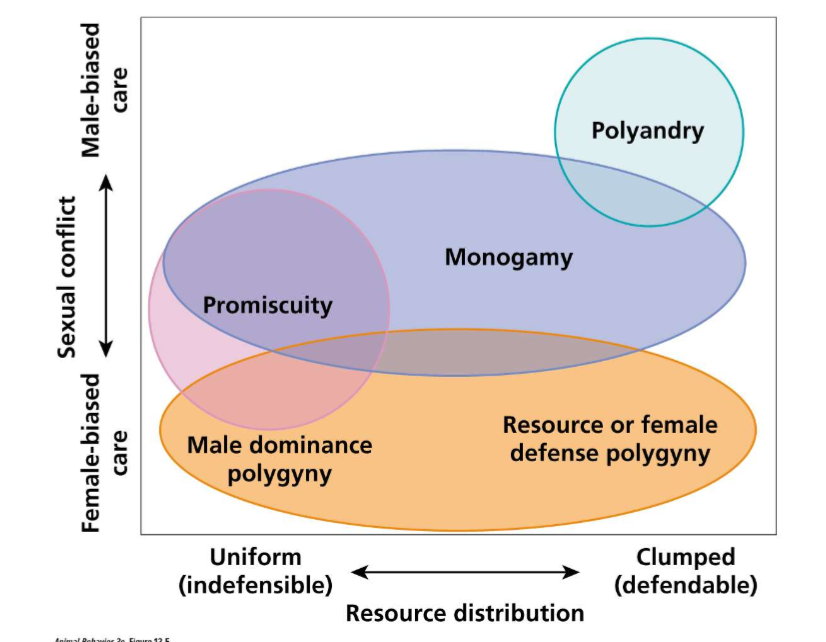
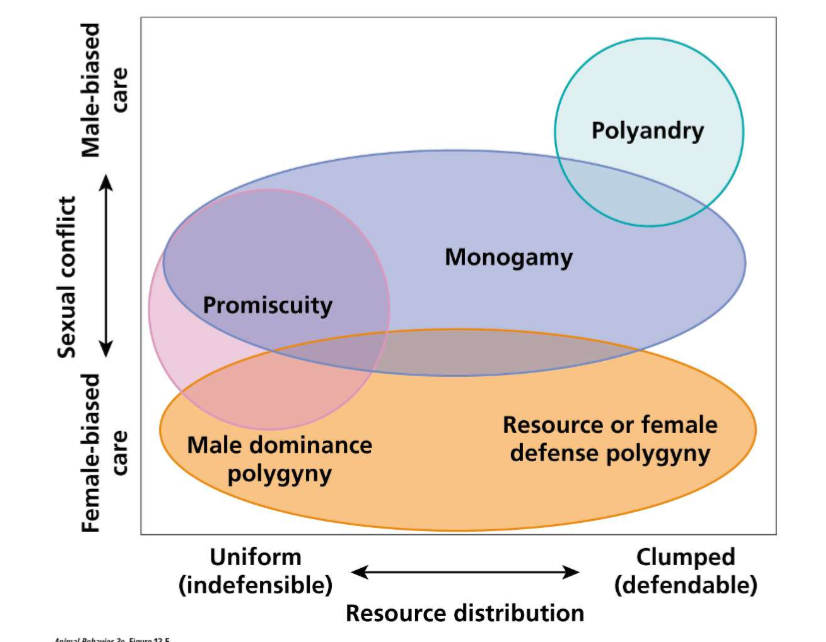
emlen and oring model
based on sexual conflict and resource distribution. sexual conflict and env conditions affect the evolution of mating systems.
mating systems result of the interaction bw sexual conflict and resource distribution

sexual conflict
differential selection on M and F to maximize their fitness
F fitness: often most limited by access to resources to invest in offspring
M fitness: most often limited by the number of mates
what varies in different environments
resource amount and distribution
Obs of mating systems in reed warblers
comparative approach to examine a group of related sp that have diff mating systems
how does variation in resource abundance affect mating systems and parental care?
RQs of mating systems in reed warblers
RQ1: how does habitat quality (amount of food resources) correlate w mating system?
RQ2: how are habitat quality and mating systems related to the level of M care?
types of habitat qualities table

M of mating systems in reed warblers
created phylogyny of reed warblers
est habitat quality
characterized the relative level of M care provided to offspring
mapped these data onto the phylogeny

R and C of mating systems in reed warblers
poor quality habitats: monogamy and high parental care
medium & good quality habitats: polygyny and promiscuity and reduced M care

Obs, RQ, and P of California mouse monogamy
O: California mice are monogamous (rare in mammals)
RQ: how does M care affect reprod success in this sp?
P: reprod success will be low if paternal care is absent
methods of California mouse monogamy
California mice focal sp
captured adults w live traps and uniquely marked them
checked F for reproductive condition (pregnant or lactating) and weighed
experimentally removed some M from monogamous pair within 3 days of litters birth
est number of young born to each F by comparing her weight loss bw the last days of pregnancy and the time of first capture after giving birth
used formula to convert body mass loss to offspring number
compared offspring number and success (emergence from burrow) to control pairs that contained a M
R and C of California mouse monogamy
R:
both groups prod similar number of young
families w fathers removed (orange) had lower offspring survival
C: M care enhances reprod success in monogamous mice
M can not feed offspring, but they can assist w temp regulation and protection

Obs, RQ, H, and P of monogamy and biparental care in poison frogs
O: closely related poison frogs differ in their mating systems
R. imitator is monogamous
R. variabilis is promiscuous
RQ: does the need for biparental care in R.imitator explain this pattern?
M of monogamy and biparental care in poison frogs
manipulated phytotelma pool size
indiv tadpoles of each sp were placed in either small or large pools and did not receive F breeding
in control, R. imitatorindiv were placed in small pool and received parental care in form of F feeding
visited each pool weekly for 3 weeks to record size (growth rate) and mortality for indiv