Digestive System (A&P Practical #2)
 Call Kai
 Learn
 Practice Test
 Spaced Repetition
 Match
 Flashcards
 Knowt Play
1/81

There's no tags or description
Looks like no tags are added yet.
82 Terms
What is the main function of the digestive system
Break down food and absorb nutrients.
What organs make up the GI tract
Mouth, pharynx, esophagus, stomach, small intestine, large intestine, rectum, anus.

What are accessory digestive organs
Salivary glands, liver, gallbladder, and pancreas.

What is mechanical digestion
Physical breakdown of food into smaller pieces.
What is chemical digestion
Enzymatic breakdown of large molecules into smaller molecules.
What is ingestion
Taking food or drink into the body.
What is absorption
Movement of digested substances into blood or lymph.
What is defecation
Elimination of feces through the anus.
What is the function of the tongue
Moves food, assists swallowing, and helps taste.
What is the function of teeth
Mechanically break down food.

What do incisors do
Cut food

What do cuspids or canines do
Tear food

What do premolars do
Crush and grind food

What do molars do
Grind food

What is the uvula
A projection from the soft palate that helps close the nasopharynx during swallowing.

What are palatine tonsils
Lymphatic tissue that helps defend against pathogens.

What is the oropharynx
The throat region behind the oral cavity.

What is the function of salivary glands
Produce saliva to moisten food and begin digestion.

Where are the parotid glands
Near the ears
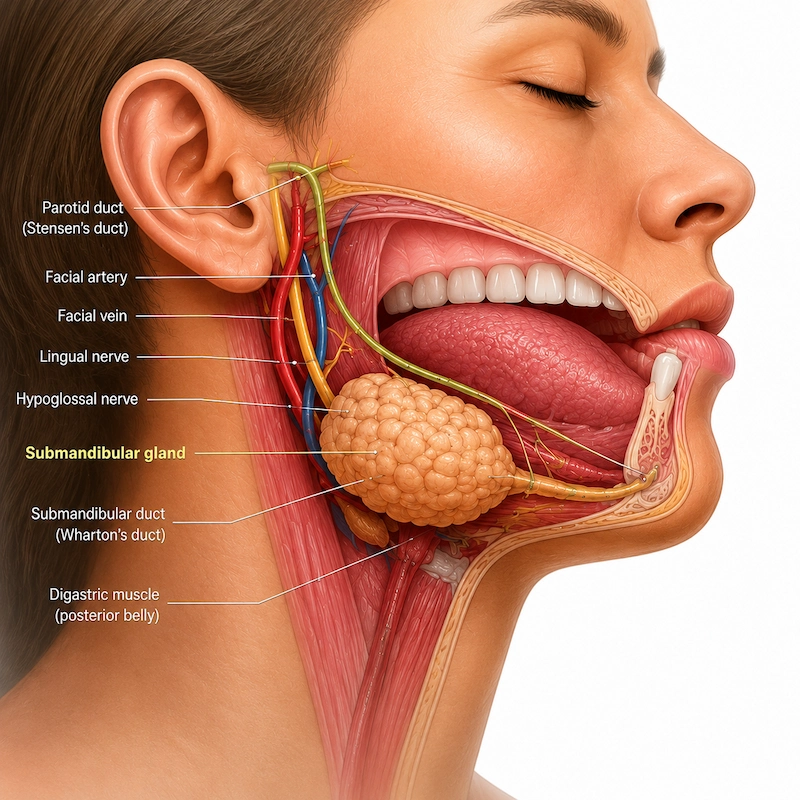
Where are the submandibular glands
Beneath the mandible

Where are the sublingual glands
Under the tongue
What is the function of the esophagus
Moves food from pharynx to stomach.
What is peristalsis
Wave-like muscular contractions that move food through the GI tract.
What is the stomach
A muscular organ that stores and mixes food with gastric secretions.
What is the cardia
The stomach region where the esophagus enters.
What is the fundus
The upper rounded portion of the stomach.
What is the body of the stomach
The large central region.
What is the pylorus
The distal region leading into the duodenum.
What is the pyloric sphincter
A muscular valve controlling stomach emptying into the duodenum.
What is the greater curvature
The long outer curve of the stomach.
What is the lesser curvature
The short inner curve of the stomach.
What are rugae
Folds of stomach mucosa that allow expansion.
What is the greater omentum
A fatty peritoneal fold hanging from the greater curvature of the stomach.
What is the lesser omentum
A peritoneal fold connecting the liver to the lesser curvature of the stomach and duodenum.
What are the three parts of the small intestine
Duodenum, jejunum, and ileum.
What is the duodenum
The first section of the small intestine that receives bile and pancreatic secretions.
What is the jejunum
The middle section of the small intestine, important for nutrient absorption.
What is the ileum
The final section of the small intestine.
What is the ileocecal valve
A valve controlling movement from the ileum to the cecum.
What is the main function of the small intestine
Digestion and nutrient absorption.
What is the cecum
The first pouch of the large intestine.
What is the ascending colon
The section of colon traveling upward on the right side.
What is the transverse colon
The section of colon crossing the abdomen.
What is the descending colon
The section of colon traveling downward on the left side.
What is the sigmoid colon
The S-shaped section before the rectum.
What is the rectum
The final storage region for feces.
What is the anus
The opening through which feces exit.
What is the main function of the large intestine
Absorb water and electrolytes and form feces.
What is the liver's digestive function
Produce bile
What is the gallbladder's function
Store and concentrate bile.
What is bile's digestive function
Emulsify fats into smaller droplets.
What is the cystic duct
The duct connecting the gallbladder to the biliary system.
What is the common hepatic duct
The duct carrying bile from the liver.
What is the common bile duct
The duct carrying bile toward the duodenum.
What is the hepatic portal vein
A vessel carrying nutrient-rich blood from digestive organs to the liver.
What is the hepatic artery
A vessel supplying oxygenated blood to the liver.
What is the pancreas's digestive function
Secrete digestive enzymes into the small intestine.
What is the peritoneum
A serous membrane lining the abdominal cavity and covering organs.
What is parietal peritoneum
The membrane lining the abdominal wall.
What is visceral peritoneum
The membrane covering abdominal organs.
What epithelium lines the esophagus
Nonkeratinized stratified squamous epithelium.
Why does the esophagus have stratified squamous epithelium
To protect against abrasion from swallowed food.
What is the muscularis mucosae
A thin smooth muscle layer in the mucosa.
What is the muscularis externa
Smooth muscle layers that produce peristalsis.
What are the two main muscularis externa layers
Inner circular and outer longitudinal layers.
What epithelium lines the jejunum
Simple columnar epithelium
What are villi
Finger-like intestinal projections that increase absorption surface area.
What are microvilli
Microscopic cell-surface projections forming the brush border.
What are intestinal crypts
Glands between villi that contain secretory and renewing cells.
What do goblet cells secrete
Mucus
What does salivary amylase digest
Carbohydrates or starch
What does lingual lipase digest
Fats
What is intrinsic factor needed for
Vitamin B12 absorption in the small intestine.
What cells secrete pepsinogen
Chief cells
What cells secrete HCl and intrinsic factor
Parietal cells
What does HCl do in the stomach
Helps activate pepsin and supports protein digestion.
What does pepsin digest
Proteins
What does pancreatic amylase digest
Carbohydrates
What does pancreatic lipase digest
Fats
What do pancreatic proteases digest
Proteins
What do pancreatic nucleases digest
Nucleic acids
What cells of the pancreas produce digestive enzymes
Acinar cells