BCH Exam 1 All Content
 Call Kai
 Learn
Learn Practice Test
 Spaced Repetition
 Match
Match Flashcards
 Knowt Play
1/706

There's no tags or description
Looks like no tags are added yet.
Name | Mastery | Learn | Test | Matching | Spaced | Call with Kai | Chat |
|---|
No analytics yet
Send a link to your students to track their progress
707 Terms
Alanine (3 letter code)
Ala
Alanine (1 letter code)
A
Valine (3 letter code)
Val
Leucine (3 letter code)
Leu
Isoleucine (3 letter code)
Ile
Methionine(3 letter code)
Met
Phenylalanine (3 letter code)
Phe
Tyrosine (3 letter code)
Tyr
Tryptophan (3 letter code)
Trp
Proline (3 letter code)
Pro
Glycine (3 letter code)
Gly
Serine (3 letter code)
Ser
Cysteine (3 letter code)
Cys
Threonine (3 letter code)
Thr
Aspartic Acid/Aspartate (3 letter code)
Asp
Glutamic Acid (Glutamate) (3 letter code)
Glu
Asparagine (3 letter code)
Asn
Glutamine (3 letter code)
Gln
Histidine (3 letter code)
His
Arginine (3 letter code)
Arg
Arginine (1 letter code)
R
Lysine (3 letter code)
Lys
Lysine (1 letter code)
K
Histidine (1 letter code)
H
Glutamine (1 letter code)
Q
Asparagine (1 letter code)
N
Glutamic Acid (Glutamate) (1 letter code)
E
Aspartic Acid/Aspartate (1 letter code)
D
Threonine (1 letter code)
T
Cysteine (1 letter code)
C
Serine (1 letter code)
S
Glycine (1 letter code)
G
Proline (1 letter code)
P
Tryptophan (1 letter code)
W
Tyrosine (1 letter code)
Y
Phenylalanine (1 letter code)
F
Methionine (1 letter code)
M
Isoleucine (1 letter code)
I
Leucine (1 letter code)
L
Valine (1 letter code)
V
Amino acids are joined by what type of bond
Covalent
Protein structures are stabilized by _________ interactions and forces
NONcovalent
Two kinds of secondary strucures
A helix, B conformation
3D folded conformation of a protein
Tertiary Structure
Multisubunit interactions (2+ proteins) make
Quaternary structures
3 ways to determine 3D strucuters
NMR, X Ray Crustallography, Cryo EM
Covalent bonds linking the amino acid sequence of a polypeptide chain
Primary Structure
Peptide bonds are stable because
(resonance)(partial double bond character)
N-Ca bond
Phi
Ca-C bond
psi
C-N bond
omega
Peptide (omega) bonds rotate Freely
False
Phi and Psi bonds rotate Freely
True
How many atoms in a peptide chain lie in a single plane
6 (six)
Secondary structure= arrangement of (main/side) chain
Main
Tertiary structure= arrangement of (main/side) chain
side
Secondary structures are stabilized by what kind of interactions
NON covalent
The uniformity of the secondary structure is produced by:
repetition of phi and psi angle
Simplest arrangement of a secondary strucure
Alpha helix
Secondary strucure with the MAXimum number of Hydrogen bonds
Alpha helix
What protrudes out of the alpha helix
R group (this means R groups affect protein function and interactions)
Each helical turn in an alpha helix is how many Å (distance)
5.4 Å
How many residues make up an alpha helical turn
4 (3.6)
Interactions between (R groups/main chains) can stabilize or destabilize the alpha helix
R groups
Alpha helix is formed by __________ (type of interaction) between the N-H of residue n and the carbonyl O of residue ___
hydrogen bonding; n+4
Alpha helix is made by hydrogen bonds between (side chains/main chains)
MAIN chains
Two amino acids that disrupt or prevent alpha helices
P, G
More common Alpha Helix handedness
Right handed
Less stable Alpha helix handedness
Left handed
The N+ to C- structure of a polypeptide produces a
net dipole
Alternative helix structure: 310 helix has how many residues per turn
3.0 (skinnier)
Alternative helix structure: π helix has how many residues per turn
4.4 (fatter)
Side groups are always oriented in cis/trans along a polypeptide chain
trans
Zigzagging polypeptide backbone
B conformation
Multiple Beta strands side by side make up a
B sheet
A single protein segment in B conformation
Beta strand
Two orientations of Beta sheets
Parallel,Antiparallel
More frequent and stable orientation of a B sheet
Antiparallel
Why is the antiparallel orientation of a Beta sheet more stable
in-line H bonding
Parallel strands have X H bonds, making them Y
angled, weaker
Secondary structures known as turns can be:
beta or gamma
Connects ends of two adjacent segments of an antiparallel Beta sheet
Beta turn
Beta turns involve how many residues
4
Type I Beta turns have a characteristic X residue at the #Y position
P2
Type II Beta turns have a characteristic X residue at the #Y position
G3
Beta turns span how many residues total
4
Beta turns are formed by hydrogen bonds between which resiudes
1 and 4
Gamma turns span how many residues
3
Both B and G turns are Xº
180
Gamma turns have a characteristic X amino acid at the #Y residue
P2
Plotting phi and psi angles make a _________ plot
Ramachandran
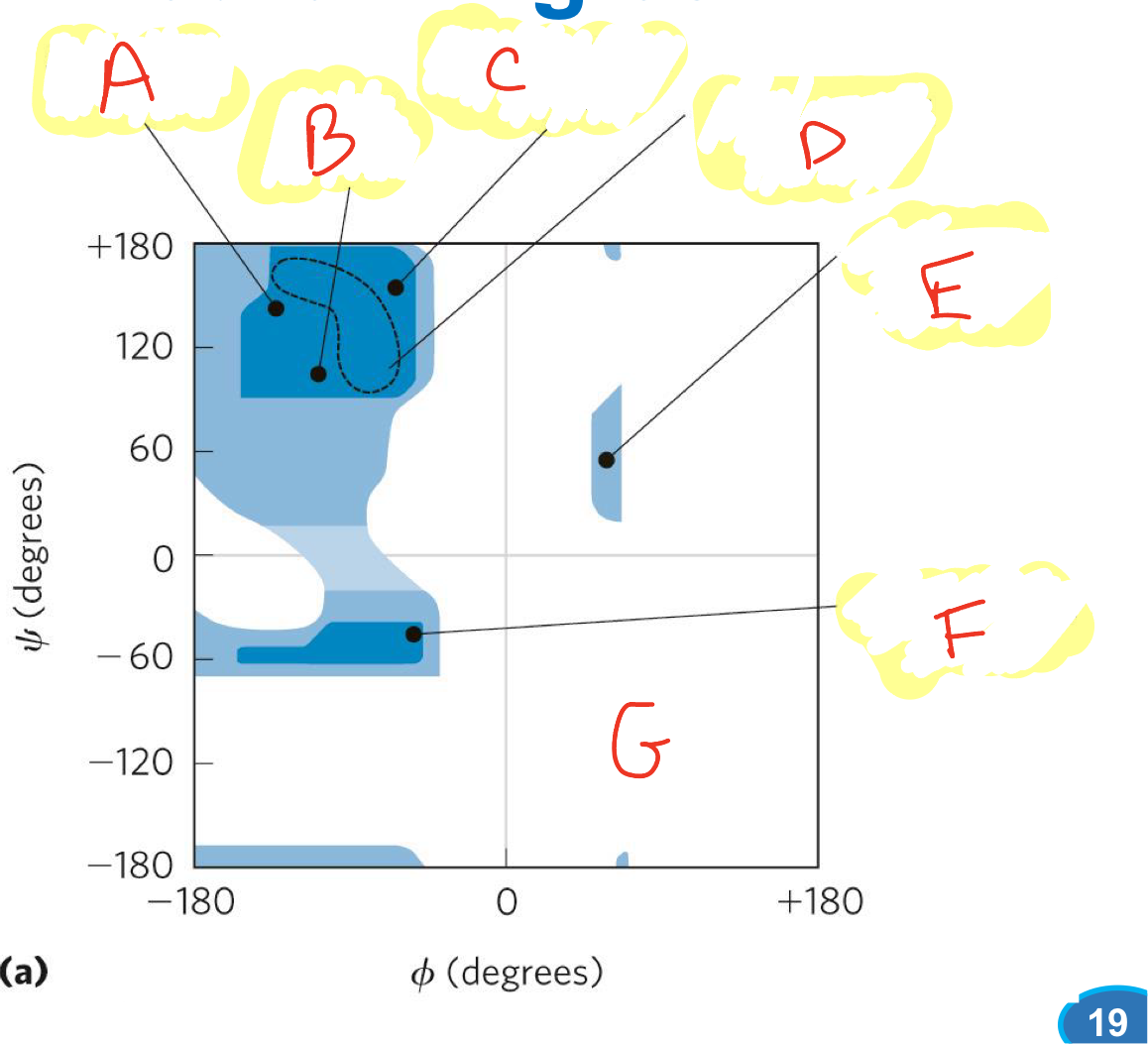
Label A
Antiparallel B sheet

Label B
Parallel B sheet

Label C
Collagen triple helix

Label D
Right twisted B sheet
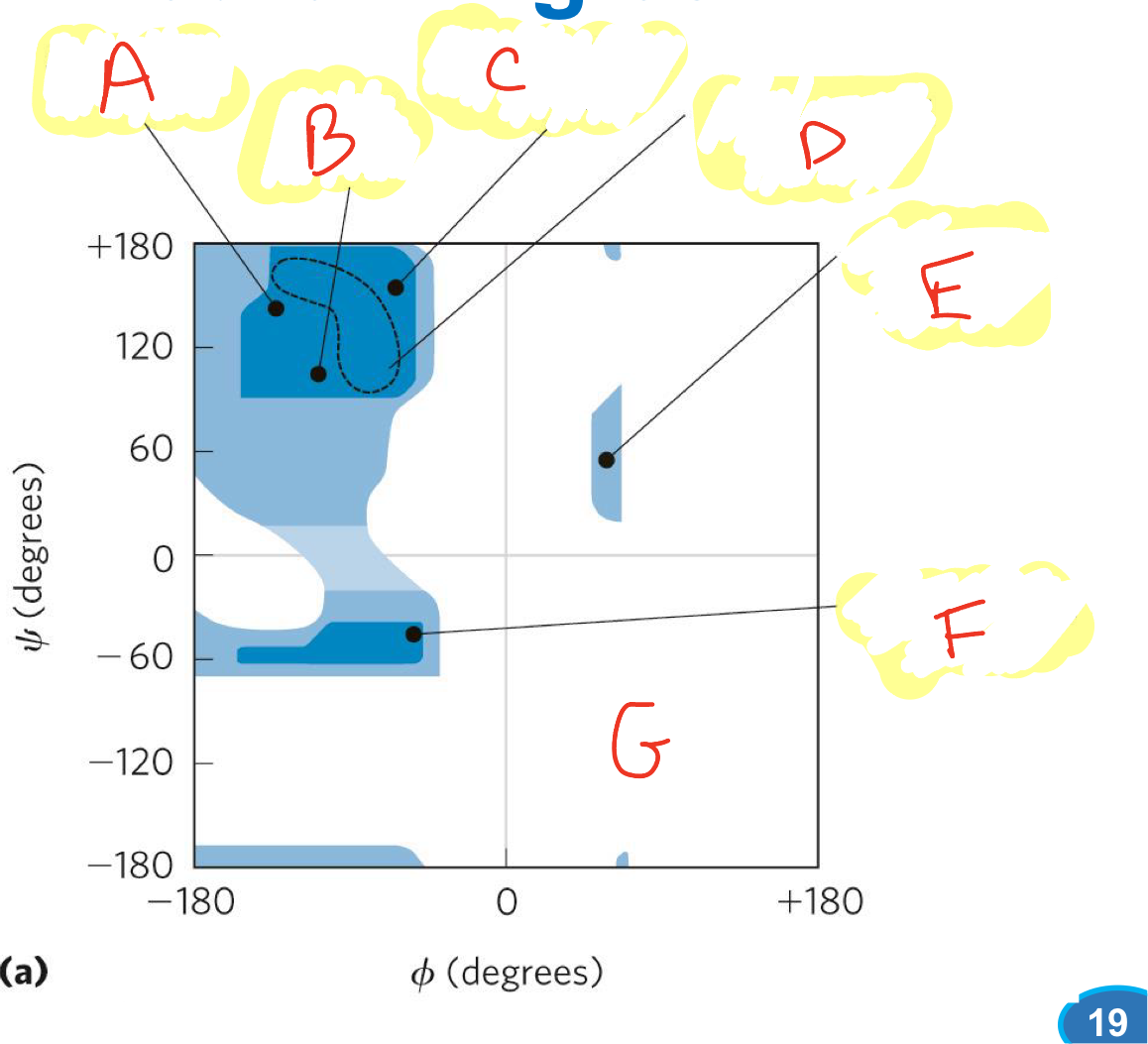
Label E
Left handed alpha helix

Label F
Right handed alpha helix

Label G
Forbidden angle
The top right quadrant of a Ramachandran plot contains what secondary structure
Left-Handed Helix
The bottom left quadrant of a Ramachandran plot contains what secondary structure
Right handed alpha helix