Proteins and Nucleic Acids
 Call Kai
 Learn
Learn Practice Test
 Spaced Repetition
 Match
Match Flashcards
 Knowt Play
1/4

There's no tags or description
Looks like no tags are added yet.
Name | Mastery | Learn | Test | Matching | Spaced | Call with Kai | Chat |
|---|
No analytics yet
Send a link to your students to track their progress
5 Terms
Proteins
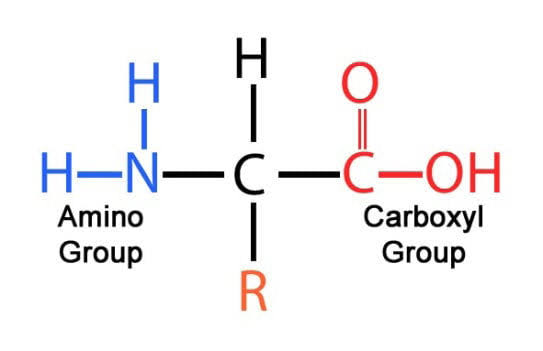
Proteins are molecules with C,O,H,N and in some sulfur. They are used for enzymes, hormones, cell growth and repair, and haemoglobin. They have a general structure of an amino group(NH2) on one end, with a carboxyl group at the other end. They are both bonded to a central carbon, which is bonded to a hydrogen and an R group. The R group is the residual group, which changes to form 20 different amino acids. Two amino acids bond to each other by a peptide bond, formed through a condensation reaction(OH of carboxyl with H of amino) to form a dipeptide. More than two amino acids bonded together is a polypeptide.
Primary and secondary protein structures.
Primary structures: This is the sequence and types of amino acids. This determines the secondary and tertiary structure.
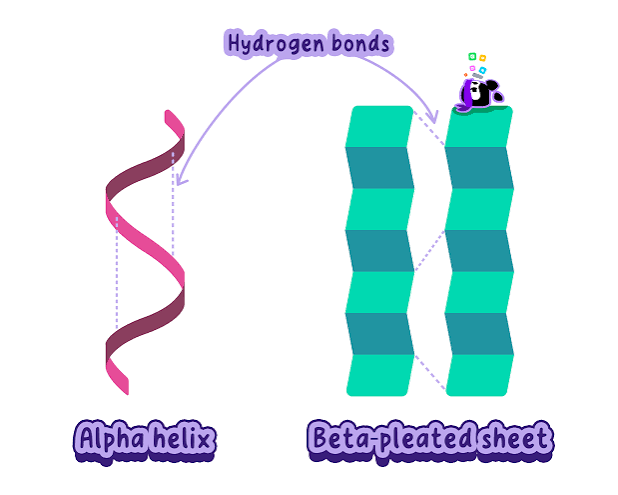
Secondary structures: There are two main types: Alpha helix and beta pleated sheets. The alpha helix is held by hydrogen bonds between two amino acids in the same chain. the beta pleated sheets have hydrogen bonds between two polypeptide sheets.
Tertiary and quaternary structures
Tertiary: This is when the secondary structure further folds into 3d shapes. There are two main types of tertiary structures: Globular and fibrous. Globular structures are round, compact and mostly soluble in water, while fibrous structures are insoluble. They are important in metabolic reactions. All enzymes are globular, since the 3d shape is needed for the active site. Haemoglobin, antibodies, and antibodies are also globular. Fibrous proteins have long and rope like structures. They are used for structural support like collagen, keratin and elastin. Tertiary structures are held by many bonds, which include hydrogen, ionic, disulfate, and hydrophobic interactions. Disulfate bonds are strong covalent bonds between two sulfurs(e.g. cysteine) .Usually, hydrophyllic amino acids are on the outside, while hydrophobic ones are on the inside.. Quaternary structures are more than one polypeptide chains working together as a whole.

Haemoglobin and insulin
Haemoglobin is a conjugated globular protein which has the function of carrying oxygen around the body. A conjugated protein is one with a prosthetic group. A prosthetic group is a non protein group which is permanently bound to the protein and is vital in its function. The prosthetic group in haemoglobin is the heme group, which contains iron in it. Haemoglobin is made up of two alpha helix and two beta pleated chains, each bound to a heme group. Insulin is an amino acid which has two chains held together by 3 disulfate bonds.

Collagen
Collagen provides structural support in many areas including the skin, heart, and tendons. It is made up of 3 polypeptide chains wrapped together like a rope, which means it has a quaternary structure.The chains are bonded by many hydrogen and covalent bonds to each other, providing strength, This makes collagen fibrils which link up to make collagen fibres, Collagen is made from 3 repeating amino acids. Elastin can stretch which is why it in connective tissues.Keratin is the protective layer for skin and hair.
