business finance exam 2
 Call Kai
 Learn
 Practice Test
 Spaced Repetition
 Match
 Flashcards
 Knowt Play
1/48

There's no tags or description
Looks like no tags are added yet.
49 Terms
ch 5 part 2
starts here
what type of rates are APR and EAR
annual rates
what is the rate used in formulas for solving things
r, which is periodic rate
r =
APR / m
effective annual rate - what is it
The true, total interest rate paid or earned in one year after accounting for the effects of compounding
apr vs ear
both measure how much it takes to borrow money, but apr doesn’t account for interest compounding while EAR does.
apr = a simple annual multiplier
nominal rate
unadjusted + stated interest rate on a loan
real rate
adjust the nominal rate for inflation - shows true purchasing power + borrowing cost
are EAR and APR real or nominal
all are nominal - because they only tell you how fast your money grows in $$ and not how many more goods you can buy
what is “real gain” in terms of
in terms of real goods/purchasing power, not just how much more money you made
how to find real purchasing power
take the APR and convert it to the EAR to find stuff in terms of how many goods you can buy

rise in price is
inflation
inflation is the…
rate of change in the general price level
nominal vs real interest rate
Nominal = % increase in dollars the investor receives from investing (what the bank quotes with EAR, APR and r)
Real = % increase in goods and services the investor can buy from investing (what you care about)
what does it mean if the nominal rate is no higher thna inflation
saving in the bank is worse than buying goods today
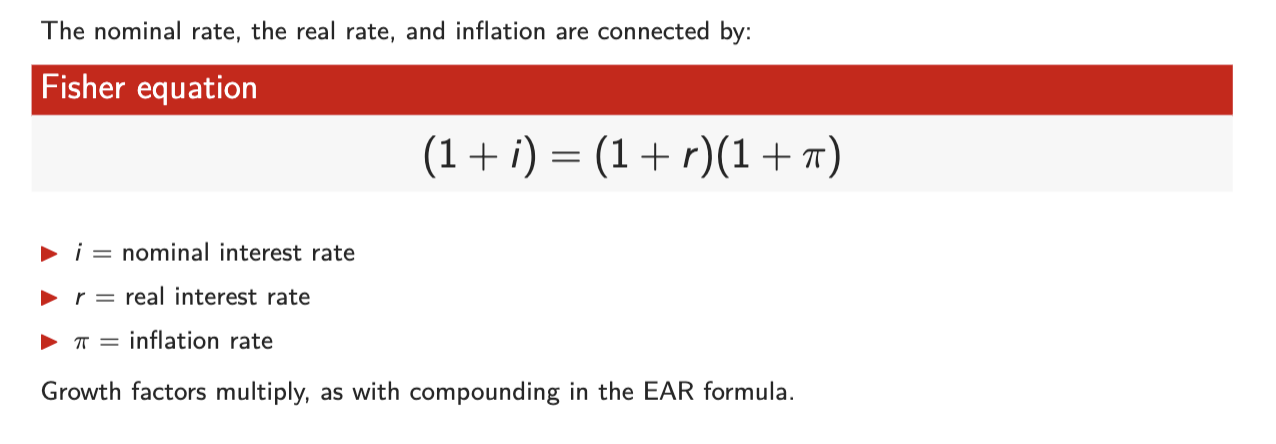
fisher equation
shows how the nominal, real and inflation are all connected
fisher equation shows…
how the nominal, real and inflation are all connected
fisher equation
fisher equation approximation

chapter 6 starts here
yes!
components of a bond
the coupon and the par value
coupon vs par

price of a coupon bond formula = what are the components
the coupon (annuity) and a par value (the lump sum)

what is YTM
a type of APR
a discount rate
purpose: find PV of the bonds cash flows = market price, if bond it held to maturity
is YTM market determined
yes!
how to solve for YTM with calc
PMT and FV = same sign. PV = opposite sign
calculator returns r=YTM/m, so you have to multiply by m
rules to find YTM on calculator
YTM on Calculator:
Market determined
PMT & FV = same sign. PV = opposite sign
Calculator returns r = YTM/m, multiply by m to get YTM
If you’re given the YTM and you need to solve for PMT or something else, you say that I% = (YTM / m) = little r
for YTM, what does the calculator return?
Calculator returns r = YTM/m, multiply by m to get YTM
If you’re given the YTM and you need to solve for PMT or something else, you say that…
I% = (YTM / m) = little r
so, you have to divide the YTM by m!!!!!
PAR BOND
YTM = coupon rate, then price = par value
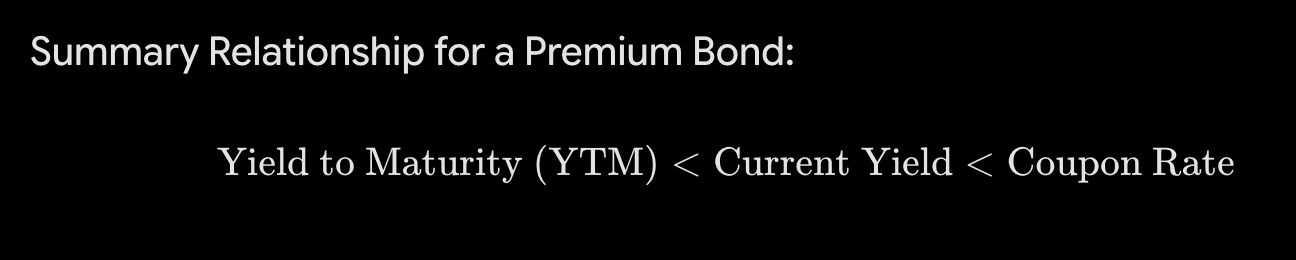
PREMIUM BOND
YTM < coupon rate then price > par value
discount bond
YTM > coupon rate, then price < par value
longer maturity =
more price risk, aka more sensitive to a change in yield than the 1 year bond
coupon rate

capital gain yield
the percentage change in the price of an asset over time, reflects price appreciation (if it’s a discount bond) or depreciation (if it’s a premium bond)
CURRENT YIELD
annual coupon / price. Coupons are always POSITIVE, so the current yield can never be negative
summary of premium bond
summary of discount bond
