Lesson 115: Food Requirement for Healthy Animals PART 1
 Call Kai
 Learn
 Practice Test
 Spaced Repetition
 Match
 Flashcards
 Knowt Play
1/14

There's no tags or description
Looks like no tags are added yet.
15 Terms
Macro nutrients requirements for dogs: protein
10 Essential Amino Acids are needed from diet
Plant proteins have lower digestibility than animal protein
Recommended amounts: AAFCO = 22% Dry Matter (DM) in puppies and 18% DM for maintenance
Macronutrient Requirements for Dogs: fat
Linoleic acid (Omega-6), Omega-3's are essential from diet
Sources: vegetable oil, chicken and pork fat
AAFCO = 8% DM in puppies and 5% for maintenance
At least 1-2% needed in diet to absorb fat soluble vitamins
Macronutrient requirements for dogs: carbs
No specific requirements for adult,
non-reproducing dogs => commercial diets meet the daily amount of glucose needed
Macronutrient requirements for cats: protein
11 (Taurine) Essential Amino Acids that are needed from diet
Animal protein sources have largest amounts
Recommended amounts: AAFCO = 30% Dry Matter (DM) in kittens and 26% DM for maintenance
Macronutrient requirements for cats: fat and carbs
Linoleic Acid AND Arachidonic Acid (Omega-6's), Omega-3's needed in their diet; cannot synthesize it
Recommended amounts: AAFCO = 9% Dry Matter (DM)
Carbohydrates: Typically, <10% should be in their diet
Growth: Puppies and Kittens
Gradual transition from milk to solid food between 4-8 weeks old
High-protein, high-fat and high-energy diet supports their growth.
Essential Fatty Acids (Omega-3's) are important for brain & eye development and skin & coat health
Puppies and kittens: micronutrients
Balanced calcium and phosphorus ratios for controlled bone growth (*large breed puppies)
Correct ratio is ideally Ca:P ratio for most young animals is 1:1-2:1
Taurine for proper development (cats)
Senior Dogs and Cats: Lower calories
Moderate protein to maintain lean muscle; without added stress on kidneys
Increased fiber to help with digestion and bowel health
Joint support ingredients: glucosamine, chondroitin
Essential Fatty Acids for brain health and cognitive function
Gestation & Lactation
High calorie content, Increase protein, Higher fat levels
Increased vitamins/minerals (Ca+ and Phos) - increased demands for pregnancy, birth and nursing
Increased Essential Fatty Acids - brain development
The Resting Energy Requirement
calories an animal needs in order to maintain basic functions for life - these are things like respiration, digestion, circulation, and metabolism
RER =
70 [body weight in kg^0.75]
True MER
Animal is at an appropriate weight
Accurate diet history is taken
Total daily calories is known
Estimated MER: more commonly used
Adjusted RER to account for estimated energy for different factors
Unknown calorie intake
Daily energy requirement calculations
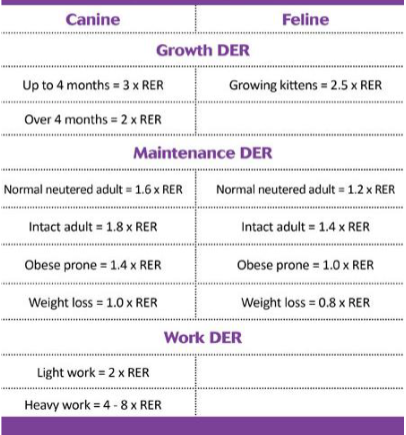
Maintenance energy requirement (MER) factors
