Term 1 midterm
 Call Kai
 Learn
 Practice Test
 Spaced Repetition
 Match
 Flashcards
 Knowt Play
1/288

Earn XP
Description and Tags
L1-15
289 Terms
Homeostasis, or the ability to…
Maintain a stable internal environment
Homeostasis is preserved when…
our physiological mechanisms use energy to keep body conditions steady in spite of disruption
Homeostatic regulation of a biological variable requires 3 components:
Sensor
Integrator
Effector
Allostasis refers to the body's ability to…
Adapt (change) our set points, or our behaviour - to meet different conditions.
Behavioural allostasis:
When we voluntarily perform behaviours that alter a regulated variable away from its current set point
Physiological allostasis:
Our internal integrators can shift their set points during specific states
Both forms of allostasis are feed-forward meaning they…
anticipate a future physiological need
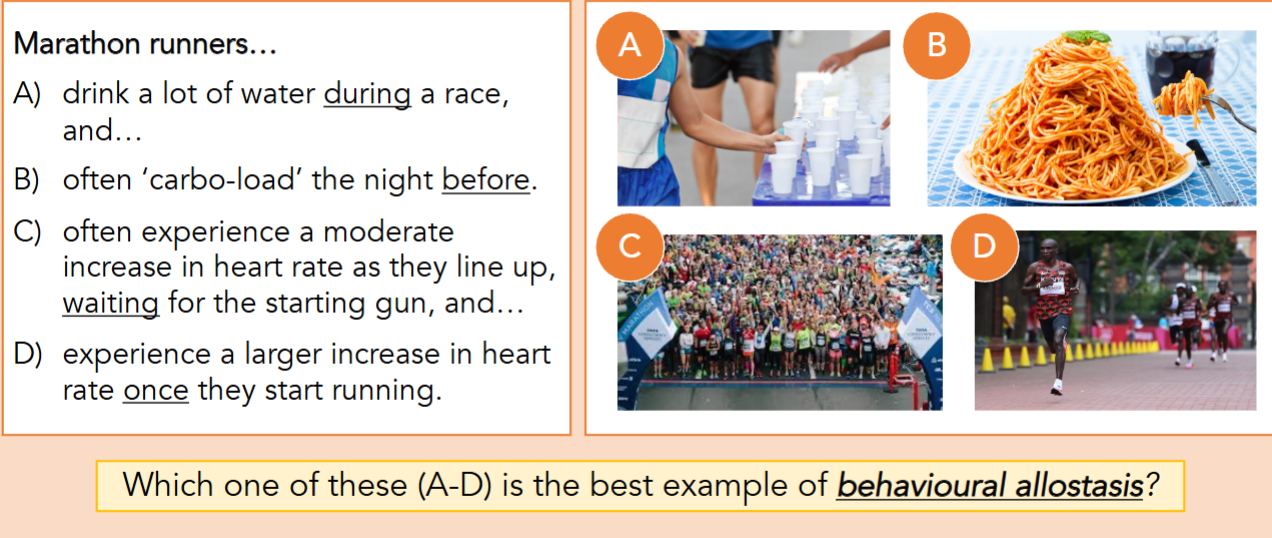
Select the right answer. Why?
B - t’s a behavior that prepares the body for the expected energy demands of the race.
feedback loops occur when…
change detected by a sensor triggers an effector response that changes the environment
Negative feedback loops…
return the controlled variable toward its set point
Positive feedback loops…
Enhance or amplify changes - each cycle moves the regulated variable from its initial set point
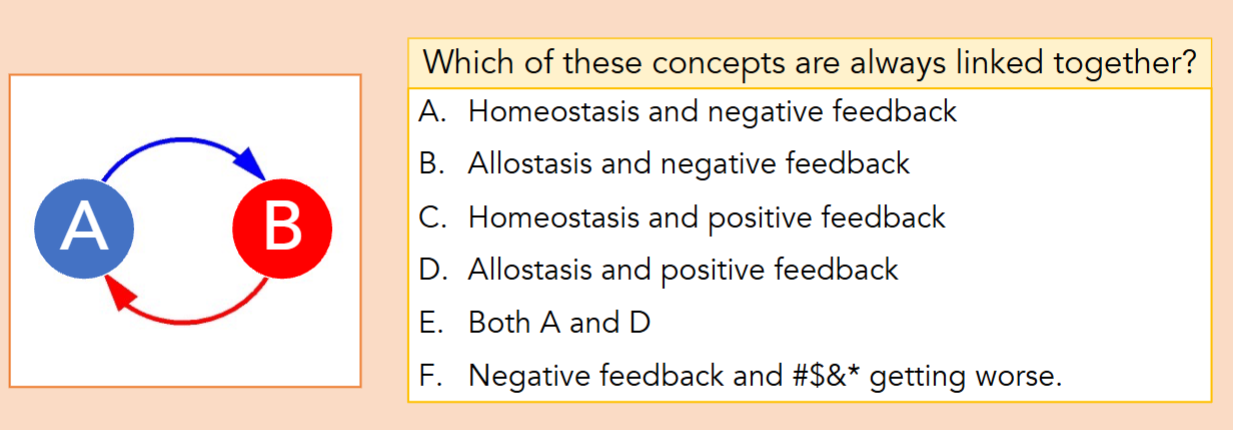
Select the right answer and why
A - allostasis adjusting to set point, positive feedback moves away from set point

explain the difference in 1. size 2. organization 3.function of bones in hand and foot
key idea?
hand has thinner bones and Foot has thicker bone
+ 3. hand has better mobility for grabbing and food is better for weight bearing for walking
key idea: structure determines function
The exact features of a structure may reflect _____-___ between _____ competeing functions
trade-offs, multiple
The cell cycle describes….
The balance in a typical cell between cell division and ‘simply’ performing normal physiological functions
interphase:
cells spend most of their time in this phase and are not dividing
mitosis
term for cell division period
if cell regulation is disrupted, what occurs (3 steps)
abnormal cell division can occur
leading to tumours
becomes cancers
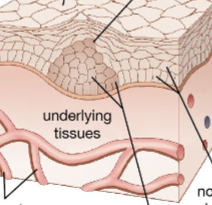
Tumours are
an area with an abnormal cell division rate

Cancer is…
When tumours move out of tissue origin and spreads to other parts of the body

Which answer is correct
D

The plasma membrane…
Separates the cytoplasm (inside) from the extracellular fluid
what ions are common within the ECF
NA and Cl
What are ions common within the ICF (cytosol)
K+
what is the concentration of Cl- in the ECF and is it higher or lower than the ICF (cytosol)
Cl- : 120mM
higher
The plasma membrane is a…
selectively permeable lipid bilayer which also contains integral membrane proteins (channels) with a variety of functions (ways to open)
The plasma membrane is selectively permeable meaning…
different molecules have different abilities to cross it
free diffusion:
small non polar (ex. co2, o2) molecules can cross plasma membrane without any protein assistance based off of concentration
Facilitated diffusion/transport
Movement with the help of membrane proteins
Passive transport… (2)
does not require atp to move materials across plasma membrane
allows substances to move according to their concentration (electrochemical) gradients
Active transport…
uses stored energy to move ions or molecules against a concentration gradient

Primary active transport:
‘ pump’ protein directly uses ATP to move ions or molecules

Secondary active transport:
uses a gradient of one molecule (created using ATP) to move another molecule
Vesicular transport:
a specialized form of active transport that can move large molecules or many molecules at a time.

where does secondary active transport occur
where does facilitated diffusion occur
A
C

which statements are true
only D
Differentiation
Cells become different types of specialized cells by expressing different combinations of proteins
Polarization
different regions within the same cell become specialized to preform different functions
Name all the types of tissue:
epithelial tissue
connective tissue
muscular tissue
nervous tissue
_____ and ____ tissue contain highly specialized cells adapted for very specific physiological roles
Muscle and nervous tissue
Muscle tissue is…
able to contract and produce mechanical force
Nervous tissue is…
specialized to send and receive information in the form of electrochemical signals
_____ and ____ tissues are more diverse in their functions, their specializations, and where they are found
Epithelial, connective
Epithelial tissues….
lines surfaces and spaces in the body
Connective tissue…
typically fills or stiffens (supports) spaces in your body

which type of tissue is @ A and which of the 4 is not within the image
A = epithelial tissue
missing tissue would be nervous
Epithelium:
A sheet of connect epithelial cells attached to a basement membrane
epithelial tissues covers surfaces in your body such as (4)
external surfaces
internal cavities
passageways
secreting structures (mucus, sweat glands)
4 functions of epithelial tissue
provide physical protection
control permeability
provide sensation
produce specialized secretions
what are some basic features of epithelial cells (3)
They have
polarization
apical surface (contact with lumen
basolateral surface (in contact with ISF)
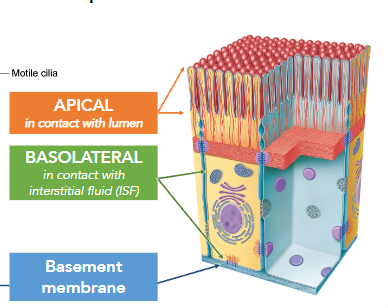
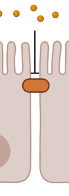
Cells within an epithelium are ____ to each other by proteins. A common method of this is ____ ____ which has small gaps between cells
Bound, tight junctions

Leaky tight junctions:
Allows paracellular (in-between) transport of water and solutes between lumen & ISF

Tight Tight junctions:
Does not allow paracellular transport between lumen & ISF
Simple epithelia means…
Stratified epithelia means…
one layer
multiple layers
→ classified by apical surface layer
Squamous epithelia are…
flat, more wide than tall
Cuboidal epithelia are…
cube like
Columnar epithelia are…
taller than they are wide
Pseudo-stratified epithelia is…
one layer but looks like multiple

Select the correct answer
E
Connective tissue is defined by…(i.e. histological def)
Extracellular protein fibres and cells suspended within a ground substance (matrix), but can fulfill many functions
matrix = liquid

select the right answer
A
Connective tissue proper can be divided into (2) types
Loose
Dense
Loose ‘proper’ connective tissue:
Has low density of extracellular fibres
Has more diversity of cell types
ex. areolar tissue

Dense ‘proper’ connective tissue:
Has high density of extracellular fibres
has low diversity of cell types
ex. Tendon
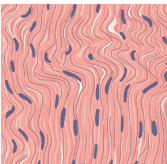

What type of cells can be found in loose proper connective tissue? (3)
Fibroblasts
Fibrocytes
Mesenchymal cells


Fibroblasts:
Secret the proteins of extracellular matrix


fibrocytes:
maintain the proteins of the extracellular matrix
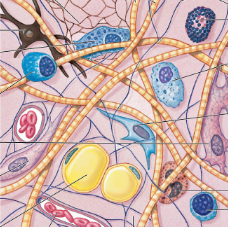

Mesenchymal cells:
Stem cells that can divide to replace damaged cells (fibroblast)

2 types of extracellular fibres in connective tissue proper
elastin fibres - elastic (stretch and recoil)
Collagen fibres - high tensile strength (create tension) (strong but not stretchy)

What is the strategy for repair for epithelium tissue
Rapid proliferation
clot forms out of blood tissue
What is the strategy for repair for connective tissue
Increased rates of secretion
scar forms when fibroblast secret collagen fibres at injury site

answer why you get bleeding gums
Fibroblasts aren’t able to produce collagen due to lack of vitamin C
Collagen gives connective tissue tensile strength
Gums struggle to hold teeth
Gums bleed
the integument consists of…
→ what is not apart of the integument
The cutaneous membrane:
Epidermis
Dermis
and Accessory structures
→ Hypodermis - subcutaneous
The integument has many functions including (3)
protection
detection
barrier
How does the integument protect?
barrier: immune and osmotic homeostasis
i.e. keeps things out and things in (water)

How does the integument detect?
Sensory organs - receptors

How does the integument regulate?
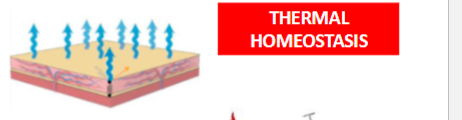
Thermal homeostasis
detects change in temperature and regulates
What is the difference between thick and thin skin and where can they be found?
Thick skin: is hairless and can be found on palmar and plantar surfaces, has stratum lucidum
Thin skin: has hair and can be found everywhere else
is dark skin thicker than light skin?
No, its just darker
name all distinct strata (layers) of the epidermis from superficial to deep
thick and thin skin are not the same
C - Stratum Corneum
L - Stratum Lucidum (only in thick skin)
G - Stratum Granulosum
S - Stratum Spinosum
B - Stratum Basale

what type of epithelium does the epidermis consist of ?
Stratified squamous epithelium

Epidermal cells are continuously generated in the _______ layers (strata), differentiated in the ____ layers and shed from the _____ layers
Deepest, middle, superficial
Explain how Epidermal cells are continuously generated
Basal stem cells in the stratum Basale proliferate (divide) producing new keratinocytes
Keratinocytes move upward through the stratum spinosum and continue differentiating.
Keratinization becomes more prominent in the stratum granulosum as keratinocytes flatten and accumulate keratin
by the stratum corneum, keratinocytes are dead, flattened, and filled with keratin
What does this mean “the epidermis is keratinized”?
cells of the epidermis become filled with keratin
keratin is a tough, cross-linked, water-resistant protein, which limits insensible perspiration (water loss through cutaneous membrane itself)
what does Melanin do and why do we need it
Melanin can absorb UV photons and releases energy safely.
Without it, UV light could damage cells - particularly DNA
Where and what do melanocytes do?
Melanocytes are located within the stratum Basale
produces melanin pigments and transfers them to keratinocytes

_______ (packed with melanin) are transferred via vesicle transport
Melanosomes


answer for CV DNA damage and CV melanosome production
DNA damage - homeostasis - want to get rid of damage
Melanosome production - allostasis
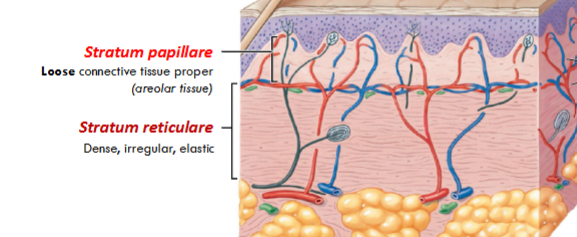
The dermis contains…
Two layers of connective tissue:
1. stratum papillare - contains loose connective tissue proper (areolar)
Stratum reticulare - dense, irregular, elastic connective tissue
explain the process of skin repair. Be sure to list phases
Inflammatory Phase
bleeding triggers clot formation
Mast cells triggers inflammatory response
Migratory Phase
A scab forms at the surface
Macrophages remove pathogens and debris
Rapid cell migration and division occur:
Epidermis: Basal cells proliferate and keratinocytes migrate to cover the wound
Dermis: Fibroblasts and other cells migrate and proliferate
Granulation tissue forms: mixture of new blood vessels, mesenchymal cells, fibroblasts (dermis)
Proliferation Phase
Deeper portions of the blood clot dissolve as new tissues replaces them
Fibroblasts produce collagen fibers and ground substance
New tissue fills the wound
Scarring Phase
Scar tissue forms as a result of the Dermis’s enhanced collagen secretion

What is a callus?
A specific thickening of the stratum corneum, caused by keratinocytes being more strongly cross-linked
Key points of inflammation: (2)
increased blood flow
Attraction of immune phagocytic cells
why do cross links stay and what does more links between cells do?
stays because no nucleus and more links results in longer/more force for them to shed

Select the correct answer
E

Select the correct answer
D - think migratory phase where new blood vessels form
The dermis contains _____ _____ that support the epidermis or allow for secondary skin functions
Accessory structures
The dermis contains many ________ (touch) and ______ (pain) neurons
somatosensory, nociceptive
_____ in the integument are epithelial structures which contribute to _____ and or ______
glands, protection, homeostasis
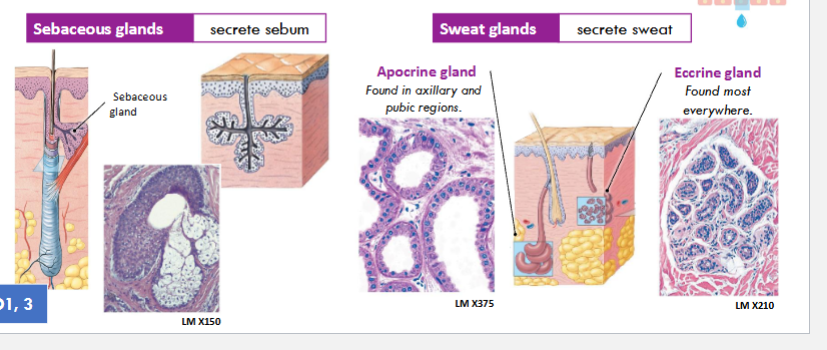
name which glands are in the integument:
Sebaceous glands: secrete sebum
Sweat glands: secrete sweat
Apocrine gland: Found in axillary and pubic regions - more active after puberty
Eccrine gland: found almost everywhere
_______ in skin play a critical role as a sensor for thermal homeostasis
Thermoreceptors
