NUR 326: exam 3 - mental health 1 💯💯
 Call Kai
 Learn
 Practice Test
 Spaced Repetition
 Match
 Flashcards
 Knowt Play
1/92

There's no tags or description
Looks like no tags are added yet.
93 Terms
what is acute inpatient mental health practice
- acute (intervention) = SAFE: stabilization, assessment, first priority safety, emergency/crisis
what is outpatient mental health practice
- outpatient (stabilizing, prevention) = TEACH: teach meds, encourage coping, adherence, community resources, health promotion
what are the 4 criteria for acute inpatient/outpatient
- crisis stabilization: monitoring individuals having mental health emergency
- community based hospital facility: admitted for psychiatric illness (psych unit in hospital or psych facility)
- state hospitals: pt with mental illness and meet state requirements → may be involved in criminal justice system
- long term care: chronic conditions and can’t live independently
what are the criteria to justify admission to an acute care facility
1. danger to self or others, functional status (cognitive impairment)
2. failure to meet expected outcomes of community based treatment
3. dangerous decline in mental health/deny having an issue
4. having medical problem on top of mental illness (comorbidities)
what are acute care goals when admitted to an acute care facility
- prevention of self harm
- stabilization of mental health crisis
- return clients to community based care
How should communication be for therapeutic communication regarding mental health
- client centered, purposeful, planned, patient goal-directed
- takes clients thoughts, feelings, and needs into account
- expressed empathy and genuine concern
- obtain information and give feedback about client’s condition
- intervention: promote functional behavior and effective interpersonal relationships
- evaluate client’s progress toward goals and outcomes
what are components of therapeutic communication regarding mental health
- time
- attending behaviors and active listening (not charting while pt is speaking)
- caring attitude
- honesty
- trust
- empathy
- nonjudgemental attitude
what are skills and techniques of therapeutic communication regarding mental health
- silence
- active listening
- general leads: pt takes direction of discussion (“go on”, “and then”)
- questions are open-ended and projective
- offering self: desire to understand (“i’ll stay here and sit with you”)
- presenting reality: indicate what is real (that was Todd, not a mafia man)
- voicing doubt: expressing uncertainty (“isn’t that unusual” “really”)
what are barriers/nontherapeutic communication
- irrelevant personal questions
- offering personal opinions
- giving advice
- false reassurance
- minimizing feelings
- changing the topic
- asking “why” questions
- offering value judgements (prevents problem solving)
- giving approval or disapproval
what are legal considerations: seclusion vs restrarints
- seclusion: isolating patients in a room
- restraints: physical or chemical restriction
what are legal considerations: access to care
patients have the right to receive mental health care
→ patient rights: refusing meds, informed consent, least restrictive/invasive meds
what are legal considerations: nurse’s role
- nurses: mandated reporting → legally required to report exploitation, neglect, and abuse
- nurses: duty to warn → if pt makes a credible threat towards another individual warm the pt if you know them or call police
what are legal considerations: voluntary admissions
- informal: not a danger, fully voluntary, can leave whenever
- voluntary: still has rights, may need to follow facility rules for discharge (can discharge AMA)
what are legal considerations: involuntary admissions
- involuntary: consistent hx of symptoms of serious mental illness, danger to self or others, persistent or acute inability to provide self-care, gravely disabled and in need to treatment, unwilling or unable to accept voluntary treatment
- temporary emergency admission → 72hr hold (danger to self or others)
- admitted without consent, legal criteria requirements
- long-term involuntary: court ordered, ongoing risk present
what are legal considerations: restraints and seclusions considerations
- can be voluntary “quiet room”
- least restrictive measures, shortest duration necessary
- providers MUST provide a prescription: age 18 and older = 4 hrs, age 9-17 = 2 hrs, age 8 or younger = 1hr
- providers must reassess the need and must rewrite order
- patients must be offered water, food, toileting, and be monitored for pain/vitals
- document every 15 to 30 mins: vitals and what pt is doing
what is defense mechanism: reaction formation
people express the opposite of their true feelings
what is defense mechanism: projection
individuals attribute their own unacceptable thoughts, feelings, or motives to another (blaming someone else for feelings or thoughts that are actually your own)
what is defense mechanism: dissociation
a person separates from their thoughts, feelings, memories, or identity
→ temporary escape from overwhelming or traumatic experiences
what is milieu therapy
- form of psychotherapy → environment is controlled to prevent self-destructive/maladaptive coping behaviors
- focus on creating an environment that is safe, calm, and healing
what activities are involved in milieu therapy
- individual therapy (1:1)
- medication management
- group therapy
- recreational activities
- unstructured flexible time (planned free time for socialization)
- case management
what are goals of milieu therapy
- safety, independence (autonomy), coping skills, socialization
- nurse role: maintain safety, structure, boundaries, and monitor behaviors
- safety intervention: remove harmful objects, observe patients, de-escalate, supervise
what are nursing interventions to ensure physical safety within milieu therapy
1. tell the client calmly and directly what they must do in a particular situation
2. use physical activity, such as walking, to de-escalate anger and behaviors
3. inform client of the consequences of their behavior, such as loss of privileges
4. use pharmacological interventions if the client does not respond to calm limit setting
5. plan for 4-6 staff members to be available and in sight of the client as a “show of force” if appropriate
what are appropriate boundaries of nurse-client therapeutic relationship
- focus on client’s ideas, experiences, and feelings
- identify and explore client’s needs and problems
- discuss problem-solving alternatives with client
- help develop the client’s strengths and new coping skills
- encourage positive behavior changes in the client
- assist the client in developing a sense of autonomy and self-reliance
- portray genuineness, empathy, and a positive regard towards client
what are inappropriate boundaries of nurse-client therapeutic relationship
- relationships slip into a social context (social relationships primary purpose is for socialization or friendship with a focus on the mutual needs of the individuals involved in the relationship)
- the nurse’s needs (for attention, affection, or emotional support) are met at the expense of the patient’s needs
what is transference and counter-transference of inappropriate boundaries of nurse-client therapeutic relationship
- transference: when a patient unconsciously redirects feelings about someone from their past onto the nurse/provider
- counter-transference: when the nurse/provider projects their own feelings or experiences onto the patient
what are risk factors of depression/mood spectrum disorders
- women
- older than 65 years of age
- stress, trauma, neglect, abuse, postpartum, family history, comorbid medical and mental health disorders, anxiety, personality disorder
- neurotransmitter deficiency and imbalance → serotonin affects mood, sexual behavior, sleep, hunger, pain perception; norepinephrine affects attention and behavior
what are expected findings among clients with major depressive disorder
need at least 5 occurring daily for at least 2 weeks for diagnosis:
- depressed mood
- difficulty sleeping or excessive sleeping
- indecisiveness → decreased ability to concentrate
- suicidal ideation
- increase or decrease in motor activity
- inability to feel pleasure (anhedonia)
- increase or decrease in weight of more than 5% of total body weight over 1 month
(MDD is unipolar - seeing just depression)
what are considerations for clients with depression disorders
- clients with depression need a structured plan that encourages them to get up, get dressed, be with other people/clients…
- should not be allowed to ruminate about past traumas (rumination = repeatedly thinking about negative past events without resolution
what are non-pharmacologic interventions used for depression disorders
- increase fiber and fluids to help with bowel movements
- safety, expressing feelings, instill hope, promote self-esteem, antidepressants, education, behavior change, socialization
- cognitive behavioral therapy, interpersonal therapy, electroconvulsive therapy, transcranial magnetic stimulation
what is cognitive behavioral therapy with depression disorders
- assists client in identifying and changing negative behavior and thought patterns
- reframe their thought process → a type of therapy that helps people change negative thoughts to improve feelings and behaviors
what is interpersonal therapy with depression disorders
encourages the client to focus on personal relationships that contribute to the depressive disorder
what is electroconvulsive therapy (ECT) with depression disorders
a highly effective, safe medical procedure for severe, treatment-resistant mental health conditions like depression, bipolar disorder, and catatonia
what is transcranial magnetic stimulation with depression disorders
MRI pulsation to stimulate focal areas of the cerebral cortex, used only for disorders resistant to other forms of treatment
what is the role of the nurse in caring for a client receiving electroconvulsive therapy (ECT)
- ECT = electrical currents induce brief seizure activity under anesthesia
- complications: short-term memory loss, confusion, disorientation, retrograde amnesia (don’t remember events before ECT was done)
- nursing interventions: education, monitor vitals, and mental status before and after, reorientation, safety, personal care
what are peplau’s 4 levels of anxiety
mild, moderate, severe, and panic
what is peplau level of anxiety: mild
- sharp senses
- increased motivation
- heightened awareness
- enhanced learning
- optimal functioning
what is peplau level of anxiety: moderate
- narrowed perceptual field
- less alert
- decreased concentration
- decreased problem-solving
- muscular tension
- restlessness
what is peplau level of anxiety: severe
- concentration narrows
- severe impairment of attention
- severe cognitive impairments
- physical symptoms
- emotional symptoms
what is peplau level of anxiety: panic
- complete lack of focus
- tendency to misperceive the environment
- marked change in baseline behavior
- marked functional impairment
- emotional and behavioral dysregulation
- delusions, hallucinations, may lose touch with reality, experience extreme fright
what are risk factors for anxiety
- all ages: more likely → white, women, lower SES, onset 11yrs (youth)
- trauma/negative life experiences
- personality trait: temperament (natural way of thinking/feeling/behaving) → usually shy/avoidance
- family hx of mental health disorder/genetic predeposition
- hx of illness (thyroid, cardiac)
- lifestyle (diet, poor exercise, alcohol/substance abuse)
when does anxiety become a disorder
when anxiety happens at inappropriate times/situations, anxiety frequency increases, the intensity of anxiety affects the person’s ability, and the duration of anxiety is prolonged
what are nursing interventions for clients experiencing general anxiety
- support client self-esteem
- assess for comorbid conditions
- safety and comfort
- suicide risk assessment: least invasive 1:1 observation, reassess every 15 if they wanna kill themselves
- relaxation/pain relief
- identify maladaptive defense mechanism
- resources
what are nursing interventions for clients experiencing mild to moderate anxiety
- therapeutic communication
- calm presence
- evaluate past coping mechanism
- explore alternatives to problems
- encourage participation in activities
what are nursing interventions for clients experiencing severe to panic-level anxiety
- safe/quiet environment
- medications PRN
- gross motor activities
- limit setting
- direct the client to acknowledge reality and focus on what is present in the environment
- remain with client
what should the nurse do for therapeutic exploration from a clinical devision point of suicide risk assessment
- open-ended statements
- encouraging elaboration
- clarifying feelings
- used when no expressed plan or intent
- ex: I feel exhausted… nothing seems worth the effort anymore
what should the nurse do for focused suicide risk assessment from a clinical devision point of suicide risk assessment
- direct questions about plan, means, intent
- assess lethality and access
- identify protective factors
- used when ideation is expressed
- ex: everyone would be better off if i disappeared… I wish i wouldnt wake up)
what should the nurse do for immediate safety implementation from a clinical devision point of suicide risk assessment
- remove harmful objects
- initiate 1:1 observation if indicated (priority)
- notify provider
- used when plan + mean are present
- ex: ive been saving my pills and plan to take them all once everyone leaves
what are risk factors related to self-harm and suicide
- biggest: previous attempt
- unstable home life
- trauma
- uncontrolled mental health issues
- no support
- comorbidities
- substance use
- lack of access to care
- changing medications
- family hx
- low socioeconomic status
- ages 10-34, 65+ men, adolescence
- healthcare workers, military, first responders
what are protective factors related to self-harm and suicide
- pregnancy
- cultural/spiritual
- suicidal ideation precautions
- medications
- coping mechanisms
- satisfaction with life
what are major assessment questions related to suicide risk
- who will you tell
- what will you say
- have you ever tried to kill yourself
- have you ever thought the world would be a better place without you
what is the short-form/6 question C-SSRS
- used to quickly assess suicide risk and if urgent intervention is needed
1. wish to be dead: have you wished you were dead, or wish you could go to sleep and not wake up
2. suicidal thoughts: have you had thoughts about killing yourself
3. suicidal thoughts with method (w/o specific plan or intent to act): have you been thinking about how you might kill yourself
4. suicidal intent (without specific plan): have you had these thoughts and had some intention of acting on them
5. suicidal intent with specific plan: have you started to work out or plan how you would kill yourself, and had the intention to carry it out
6. suicidal behavior (actual/interrupted/preparatory attempts): have you ever done anything, started to do anything, or prepared to do anything to end your life
what are nursing interventions for clients at risk for suicide or self-harm: least invasive precaution
- 1:1 observation (needs provider’s orders)
- every 15 mins observation checks: assess for suicide
what are nursing interventions for clients at risk for suicide or self-harm
- personal belongings search: look through room, remove any objects that can be used for harm: cords, IV, sheets, doorknobs, garbage bags, shoelaces, metals, glasses, mirror, sharps container
- mouth checks to ensure nothing is left in mouth
what is bipolar I
- at least 1 episode of mania alternating with major depression
- hospitalization
(full mania (often hospitalized) + depression)
what is bipolar II
- one or more hypomanic episodes alternating with major depressive episodes
(hypomania + major depression)
what is cyclothymic disorder
- at least 2 years of repeated hypomanic manifestations that do not meet criteria of hypomanic episodes alternating with minor depressive episodes
- milder, chronic version of bipolar disorder
(chronic, mild ups and downs > 2 years)
what should you do when pt is in mania
1. food/fluids/sleep
2. safety
3. then meds/teaching
what are expected findings among clients with bipolar disorders for mania
- abnormally elevated mood, irritable, or expansive
- acute manic episodes require hospitlization (last one week)
- aggression, don’t drink fluids or eat, risky behaviors, big energy, tangential speech (habitually drifts from the main topic), poor insight, impaired judgement, echolalia (repeats words or phrases spoken by others)
what are expected findings among clients with bipolar disorders for manic mood/behavior (mania)
- euphoric, grandiosity (inflated self-importance, superiority), pressured speech, impulsivity, excessive libido, recklessness, social intrusiveness, diminished need for sleep, distractibility, inattentiveness
(think kanye west)
what are expected findings among clients with bipolar disorders for mania, psychotic symptoms (mania)
- formal thought disorder: thoughts are unclear or have difficulty expressing thoughts clearly
- delusions, hallucinations
what are expected findings among clients with bipolar disorders for cognitive symptoms of mania
- Racing thoughts
- Distractibility
- Disorganization
- inattentiveness
what are expected findings among clients with bipolar disorders for hypomania (4 days, 3 manifestations)
- less severe episodes of mania
- last at least 4 days
- 3 or more manifestations of mania
- less impairment, does not require hospitalization
what are expected findings among clients with bipolar disorders rapid cycling 4 eps within 1 year
- 4+ episodes of hypomania/acute mania within one year
- High recurrence rate, resistance to treatment
what are genetic risk factors for bipolar disorders
immediate, 1st degree family member with bipolar disorder (Mom, Dad, Brother, or Sister)
what are physiological risk factors for bipolar disorders
- Comorbidities: mental health diagnoses
- Neuroendocrine disorders: Hyperthyroidism: similar manifestations
what are environmental risk factors for bipolar disorders
- Stress can cause mania and depression, increasing the risk of severe manifestations: trauma, abuse, lack of sleep
what are nursing interventions for pts experiencing a manic episode with bipolar disorder: milieu therapy (bipolar)
- focus on safety for the client and staff
- assess for SI, intentions, escalating behavior (C-SRSS)
- monitor for poor judgement and impulsive behavior
- decrease stimulation
- provide outlets for physical activity (going for walks) and allow for gross motor activity → frequent rest periods, activities that have low level concentration, simple instructions, make sure activity doesnt require a lot of thought
what are nursing interventions for pts experiencing a manic episode with bipolar disorder: self-care needs (bipolar)
- Monitor sleep, intake, nutrition, choice of clothes, prompt/remind regarding hygiene and dress
- Give calm, matter-of-fact, concise explanations and directions
- Be assertive when offering water/fluids (“Here, drink this”)
- Reinforce non-manipulative behaviors
what are nursing interventions for pts experiencing a manic episode with bipolar disorder: relapse prevention (bipolar)
- psychotherapy and support groups
- indications of relapse and how to manage a crisis
- precipitating factors of relapse
- importance of maintaining structure regular sleep, meal, and activity patterns
- medication administration and adherence
- avoid caffeine, substance use, and alcohol
what is anorexia nervosa
- intense fear of weight gain
- distorted body image
- restrictive calories with significantly low BMI
- subtypes: restricting (indivudals drastically restrict food intake and does not binge or purge) and binge-eating/purging type (individual engage in binge eating or purging behaviors)
- long term treatment: inpatient stabilization, outpatient psychotherapy, individual group and family therapy (chronic illness)
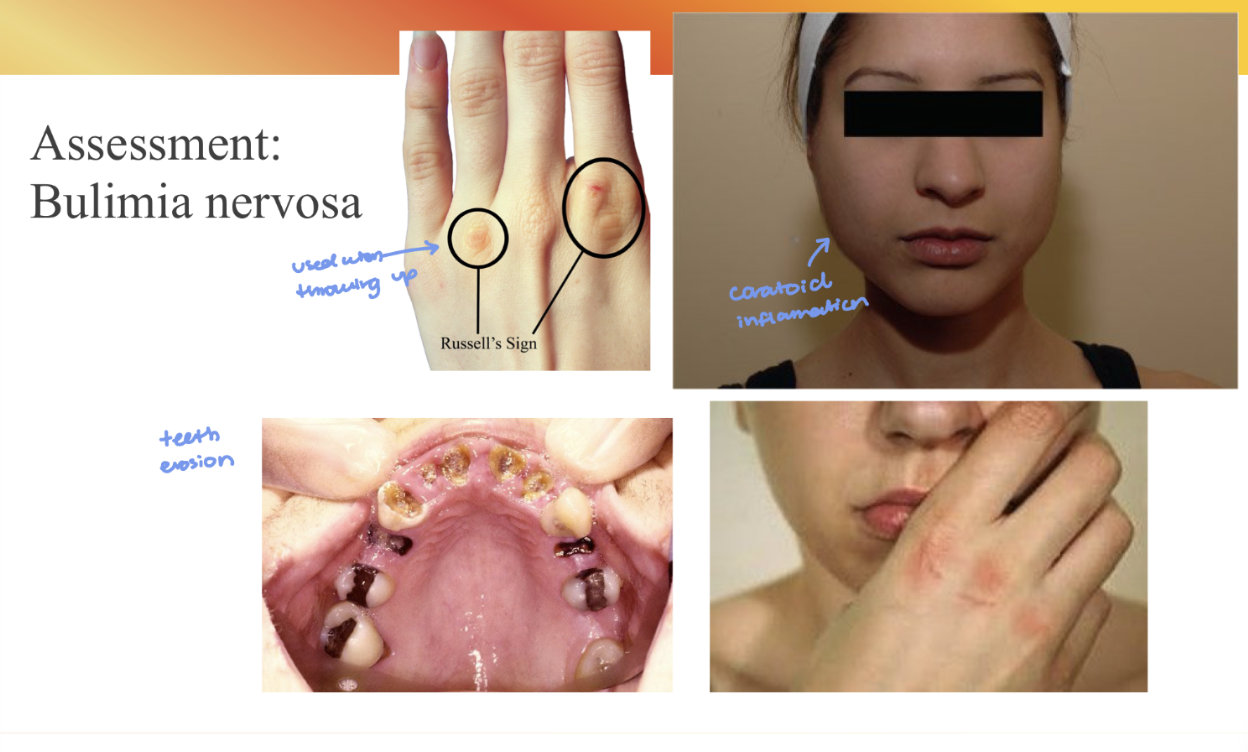
what is bulimia nervosa
- often weight within normal range or higher (BMI 18.5 to 30)
- recurrent episodes of uncontrolled binging
→ inappropraite compensatory behaviors like vomiting, laxatives, diuretics, enemas, or exercise
→ self image largely influenced by body image
(Note: Subtypes are not included in DSM-5)
what is binge eating disorder
- recurrent episodes of uncontrolled binging without compensatory behaviors
- binging episodes induce guilt, depression, embarrassment, or disgust
what are risk factors for eating disorders
- individual: participation in sports and occupational choices that encourage thinness, a specific body type or weight; being a picky eater in childhood; hx of obesity
- comorbidities: bipolar, depressive and anxiety disorders, ocd, alcohol and substance use disorders
- genetics
- neurological
- environment
what are assessments for eating disorders
- history
- MSE: overgeneralization, all-or-nothing thinking, catastriphizing
- physical
- labs
what does anorexia nervosa look like
lanugo

what does bulimia nervosa look like
teeth erosion, russell’s sign, carotid inflammation
what is criteria for acute care treatment of eating disorders
- vitals: HR <50, BP <90/60, temp <96F
- labs: K <2.5, severe dehydration, ECG abnormalities (arrythmias)
- weight: <75% ideal body weight or rapid loss (<10% of body weight in 1-2 months)
- psych symptoms: suicidality, psychosis, refusal to eat
- functioning: inability to care for self or adhere to outpatient treatment program (continued weight loss, electrolyte disturbances, refusal to eat)
- medical complications: GI obstruction, electrolyte crisis
what are behaviors indicating eating disorder
- peculiar handing of food: cutting food into small bits, eating slowly, chewing each bite excessively, pushing pieces of food around plate, hinding food, fear of eating in front of others, obsessive diet habits
- disappearing after meals
- frequently looking in mirror and checking appearance
- low self-esteem, self-worth, impulsivity, difficulty in relationships
- possible development of rigorous exercise regimen
- Possible self-induced vomiting, use of laxatives and diuretics
- Guilt or shame from eating
what is refeeding syndrome
- body mass index <16
- significant weight loss, >10% in past 3-6 months
- little of no nutritional intake in last 5 or more days
- low levels of potassium, phosphate, or magnesium before feeding
- hx of alcohol or substance misuse
- long-term use of antacids or diuretics
what are important considerations of refeeding syndrome
- begin feeding slowly (think pediatric calories)
- tube feeding: need phosphorus
- administer thiamin + vitamins first
- phosphate!
- priority
what are nursing interventions to support clients with eating disorders
- self-assessment
- promote self-esteem and positive self-image, encourage decision making and sense of control
- cognitive-behavioral therapies: cognitive reframing, relaxation techniques, journal writing, desensitization exercises
- structured, inflexible meal and snack times: small frequent meals, high fiber, low sodium, limit high-fat/gassy foods/caffeine bc it can make them want to eat less
- monitor during meals and postprandial
- weight, labs, vitals, multivitamins
what is the role of nurses in reporting abuse/neglect and vulnerable adults
- nurses have the legal duty to report any suspicions of abuse/neglect
- vulnerable adults: an individual who is of legal age and who is unable to protect themselves from abuse, neglect, or exploitation by others because of mental or physical impairment
what are expected findings among client experiencing abuse when it comes to history
- may be incomplete or inconsistent with injuries observed
- victims may be afraid to provide evidence (retribution/punishment)
- victims may not be able to recollect events (disassociation and psychic shock)
what are expected findings among client experiencing abuse when it comes to examination
- injuries range form obvious to severe
- injuries may manifest as old or new
- bruises in various stages of healing
- be alert to unusual patterns of cuts, bruises, burns, and fractures
- take notes of injuries not typically seen
what are appropriate nursing interventions when caring for clients experiencing abuse
- treat underlying injuries
- refer victims to safe-house
- emotional support (empathy not pitty)
- collaborative practice referrals (social work, counseling)
- decreased stigma
- help clients develop safety plan for future tense helps them get out of abuse
what are behavioral cues of potential violence from clients
- hyperactivity → pacing, restlessness
- hypersensitivity, easily offended
- intense eye contact or no eye contact at all
- facial expressions → frowning, grimacing
- body language → clenching fist, waving arms
- aggressive postures → leaning forward, appearing tense
- drug/alcohol intoxication
what are verbal cues of potential violence from clients
- loud, rapid talking
- yelling or shouting
- threats of harm
- abrupt silence
- sarcastic remarks
- illogical responses
- statements of fear or suspicion
what are risk factors for potential violence from clients
- intoxication, TBI, concussion, delirium, dementia, psychosis, acutely manic
- hx of aggression, poor impulse control, violence
- poor coping skills, limited support systems
- comorbidities that lead to acts of violence (delusions, command hallucinations, violent angry reactions with cognitive disorders)
- living in violent environment
- limit setting by the nurse within the therapeutic milieu
- early age of onset of psychiatric symptoms
- length of time in hospital: delirium, feel like they are being held against their will, sick of being in hospital
what are nursing interventions/de-escalation techniques to manage anger among clients: promote safety
- minimize personal risk
- nonthreatening communication
- awareness of environment
- availability of other staff members
- awareness of clothing and objects
- de-escalation training
what are nursing interventions/de-escalation techniques to manage anger among clients: de-escalation
- respond quickly
- Situational awareness and control of the environment
- Remain calm and in control
- Encourage the client to express feeling verbally using therapeutic techniques (reflective techniques, active listening, silence)
- Allow pt with as much personal space as possible (as reasonable)
- Maintain eye contact and sitting/standing at same level
- Communicate with honesty/sincerity, non aggressive stance
- Avoid accusatory/threatening statements
- Describe options clearly and offer choices
- Reassure that staff members are present to help prevent loss of control
what are nursing interventions/de-escalation techniques to manage anger among clients: limit setting
- Tell client calmly and directly what they must do in a particular situation, such as “I need you to stop yelling and walk with me to the day room where we can talk”
- Use physical activity such as walk, to deescalate anger and behaviors
- Inform clients of the consequences of their behavior, such as loss of privileges
- Pharmacological interventions if the client does not respond to calm limit setting
- Plan for four to six staff members to be available and in sight of the client as a “show of force” if appropriate
what are nursing interventions/de-escalation techniques to manage anger among clients: seclusion and restraint
- not intended as punishment/punitive
- physician orders required
what is labile, delusions of grandeur and delusions of persecution
- labile: sudden and frequent mood swings
- delusions of grandeur: false belief that you are extremely important, powerful, or special
- delusions of persecution: false belief that others are trying to harm, watch, or target you