Biochemistry - Electron Transport Chain
 Call Kai
 Learn
 Practice Test
 Spaced Repetition
 Match
 Flashcards
 Knowt Play
1/13

There's no tags or description
Looks like no tags are added yet.
14 Terms
Describe the structural components of mitochondria
Has two membranes:
Inner membrane (cristae) - impermeable to nearly all ions and small molecules (some specific transporters modulate molecule movement)
Outer membrane - permeable to most small molecules
Two compartments
Matrix (inner)
Intermembrane space (outer)
Create a diagram of a mitochondrion which includes the inner and outer membranes, cristae, matrix, and intermembrane space.

Where does the PDH, TCA, electron transport chain, and ATP synthase occur in the mitochondria?
PDH - matrix
TCA - matrix
Electron transport chain - inner mitochndrial membrane
ATP synthase - inner mitochondrial membrane
Describe the electron transport chain and it function
Electron flow through four protein complexes embedded in the inner mitochondrial membrane
Generation of an unequal distribution of protons and an electrical potential across the inner mitochodrial membrane that creates a proton-motive force used by the ATP synthase to synthesize ATP

Explain the concept of redox potential.
reduction potential (E) is a measure of the tendency of the oxidizing agent to be reduced
aka a measure of the tendency of a chemical species to aquire electrons from or lose electrons to an electrode and thereby be reduced or oxidized respectively
In low standard reduction potentials electrons are given off
In high standard reduction potentials electrons are taken up

Name the four complexes of the ETC
NADH-Q oxidoreductase (I)
Succinate-Q reductase FADH2 (II)
Q-cytochrome c oxidoreductase (III)
Cytochrome c oxidase (IV)
Which complexes move protons into the intermembrane space of the mitochondria
Electrons flow though the complexes, and the free energy change associated with the transfer of electrons is used to pump protons (Complexes I,III, and IV) out of the matrix and into the intermembrane space of the mitochondria
Why do we need the intermediary steps of the electron proton chain?
Preventing leaks, as the electron flow can be better controlled
Limiting damage due to the presence of reactive oxygen species
Generating the proton gradient
Specifically list the steps of electron flow in complex I
NADH hands off 2e- and 2H+ to FMN
FMNH2 is formed and passes e (without H+) through several Fe-S clusters
Final Fe-S cluster passes 2e- to Q, and 2H+ are taken to form QH2
TM proteins transfer e-, inducing conformational changes and proton transport
4 protons are pumped out in the process

Draw the electron transport chain

In actuality, the pH outside is about 1.4 units lower than the pH inside
How does Complex II differ from the other three?
Complexes I,III, and IV pump protons across the inner mitochondrial membrane through use of electron flow
Complex II does not pump protons
What are the two special carriers in the electron transport chain
Coenzyme Q
Derivative of quinone, with a long hydrophobic tail
Cytochrome c
a small (12 kDa) soluble, heme-containing protein

Describe the electron flow from NADH
Complex I → Q → Complex III → Cytc → Complex IV → O2
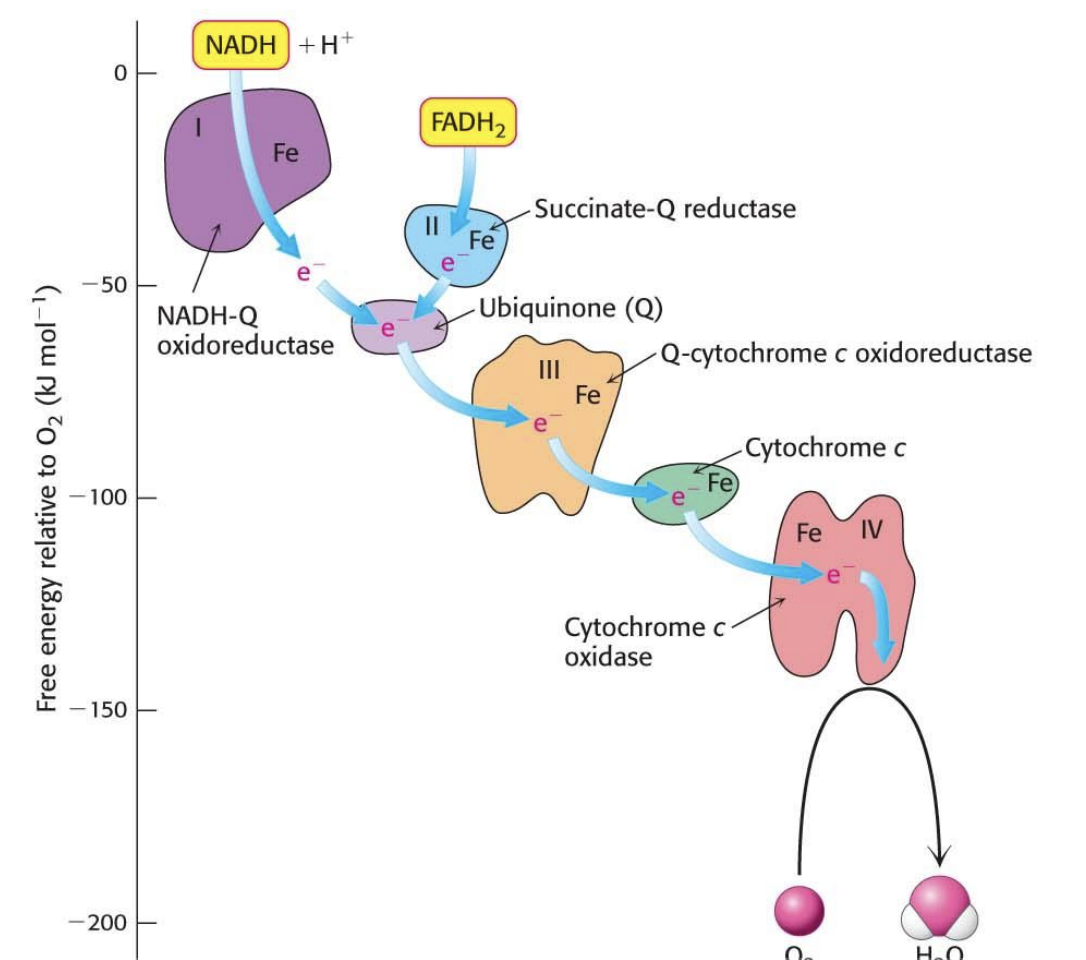
Describe the electron flow from FADH2
Complex II → Q → Complex III → Cytc → Complex IV → O2
