DH 105 - Midterm (Kahoot)
 Call Kai
 Learn
 Practice Test
 Spaced Repetition
 Match
 Flashcards
 Knowt Play
1/172

There's no tags or description
Looks like no tags are added yet.
173 Terms
What classification is shown in this photo?
Class III

What is the general timeline for a child to have a primary dentition?
6 months - 6 years old
What is the general timeline for the permanent dentition?
Approximately after 12 years old
The mixed dentition period occurs between 6-12 years of age.
True or False?
True
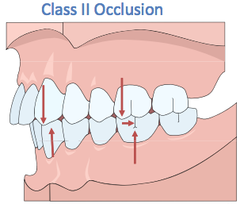
What classification is shown in this photo?
Class II
Define Height of Contour:
a) also known as the crest of curvature
b) greatest elevation of the tooth occlusion-cervically
c) greatest elevation of the tooth incisors-cervically
d) all of the above
All of the above
The CEJ is where the enamel of the crown and cementum of the root usually meets.
True or False?
True
What is a line angle?
Formed by the lines that are created at the junction of 2 crown surfaces.
- Like the corners of a box
The clinical root is the part visible due to recession.
True or False?
True
What makes up the permanent anterior teeth?
a) incisors only
b) canines only
c) both incisors and canines
d) none of the above
Incisors and canines
What are the developmental lobes on anterior teeth?
Mesiolabial, middlelabial, distolabial, and lingual lobe
Incisors function as instruments for
Biting and cutting
Canines function as instruments for
Piercing and tearing
Premolars function as instruments for
Assisting molars in grinding, as well as canines in piercing and tearing
Molars function as instruments for
Grinding
The permanent maxillary molars have how many roots?
3
The permanent maxillary 1st premolars have how many roots?
2 roots, with root trunk
The permanent mandibular 1st and 2nd premolars have how many roots?
Single root
Permanent mandibular molars have how many roots?
2 roots
Triangular ridges descend from the cusp tips toward the central part of the occlusal table.
True or False?
True
The perm. max. 1st premolar is the only tooth that has a buccal cusp, w/ the mesial cusp slope longer than the distal
True or False?
True
Which teeth have roots that are bifurcated?
Maxillary 1st premolars
How do you distinguish permanent maxillary first molars from the second?
Maxillary 1st molar roots are more divergent
The fifth non-functioning cusp on the permanent maxillary first molar is present on the
Mesiolingual cusp
The primary dentition is also known as...
Deciduous dentition
The crown of the permanent mandibular 1st molars tilt...
lingually
What tooth in the permanent dentition replace the primary first molar?
Permanent 1st premolar
Which tooth is formed from more than 4 lobes?
Mandibular first molar
When compared to the mandibular second molar, the mandibular first molar has which additional cusp?
Distal cusp
From which view is only one root visible on a mandibular first molar?
Mesial
How many non-succedaneous teeth are in the complete dentition?
12
The largest cusp of the maxillary molars is...
Mesiolingual cusp
Which tooth has the longest root?
Maxillary canine
The premolars develop:
a) apically and lingually to primary teeth
b) within the retromolar pads
c) between the roots of the primary molars
d) none of the above
Between the roots of the primary molars
When comparing the first and second premolars, which tooth is more likely to have a deeper mesial root concavity?
a) #3
b) #12
c) #20
d) #30
#12
Which tooth when looking from the proximal view, will have a definite lingual tilt and a non-functional cusp?
a) #13
b) #4
c) #30
d) #21
#21
When looking from an occlusal view, a mandibular second premolar with 3 cusps may exhibit this type of occlusal groove:
"Y" pattern
Which of the following bumps or ridges is NOT likely to be found on a maxillary premolar?
a) oblique ridge
b) marginal ridge
c) triangular ridge
d) transverse ridge
Oblique ridge
What is the correct order of anatomic landmarks of a tooth with two roots from the CEJ to the root tip?
Cervix, trunk, furcation, apex
What separates the portions of tooth formed by different lobes?
Developmental grooves
A prominent ridge crossing the occlusal surface of the maxillary first molar, (unique to maxillary molar teeth), is the...
Oblique ridge
When the buccal cusps of maxillary posterior teeth line up directly over the mandibular cusps, it is called...
End-to-end
When the mandibular lingual cusps are positioned more buccally than the maxillary cusps, it is called...
Posterior cross bite
The most striking identifying characteristic of a mandibular first premolar is which of the following grooves?
Mesiolingual
Which of the following is not a depression?
a) pit
b) ridge
c) fossa
d) groove
Ridge
The CEJ curves more on the distal of the tooth than on the mesial.
True or false
False
The lingual anatomy of the maxillary central incisors are _______ than those of the maxillary lateral incisor.
More prominent
The entire visible portion of a tooth is called...
Clinical crown
An open contact between two incisors would change the contour of the...
Interdental papilla
The location of the _____ remains at the same location throughout the life of the tooth:
a) CEJ
b) gingival crest
c) interdental papilla
d) alveolar bone
CEJ
If a 46 year old patient has a deciduous tooth, the dentition is classified as...
Mixed
Which is NOT true of the mandibular central incisors?
a) often have a lingual pit
b) smallest teeth in the mouth
c) only one antagonist
d) the are the most symmetrical
Often have a lingual pit
The proximal contact area on the distal surface of a mandibular lateral incisor is located...
Slightly more cervical than on the mesial
Generally, on the lingual surface of a maxillary canine there is (are)...
Two fossae
A mandibular canine root sometimes bifurcates...
Facial and lingual roots
When comparing mandibular first and second molars, which is NOT true?
Crown is larger on the second molar
Which of the following permanent teeth erupt last?
Maxillary canines
From which view can you only see the maxillary lingual/palatal and mesial root?
Mesial
_____ are rounded incisal extensions of the labial lobes found on newly erupted or unworn permanent incisor teeth.
Mamelons
Which statement is true regarding all lateral incisors (maxillary and mandibular)?
The mesioincisal angles are more square than the distoincisal angles
Compared to permanent maxillary lateral incisors, maxillary central incisors are more likely to exhibit...
A root that is almost the same length as the crown
The crown of the permanent maxillary canine is ________the crown of the permanent mandibular canine.
Shorter than
Multiple supplemental grooves are found on the occlusal surface of which tooth?
Maxillary 2nd premolar
An eight year old child should have how many teeth?
24
During what age span are primary teeth in the process of erupting (emerging) into the mouth?
6 months to 2 years
How many succedaneous teeth are in the dentition?
20
Primary teeth have less bulbous crowns than permanent teeth.
True or False?
False
Primary teeth have greater divergence of roots.
True or False?
True
Primary teeth are whiter than permanent teeth
True or False?
True
The permanent mandibular central incisors erupt at what age?
6-7 years old
How many roots does a primary maxillary first molar have?
3
Primary teeth have deeper pits and fissures than permanent teeth.
False
When maxillary anterior teeth are lingual to the mandibular anterior teeth, this is called...
An anterior cross bite
The maxillary anterior teeth are labial to mandibular anterior teeth, this is called an anterior crossbite.
True or False?
False
The mesiobuccal cusp of the maxillary first molar sits over the mesiobuccal groove of the mandibular first molar, it is...
Angle's Class I occlusion
When facial profile is the mandible forward relative to the upper part of the face, it is...
Prognathic
Relationship of the mandible to the maxilla
Centric relation
When the lower jaw sits back further from the upper jaw, it is called...
Retrognathic
Tooth wear caused by tooth-to-tooth contact...
Attrition
The maxillary canines erupt before the mandibular canines.
True or False?
False
Which class of teeth replace the primary molars?
Premolars
Which tooth does tooth #19 replace?
None. It is non-succedaneous.
Which premolars are more likely to be congenitally missing
Mandibular second premolars
Where does the crown of tooth #4 sit before eruption?
Between the roots of tooth "A"
Primary teeth become loose after the permanent teeth cause root resorption.
True or False?
True
If two triangular ridges join, the entire ridge is called...
Transverse ridge
All anterior teeth form from how many lobes?
4
How many molars are there per quadrant in an adult dentition?
3
How many teeth in the adult dentition have a labial surface?
12
How many total premolars are in the adult dentition?
8
What is the universal number for the permanent mandibular left first molar?
19
In a mesial view of any tooth, vertical lines may divide the crown into thirds called facial, middle, and _______.
Lingual
Using the Universal numbering system, what number is used to identify the maxillary right canine?
6
Which mineralized tissue is the hardest?
Enamel
How many teeth are present in one quadrant of a complete adult (permanent) dentition?
8
What class of teeth is present in the permanent dentition that is NOT present in the primary dentition?
Premolars
Area toward the midline
Mesial
Area away from the midline
Distal
Area toward the cheek
Buccal
Area toward the tongue
Lingual