Lecture 21 - Disease ecology
 Call Kai
 Learn
 Practice Test
 Spaced Repetition
 Match
 Flashcards
 Knowt Play
1/18

There's no tags or description
Looks like no tags are added yet.
19 Terms
Primary vs secondary succession exit ticket
If soils and seeds are still there (secondary), the forest will grow back fast, but if none are there, they have to wait for the plants to move in. Competition intensifies as vegetation returns, and early colonists might later be replaced
For community composition, severe burning increases reliance on immigration and may alter which species establish, leading to a different community from the original forest.
Fire-related traits like resprouting, fire, and rapid establishment influence survival
Misconceptions:
Sterilization doesn't mean nutrients disappear. There are just no organisms
Fixed sequence of succession
Harsher conditions don’t mean faster evolution. Strong selection does not guarantee rapid evolution - heritable variation, population size, reproduction, and gene flow also matter
Both sides won’t converge: they may become more similar, but differential dispersal, soil characteristics, and species interactions could generate different mature communities.
What is disease ecology?
Study of how ecological processes (e.g., inter- or intraspecific interactions, organism-environment interactions) influence disease spread.
What do parasites and pathogens impact?
Individuals, populations, and communities.
ex: amphibian populations worldwide have been devastated by chytrid fungus
ex: sea star wasting disease causes keystone predator Pisaster ochraceus to disintegrate
What kind of interaction is disease?
Asymmetric interaction, as participants don’t have equal roles, and while the pathogen benefits, the host is harmed. It’s a type of exploitative interaction.
Pathogens vs parasites
Infectious diseases are like parasites:
Parasite: An organism that feeds on cell contents/tissues/fluids of a host while in or on the host organism; harms and may kill its host. Generally much smaller than the host, can also (sometimes) live outside of the host organism.
Pathogen: An organism or virus that causes disease (not necessarily living on/in a host)
disease requires overlap between the host and agent (pathogen or parasite) in the environment
What are the different classes of transmission?
Direct transmission
zoonotic disease
vector-borne diseases
Describe direct transmission
There needs to be niche overlap
Two population systems: viral (influenza, COVID, measles), bacterial (tetanus), and fungal (Aspergillus) infections. There is horizontal transmission (person-to-person) and vertical (pathogen from mother to offspring)
Indirect transmission may occur through water or food (e.g., cholera, salmonella), or aerosols
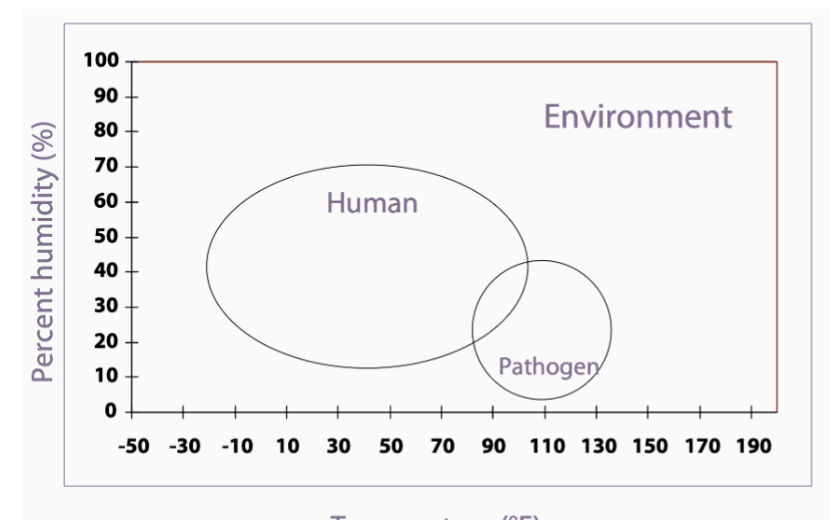
What ecological factors affect Influenza A virus (the flu)?
Ecological factors:
1) Host density: Transmission is highly density-dependent – it requires high concentrations of
susceptible hosts (schools, offices, public transit) to cross the threshold for exponential spread
2) Climate/seasonality: Cold, dry air increases transmission efficiency and keeps hosts indoors in close contact, concentrating susceptible individuals
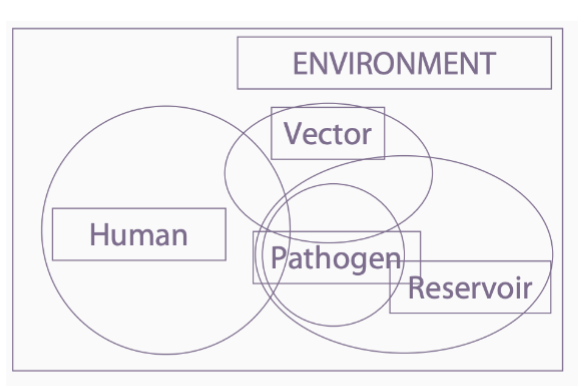
Describe zoonotic diseases, reservoir, and spillover
Reservoir: A population that harbors a pathogen, often asymptomatically
Spillover: A pathogen jumps from a reservoir to a new host, often humans
The pathogen usually resides in another species (reservoir species) and can spread directly to humans from the reservoir species (e.g., rabies, schistosomiasis, Hendra virus)

Describe vector-borne diseases and vector
Vector: A living organism (usually a biting arthropod) that transmits an infectious agent from one host to another
Pathogen transmitted to humans from a reservoir through a vector species (often arthropods – mosquitoes, ticks etc). The vector does not cause disease, just carries it (e.g. malaria, Lyme disease, bubonic plague)
Reservoirs are where the pathogen lives, and they allow the pathogen to survive and persist (ie. rodents can serve are reservoirs for bactera causing bubonic plague)
vector is what carries the pathogen to another host (ie. mosquito)
What is the SIR Model of Disease, and what is Beta and Gamma?
SIR is a model of disease and tracks the progression of individuals from being susceptible to infectious, and then to recovered (or dead). Infectious individuals will transmit the disease to susceptible individuals.
Assumes a single population and a single host species only.
B = disease transmission rates
𝛄 = recovery rates

What are key parameters of the SIR model?
• Transmission rate (β): reflects how readily infection spreads through contacts. Higher B increases the rate at which susceptible individuals move into the infected compartments, leading to a faster and steeper outbreak.
• Recovery rate (𝛄): reflects how quickly infectious individuals leave the infectious class to the recovery class, shortening the window they can spread the disease
• Basic reproduction number (R0): the average number of secondary infections caused by one infectious individual in a largely susceptible population under specified conditions
Higher transmission or a longer infectious period increases the potential for spread. If R0 > 1, the infection grows. Changes in β or 𝛄 alter how fast the disease spreads.
Ro = β/𝛄. Thus, if the transmission rates are greater than the recovery rates, infection grows.

What curves does the SIR model produce?
The SIR model produces characteristic epidemic curves
• S decreases as people become infected (moves from susceptible to infected)
• I rises to a peak then declines (people start recovering)
• R increases as people recover

How do ecological factors affect disease dynamics?
higher host population density = more contacts
higher β → higher Ro
More competent hosts or vectors
higher β → higher Ro
Environmental conditions (temperature, precipitation, seasonality, habitat change) affect pathogen survival, vector abundance, and host behavior and physiology
changes to β, 𝛄, Ro
Warmer temperatures increase vector activity

What is the density dependence significance for disease?
Diseases spread by contact between infectious and susceptible individuals. Below a certain threshold population density, diseases
cannot spread and instead die out. This illustrates why disease is a density- dependent factor
In this example of the bison, under a certain herd size, the herds have less exposure, but once the herd size reaches a certain threshold, there is high disease spread and can enter exponential growth phase.

Public health interventions
isolation, masks
vector control
sanitation, reduced contact
vaccination
Work by reducing β, increasing 𝛄, or decreasing the pool of susceptible hosts (reduce contacts)
What is herd immunity and what do vaccinations do?
Vaccination reduces disease spread by reducing the number of susceptible hosts in a population.
Herd immunity is the indirect protection from an infectious disease that occurs when a population is mostly immune (due to vaccination or infection), breaking chains of transmission and protecting the non-immune.
Measles requires ~95% of the population to be vaccinated
As of October 8, 2026, 4,080 confirmed measles cases were reported in the United States in 2026 (CDC)
Disease was declared eradicated in the US in 2000
Nationwide, vaccination rates have fallen to 92.4%, with pockets of much lower rates
Gaines county, Texas – 762 cases and 2 deaths, 82% vaccination (range 46-94%)
Returning vaccination rates to >95% is needed to provide herd immunity

How does global change affect disease spread?
It amplifies it!
• Habitat destruction – more disease vector species humans, enhancing
chance of zoonotic (cross-species spread)
• Urbanization – people contact each other more frequently, increasing spread rates
• Air travel – people cross over long distances more often, increasing spread rates
• Climate change – previously tropical-only diseases (like Zika virus) can now affect people in areas that are becoming warmer → warmer climates are well suited for these viruses because there is higher transmission rates
Climate change is exacerbating infectious diseases
Dengue virus ecological factors
1) Vector range (climate sensitivity): Warmer temperatures expand the range and shorten development times for faster transmission
2) Artificial habitat/container breeding: Small, standing water sources are being made by humans (e.g. tires, buckets)
3) Human behavior: prevent vector biting (e.g. bed nets, insect repellent)
World Health Organization Dengue Fact Sheet, 21 Aug 2025:
• Incidence of dengue has increased rapidly, from 500k in 2000 to 14.6M in 2024
• Endemic in >100 countries
• During 2024, ongoing transmission, combined with an unexpected spike in dengue cases, resulted in a historic high of over 14.6 million cases and more than 12000 dengue-related deaths reported.
